
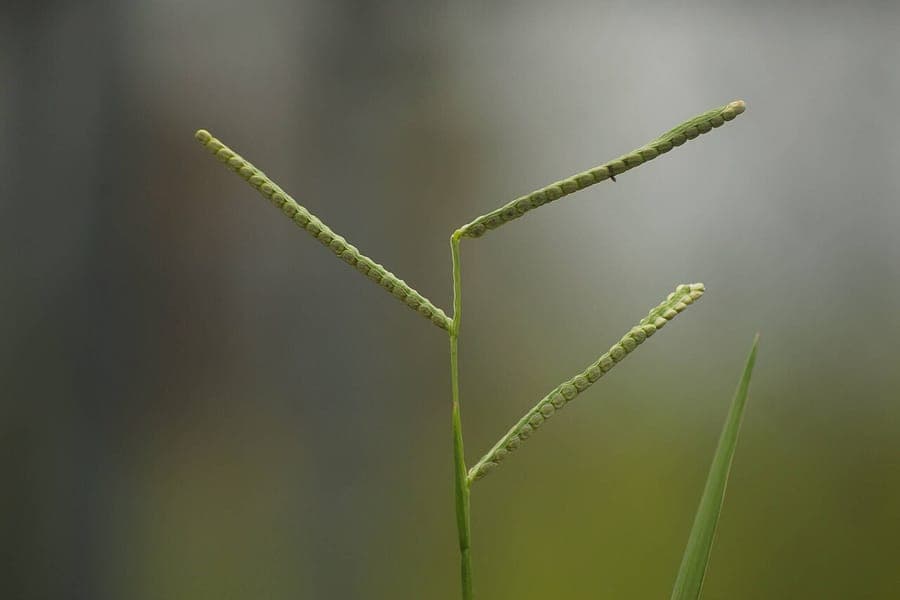
Kevin Faccenda / CC BY 4.0, via Wikimedia Commons
Paspalum scrobiculatum: complete guide
Paspalum scrobiculatum
Want to see Paspalum scrobiculatum: complete guide in your garden?
1 minute, no credit card
Overview
Paspalum scrobiculatum, commonly called ditch millet, kodo millet, or coast paspalum, is a warm-season ornamental grass native to tropical and subtropical Africa and Asia. This fast-growing species is valuable both for agricultural use (seed production) and for ornamental applications in contemporary garden designs.
The grass produces characteristic seed panicles offering food for wild birds while adding fine texture and movement to landscapes. Paspalum scrobiculatum excels at erosion control and improving soil quality through organic matter accumulation.
Appearance and Growth
Paspalum scrobiculatum is a tufting, warm-season grass reaching 60-150 centimeters tall depending on growing conditions. Leaves are long, linear, and fine-textured. During the growing season, each plant produces 2-4 seed panicles containing small, olive-green seeds.
The overall plant habit is upright to semi-weeping. The seed panicles are subtly beautiful, adding lightness and movement to landscape schemes. Flowering occurs from mid-summer through fall.
Ideal Location
Paspalum scrobiculatum thrives best in full sun with at least six hours of direct daily sunlight. The plant adapts to various light levels but growth accelerates noticeably in sunnier locations.
This species tolerates fairly windy locations, though extreme winds can damage stems. Place in somewhat sheltered zones where strong gusts are minimized but air circulation remains good.
Soil
Paspalum scrobiculatum grows across a broad soil spectrum - from poor to fertile soils. The grass performs best on well-drained, moderately fertile soils with pH 5.5-7.5.
The plant is moderately drought-tolerant once established, but performs optimally on consistently moist soils during the growing season. Heavy clay and waterlogged conditions should be avoided.
Watering
During the growing season, water regularly - at least once weekly in hot, dry conditions. Once well-established (after four to six weeks), the grass is fairly drought-tolerant and requires less frequent watering.
In container culture, maintain consistent moisture without waterlogged conditions. In ground culture, deep watering is superior to frequent shallow watering to promote deep root development.
Free design
Want to see Paspalum scrobiculatum: complete guide in your garden? Make a free design now.
Pruning and Maintenance
Paspalum scrobiculatum requires minimal pruning. If desired, the grass can be cut back to approximately 15-20 centimeters in fall after seed maturation to maintain neat appearance.
The plant can also be cut back in late fall or early winter after bird seed harvesting, though many gardeners prefer leaving seed heads for winter bird food.
Maintenance Calendar
Spring (March-May): Sow seed or transplant young plants once temperatures exceed 18 degrees Celsius. Begin regular watering.
Summer (June-August): Water regularly. Plants grow rapidly. Seedlings may be thinned if needed.
Fall (September-October): Seed panicles mature. Birds naturally consume seeds. Leave seed heads for winter bird feed.
Winter (November-February): In cold climates, plants die back. Seeds persist for bird food. Dead growth can be cut and removed.
Winter Hardiness
Paspalum scrobiculatum is a warm-season grass and not hardy in northern Europe. Plants do not survive frost periods. In container culture, dead plants can be replanted or reseeded each spring.
Seeds are frost-hardy and can promote natural self-seeding next spring if seed falls and survives.
Companion Plants
Paspalum scrobiculatum combines beautifully with:
- Other warm-season grasses (Panicum, Andropogon)
- Sun-lovers (Zinnias, Cosmos)
- Drought-tolerant succulents (Sedum)
- Native wildflowers for birds
Final Thoughts
Paspalum scrobiculatum is a practical and beautiful grass offering ecological value while delivering visual appeal. Whether used for bird seed, erosion control, or garden texture - this grass deserves space in sustainable landscapes.
Start seeds in spring from birdseed suppliers or sow directly in the garden in late May. By late summer, this warm-season grass will reward you with beautiful, productive seed panicles.
Want to see Paspalum scrobiculatum: complete guide in your garden? Make a free design now.
Upload a photo, pick a style, and get a photorealistic design with plant list in under a minute.
No credit card required


Similar plants
Sporobolus pungens: complete guide
Sporobolus pungens
Sporobolus pungens is a stoloniferous Mediterranean coastal grass with outstanding salt and drought tolerance, perfect for seaside and dry gardens.
Mediterranean aegilops: complete guide
Aegilops biuncialis
Everything about Aegilops biuncialis, a Mediterranean annual grass with ornamental spikes and outstanding drought tolerance for dry gardens.
Silver bluestem: complete guide
Bothriochloa saccharoides
Full guide to Bothriochloa saccharoides (silver bluestem): site, soil, watering, winter hardiness, pruning, and garden companions.