
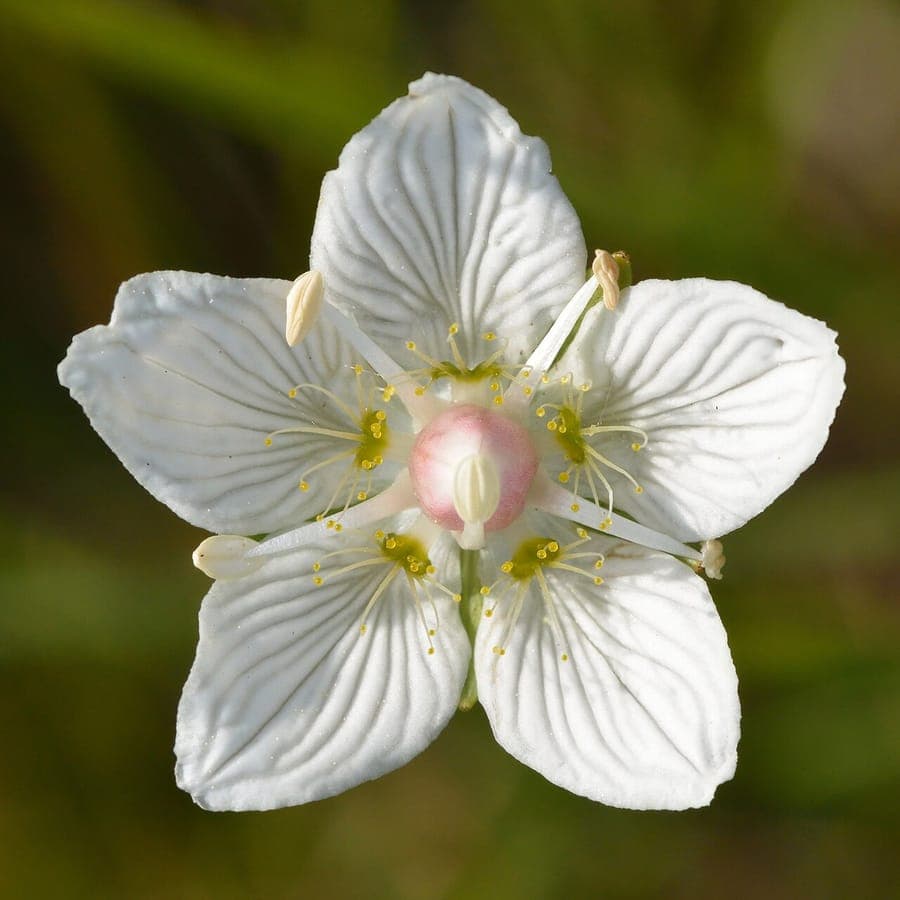
Ivar Leidus / CC BY-SA 4.0, via Wikimedia Commons
Parnassia palustris: complete guide
Parnassia palustris
Want to see Parnassia palustris: complete guide in your garden?
1 minute, no credit card
Overview
Parnassia palustris, well-known as bog-star or marsh-grass-of-parnassus, is a bewitchingly delicate plant from the Celastraceae family. This plant grows naturally in marshes and boggy meadows of the northern temperate zone, from Scandinavia to the arctic circle and southward to temperate regions. The name 'palustris' literally means 'of the marsh'. Despite her preference for wet ground, this plant can also shine in front-garden designs with strategically placed wetland zones, where she stops visitors rather than passersby to enjoy.
Appearance and Bloom
Parnassia palustris grows as a fine, elegant rosette of narrow, heart-shaped leaves. The plant reaches only 15 to 30 centimeters height. The true beauty lies in the flowers: delicate white blooms with five petals and impressively structured yellow groupings of stamens. Each flower is only a few centimeters across, but their elegant form and white purity make the plant irresistible in August-October. Each plant produces only a handful of flowers, which increases their value.
Ideal Location
Parnassia palustris thrives optimally in moisture-rich environments with full sun to semi-shade. The plant needs open, light-filled spots, not overwhelmed by dense shrub growth. In front-garden contexts, it works perfectly in moist hollows, along water features, or in wet low spots where water is regularly present. Full shade leads to poorer flower formation and stretched growth. The plant feels more comfortable on cool, wet locations than in warm-dry environments.
Soil
Parnassia palustris requires acidic to neutral, moisture-rich moorland or sedge-peat soil. The plant does not grow in standard garden soil; it needs groundwater or regular marsh moisture. In pot culture, one prefers acidic sedge-peat or moorland peat. Drainage must be limited; over-drainage is fatal. Mineral-poor acidic peat seems ideal. Therefore, create a specific wet habitat with transported peat-rich soil.
Watering
Parnassia palustris must remain continuously wet during the growing season (May-October). More than other plants in this article, this species feels unhappy without constantly wet feet. In pot culture, one places the pot in a water tray, supplied with continuous water. In ground culture, groundwater level must remain minimum 5-10 centimeters below soil surface. In very dry summers, add supplemental water.
Free design
Want to see Parnassia palustris: complete guide in your garden? Make a free design now.
Pruning
Parnassia palustris requires no pruning in the traditional sense. Remove only dead flowers and wilted leaves carefully after the growing season. This limits disease risk and promotes neater appearance. The plant will naturally die back after blooming and sprout again from roots next season. No drastic shaping needed; the natural habit is most beautiful.
Maintenance Calendar
Spring (March-May): Plant begins to emerge. Ensure consistent moisture levels. Check water-supply regime. Plant enters bloom.
Summer (June-August): Bloom reaches its peak (July-September). Maintain continuous water. Enjoy elegant white flowers. No other concerns.
Autumn (September-November): Bloom ends. Seed ripens and disperses. Plant begins to die back. Remove dead leaf matter.
Winter (December-February): Plant sleeps. Minimal attention. Water less but do not dry completely. Protection against frost damage with leaf material.
Winter Hardiness
Parnassia palustris is very frost-hardy to -20 degrees Celsius. In near-arctic regions, it survives winters without difficulty. In continental climates with strong frost fluctuations, light protection with leaf matter offers benefits. However, the plant regrows quickly from roots, even after frost death of above-ground parts.
Companion Plants
Parnassia palustris combines well with other marsh plants such as Molinia caerulea (purple moor-grass), Drosera (sundew), and fine sedges. In moisture-rich biotopes, Iris, Caltha, and Filipendula also work well. Avoid vigorous-growing plants that would suppress this delicate plant. Low-growing ferns work perfectly in combination.
Conclusion
Parnassia palustris takes you away into marsh enchantment in your front garden. This plant requires specific moisture regimes but will reward you with elegant flowers that stop visitors to gaze. Create a marsh habitat and let this delightful plant work its magic.
Find Parnassia palustris seeds or plants at specialized nurseries. Check gardenworld.app for more moisture-loving plant combinations. Gardenworld.app helps you bring aquatic beauty to your front garden.
Want to see Parnassia palustris: complete guide in your garden? Make a free design now.
Upload a photo, pick a style, and get a photorealistic design with plant list in under a minute.
No credit card required


Similar plants
Fringed grass of Parnassus: complete guide
Parnassia fimbriata
Everything about Fringed grass of Parnassus (Parnassia fimbriata): growing, soil, watering and care. A delicate mountain perennial with white fringed flowers.
Euonymus cornutus: complete guide
Euonymus cornutus
Horned spindle is an intriguing shrub from central China with distinctive winged seed capsules. Learn how to grow this unique plant.
Large-Winged Spindle: complete guide to this Far Eastern shrub
Euonymus macropterus Rupr.
Discover Large-Winged Spindle (Euonymus macropterus), an elegant Japanese shrub prized for spectacular winged fruits. Perfect for Asian gardens and woodland plantings.