
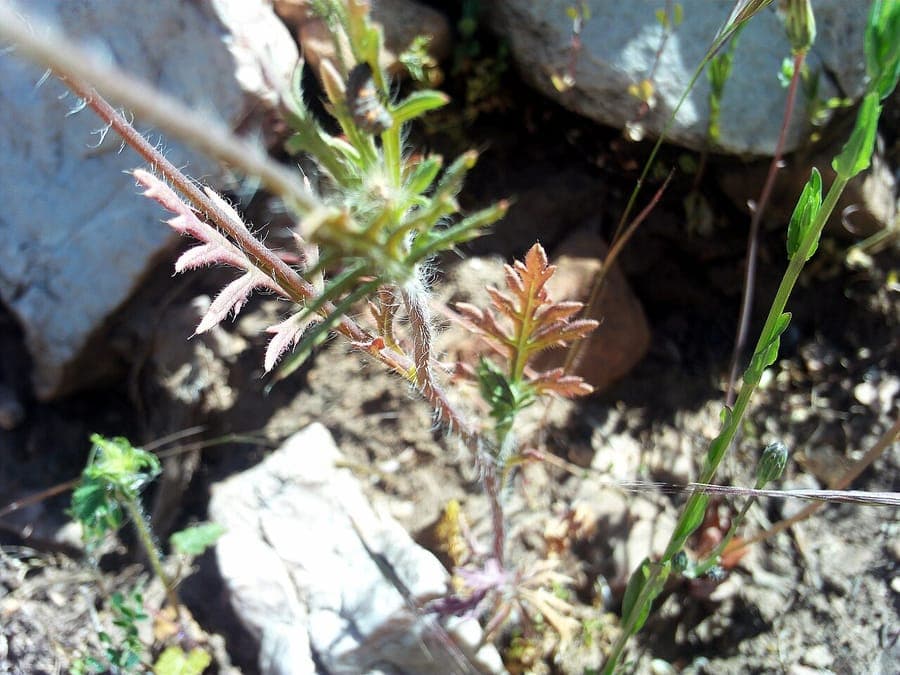
Javier martin / Public domain, via Wikimedia Commons
Papaver pinnatifidum: complete guide
Papaver pinnatifidum
Want to see Papaver pinnatifidum: complete guide in your garden?
1 minute, no credit card
Overview
Papaver pinnatifidum, known as Finely-divided poppy or Feathery-leaved poppy, is a enchanting wild poppy from the Papaveraceae family. This plant originates from the Mediterranean and Southeast European mountain areas. The plant is named for its distinctive finely-divided (pinnatifidum) leaves.
This is a heritage plant that readily reproduces via seed. It is ideal for gardeners who love self-seeders and who want to design dry, Mediterranean gardens. The combination of refined foliage and red flowers makes it very attractive.
Appearance and blooming
Papaver pinnatifidum grows as an elegant, airy plant reaching 20-40 centimeters in height. The leaves are very distinctive: finely divided, green and very refined in appearance. They look almost feathery in texture.
Flowers appear in May to June and are red to pink colored, usually with darker black spots at the base of the petals - very characteristic of poppies. The flowers are about 3-5 centimeters in diameter and rise elegantly above the fine foliage.
After blooming, typical poppy seed capsules (pods) form that ripen in summer. These capsules contain numerous seeds dispersed by wind.
Ideal location
Papaver pinnatifidum thrives in fully sunny locations. This plant needs no shade and performs best with 6+ hours of direct sunlight daily. The plant tolerates windy conditions well and hot summers.
Choose an open spot in dry borders, rock gardens, or against warm walls. The plant grows excellently in Mediterranean garden styles. Avoid wet, shady spots.
Once established, the plant will reproduce from seed in suitable places, creating a natural growing effect.
Soil
Papaver pinnatifidum is very undemanding with soil type as long as drainage is good. The plant flourishes in poor, sandy or gravelly soils. Chalky soils are favorable. The plant actually grows better in less fertile grounds.
A pH between 6.0 and 8.0 is acceptable. Very fertile soils can lead to excessive foliage and less blooming. Heavy clay soils can be improved by adding sand and gravel.
The plant absolutely cannot tolerate stagnant water. Excellent drainage is essential.
Watering
Papaver pinnatifidum has very limited water requirements once established. This is a very drought-tolerant plant. Water only in exceptionally dry periods.
First year after sowing: occasional water during dry periods helps seedling establishment. Once plants grow, minimal water. In dry summers: no supplemental water needed.
Winter rain provides sufficient water. This plant requires virtually no summer watering.
Free design
Want to see Papaver pinnatifidum: complete guide in your garden? Make a free design now.
Maintenance
Papaver pinnatifidum requires very minimal maintenance. Remove faded flowers after blooming if desired to keep the plant neat, although this is not necessary.
If you want seeds to propagate, let seed capsules ripen and let them fall naturally to ground. This provides self-seeders the next season.
No pruning is needed. The plant grows in natural form.
Self-seeding
A major advantage of Papaver pinnatifidum is its ability to reproduce via seed. In suitable conditions (dry, sunny locations), seedlings will appear from natural seed fall.
This gives the garden a natural, wild appearance. You can easily remove unwanted seedlings.
Winter hardiness
Papaver pinnatifidum is hardy to about -10 degrees Celsius. This is typically an annual or short-lived plant that blooms and sets seed in its first season.
In milder climates (West Europe) the plant can sometimes overwinter and grow the next season. In colder areas the plant replants itself from last season's seed.
Botanical background
The plant belongs to genus Papaver, a large group of approximately 50-70 species. Papaver pinnatifidum is a traditional Mediterranean medicinal plant with long history.
Unlike some poppy species, this plant has not been used for opium production and is entirely legal to grow.
Toxicity and legal status
Papaver pinnatifidum is not toxic to humans in normal contact. The plant contains no significant alkaloid content like other poppy species and is completely safe for gardens.
The plant is legal to grow in virtually all countries. There are no legal restrictions.
Companion plants
Papaver pinnatifidum forms beautiful combinations with other drought-tolerant alpine and Mediterranean plants. Combine with lavender, santolina, teucrium, salvia and other drought-lovers.
In rock gardens it works wonderfully with sedums, sempervivums and other succulents. The red flowers contrast nicely with silver or gray foliage of other plants.
Propagation and sowing
Papaver pinnatifidum is very easy to grow from seed. Sow in fall or early spring in dry seed mix. Seed germinates quickly (often within 2-3 weeks) in cool, well-drained environment.
Transplant seedlings to their permanent location once large enough. This can sometimes be tricky because poppies root deeply and dislike transplanting. Direct sowing in place is a better approach.
Conclusion
Papaver pinnatifidum is a jewel for gardeners who love self-seeders and Mediterranean flora. Its finely divided foliage, red flowers and drought tolerance make it ideal for modern, low-maintenance gardens. For designing dry borders full of alpine wildflowers, visit gardenworld.app for expert advice. Gardenworld.app helps you create enchanting, naturally growing gardens full of spontaneous beauty.
Want to see Papaver pinnatifidum: complete guide in your garden? Make a free design now.
Upload a photo, pick a style, and get a photorealistic design with plant list in under a minute.
No credit card required


Similar plants
Papaver gorodkovii: complete guide
Papaver gorodkovii
Papaver gorodkovii, the arctic poppy, thrives from Alaska to Russia's Far East. Discover how to grow this rare, extremely cold-hardy rock garden treasure.
Papaver setiferum: complete guide
Papaver setiferum
Papaver setiferum is a hardy giant Caucasian poppy with fiery red blooms. Discover siting, soil, deadheading and winter hardiness.
Pale Poppy: complete guide
Papaver alboroseum
Discover pale poppy (Papaver alboroseum) - rare alpine poppy with white-pink flowers. Precious beauty from Kamchatka. Cultivation in alpine and rock gardens.