
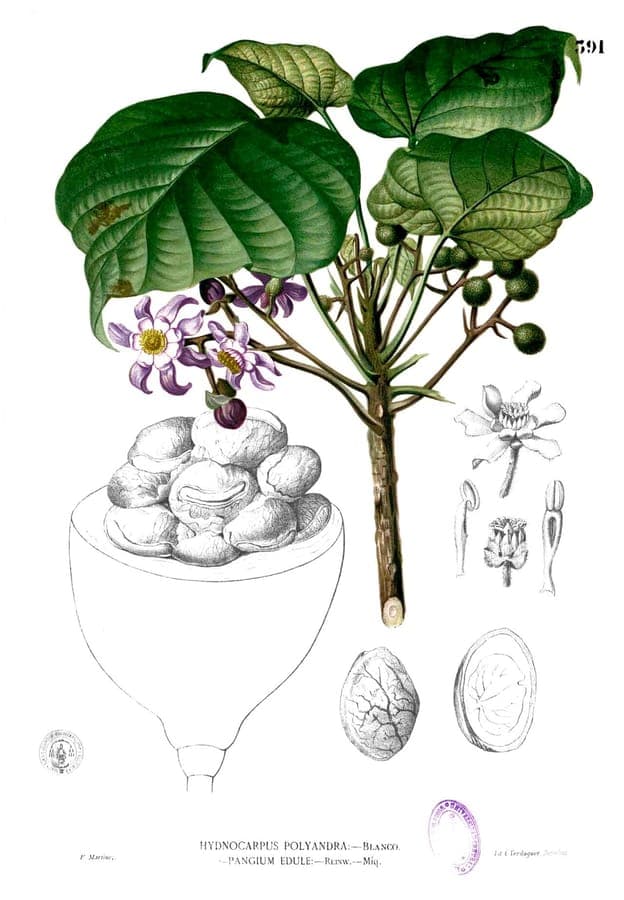
Francisco Manuel Blanco (O.S.A.) / Public domain, via Wikimedia Commons
Kepayang: complete guide
Pangium edule
Want to see Kepayang: complete guide in your garden?
1 minute, no credit card
Overview
Pangium edule, commonly known as Kepayang, Pangi, or Football Fruit, is a fascinating tropical tree native to Southeast Asia. This plant is distributed across Borneo, Java, Sumatra, and other islands of the Malayan Archipelago, spanning from Nicobar islands through to Vanuatu. The tree is celebrated for its distinctive football-shaped fruits that contain unique black seeds highly valued in traditional cuisine. While this species cannot thrive in Dutch gardens due to tropical requirements, understanding it is valuable for those interested in exotic plant varieties and tropical agriculture. Kepayang holds significant cultural importance throughout Southeast Asia and is traditionally used for nutrition and medicinal purposes. The tree grows best in warm, humid tropical climates where temperatures never drop below 15 degrees Celsius. In its natural habitat, this tree reaches average heights of 10 to 20 meters, making it an impressive landscape element.
Appearance and Bloom
The Kepayang grows into a substantial tree with a dense canopy that provides complete shade. The leaves are large and deeply lobed, with a characteristic shape that is crucial for photosynthesis in this tropical species. Each leaf can reach 20 to 30 centimeters in length and features distinct veins that transport water and nutrients throughout the plant tissue. The most distinctive feature is undoubtedly the football-shaped fruit, which can reach approximately 20 centimeters in diameter and consists of an extremely hard shell protecting the valuable seeds inside. These fruits are incredibly sturdy, with a roughness that reflects their strength and protects them from premature damage in the wild. The tree flowers with small, inconspicuous blooms that later develop into these impressive fruits through a gradual transformation over months. The flowering period occurs during specific seasons depending on regional conditions, typically during the summer months. The seeds inside are black and dense, each approximately 2 to 3 centimeters in diameter. These seeds are nutrient-rich and are valued in traditional Southeast Asian cuisine after extensive preparation to reduce any toxic compounds.
Ideal Location
Kepayang requires a true tropical climate with consistent warmth and adequate moisture throughout the year. In its natural habitat, the tree grows in tropical regions of Southeast Asia where temperatures remain consistently high between 25 and 35 degrees Celsius year-round. The tree thrives in mixed tropical forests where it reaches medium to large size. Cultivation outside the tropics would require a large greenhouse with conditioned environments, which is impractical for most Dutch gardeners. In its natural habitat, the tree grows at various elevation levels, from sea level to approximately 1000 meters altitude. The tree can grow in both full sun and partial shade, although full sun is recommended for optimal fruit production. In Southeast Asia, Kepayang trees are frequently encountered in cultivated gardens, where they are grown as valuable food producers.
Free design
Want to see Kepayang: complete guide in your garden? Make a free design now.
Soil
In its natural environment, Pangium edule grows in nutrient-rich tropical soils with good drainage characteristics. The tree prefers soils with sufficient organic matter derived from fallen leaves and other organic debris. Soil structure is essential for success with this plant. An ideal soil contains 5 to 10 percent organic matter and maintains a pH between 5.5 and 7.0. Drainage must be excellent to prevent root rot, even in the humid tropical climate where regular rainfall occurs. Volcanic soils seem particularly suitable for this species, probably due to their pore structure and mineral composition. In cultivation, compost and other organic additions are regularly applied to the soil.
Watering
In nature, this species experiences regular tropical rainfall, often exceeding 3000 millimeters annually. The tree needs consistently moist but not waterlogged soil for optimal growth. During drier periods, supplemental watering should be provided, though the tree can tolerate considerable drought with its deep root system. In cultivation, a regular watering schedule is essential, especially during the growth period. Young trees require more frequent watering than mature specimens. Stagnant water must be absolutely avoided as it can lead to root rot. Drainage around the tree must function properly at all times.
Pruning
In tropical cultivation, Pangium edule requires minimal pruning. The tree naturally develops a strong, attractive form without intervention. Light pruning can be applied to remove damaged branches or shape the tree for better fruit accessibility. It is important to avoid large cuts that might introduce disease.
Maintenance Calendar
During the growing season (May through September in the tropics), the tree grows actively. Feeding can be applied monthly with balanced fertilizer. The football-shaped fruits develop slowly over months, reaching full size after approximately six to twelve months of growth. During periods of reduced growth, minimal maintenance is needed. Weed removal around the tree is important for healthy roots.
Winter Hardiness
Pangium edule is a tropical species without winter hardiness. The tree cannot grow outdoors in temperate climates and requires minimum temperatures around 15 to 18 degrees Celsius. Frost will cause severe damage or complete destruction. In the Netherlands, this tree can only be cultivated in heated greenhouse conditions.
Companion Plants
In traditional Indonesian gardens, Kepayang is sometimes cultivated near other Malayan fruit trees such as mango and durian. The shade from the tree can provide protection for understory plantings of other tropical crops. The tree attracts various bird and insect species.
Closing
Kepayang is a remarkable tropical tree worthy of admiration for its unique fruits and growth pattern. While cultivation in the Netherlands is practically impossible without specialized greenhouse facilities, knowledge of this plant is valuable for enthusiasts of exotic botany and tropical agriculture. Those situated in tropical climates will enjoy this impressive tree and its valuable fruits.
Want to see Kepayang: complete guide in your garden? Make a free design now.
Upload a photo, pick a style, and get a photorealistic design with plant list in under a minute.
No credit card required


Similar plants
Acer pycnanthum: complete guide
Acer pycnanthum
Acer pycnanthum, the Japanese swamp maple, is a fast-growing tree with early red flowers and brilliant autumn color, ideal for damp garden settings.
Freeman maple: complete guide
Acer × freemanii
Everything about the Freeman maple (Acer x freemanii): a fast-growing shade tree with spectacular autumn colour for large gardens.
Silver vine: complete guide
Actinidia polygama
Discover silver vine (Actinidia polygama): a hardy climbing plant with silvery foliage, loved by gardeners and cats alike.