
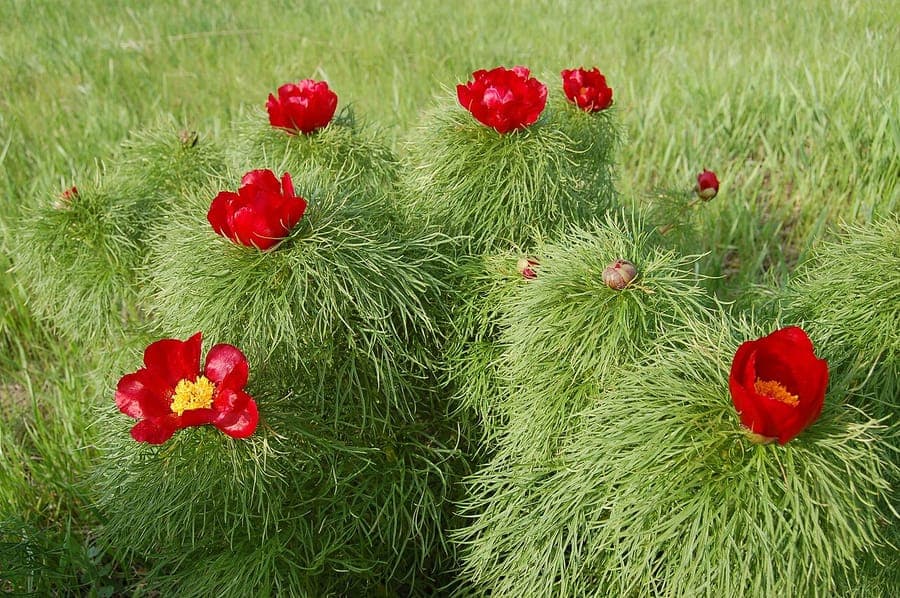
Михайло Гончаров / CC BY-SA 4.0, via Wikimedia Commons
Fern leaf peony: complete guide
Paeonia tenuifolia
Want to see Fern leaf peony: complete guide in your garden?
1 minute, no credit card
Overview
Paeonia tenuifolia, the fern leaf peony, stands out in any border with its feathery, fern-like foliage and bold, cup-shaped red blooms. Native to regions like Bulgaria, the Caucasus, and parts of Eastern Europe, this perennial thrives in USDA zones 4 to 8. It's adapted to hot summers and freezing winters, making it a reliable performer in both UK and US gardens. Unlike many peonies, it grows quickly in spring, forming a bushy mound before flowering.
This plant isn't about long bloom time-it's about drama. For two intense weeks in late spring, it lights up the garden with dozens of deep red, densely packed flowers. After blooming, the foliage remains attractive all summer, turning golden in autumn. It's a conversation starter, and once you grow it, you'll want more.
On gardenworld.app, you can visualise how this peony fits into your garden layout. Try pairing it with late-rising perennials that cover the ground after it dies back.
Appearance & bloom cycle
The foliage is the first highlight. Each leaf is finely divided into narrow, thread-like segments, creating a soft, airy texture. New growth emerges bronze-red, matures to dark green, and holds its form well. In autumn, expect subtle yellow highlights-rare for peonies.
Flowers appear from mid to late May, depending on climate. Each stem carries one 8–10 cm wide bloom, deep red with a velvety sheen. The petals are narrow and numerous, forming a tight, spherical shape. Bloom duration is short-about 10 to 14 days-but the impact is unforgettable.
After flowering, seed pods form and ripen through summer. These are decorative and can be left on the plant or collected for propagation. The plant dies back completely in late autumn.
Ideal location
Full sun is non-negotiable. Aim for at least 6 hours of direct sunlight daily. In shadier spots, stems stretch, flop, and bloom poorly. A sheltered site protects the slender stems from strong winds, which can snap them during storms.
Use this peony as a mid-border plant. Its fine texture contrasts beautifully with bold-leaved companions. Avoid planting behind tall, coarse plants that will hide its delicate form. It also works well in cottage gardens, gravel beds, or rockeries with good drainage.
Soil requirements
Well-drained soil is essential. While it tolerates clay, avoid waterlogged conditions. Amend heavy soils with grit or compost to improve drainage. Sandy soils work well as long as they retain some moisture.
pH range: 6.0 to 7.5. It doesn't need rich soil-over-fertilising leads to weak growth. A light top-dressing of compost or well-rotted manure in autumn is enough. No need for high-nitrogen feeds.
Free design
Want to see Fern leaf peony: complete guide in your garden? Make a free design now.
Watering
Once established, Paeonia tenuifolia is drought-tolerant. The first growing season is critical-keep the soil evenly moist, especially during dry spells. After that, supplemental watering is rarely needed unless facing prolonged drought.
Water at the base, not overhead, to prevent fungal diseases. Let the soil surface dry slightly between waterings. Mulching helps retain moisture and suppress weeds, but keep mulch away from the crown to avoid rot.
Pruning
Minimal pruning required. Leave the foliage intact through summer. Cut back to 5 cm above ground after the first hard frost in November or December. This reduces disease carryover and tidies the bed.
Don't cut back in spring-buds form close to the soil and are easily damaged. If seed heads are left, remove them in late summer once they've served their ornamental purpose.
Maintenance calendar
- January–February: Dormant. Avoid disturbing the crown.
- March: Watch for emerging shoots. No feeding needed.
- April: Rapid growth. Monitor for slugs and dry spells.
- May: Bloom time! Stake lightly if needed.
- June–July: Foliage persists. No feeding, minimal watering.
- August: Seeds mature. Collect if desired.
- September–October: Prepare for dormancy.
- November–December: Cut back. Apply compost mulch.
With gardenworld.app, you can generate a custom care calendar that matches your local weather and soil conditions.
Winter hardiness
Extremely hardy-survives down to -35°C (USDA zone 4). It requires winter chilling to bloom properly. No winter protection needed, even in harsh climates. The key threat is wet soil, which causes root rot. Ensure good drainage to prevent this.
Companion plants
Choose companions that complement its fine texture:
- Allium giganteum: same bloom time, purple contrast.
- Euphorbia characias: silvery-green foliage adds contrast.
- Salvia x sylvestris: extends colour into summer.
- Carex comans: fine grasses soften the edges.
Avoid aggressive spreaders like mint or large hostas that overwhelm it. Stick to plants with upright or mounded forms.
Closing
The fern leaf peony is a gem for gardeners who appreciate texture and brief, breathtaking moments. It's tough, low-maintenance, and unlike any other peony. You'll find it at garden centres in spring, often sold as bare-root divisions.
Plant it right, give it sun, and you'll enjoy it for decades. For help designing around it, check gardenworld.app-it's the smart way to plan before you plant.
Want to see Fern leaf peony: complete guide in your garden? Make a free design now.
Upload a photo, pick a style, and get a photorealistic design with plant list in under a minute.
No credit card required


Similar plants
Tree peony (Paeonia x suffruticosa): complete guide
Paeonia x suffruticosa
Discover tree peonies: cultivation, care essentials, and garden placement. Magnificent flowers and long-lived shrub plants.
Paeonia californica: complete guide
Paeonia californica
Discover California peony, a spectacular flowering plant with deep red blooms. Complete growing guide with design tips and care instructions.
Paeonia cambessedesii: complete guide
Paeonia cambessedesii
Discover the rare Balearic peony, an exclusive and botanically unique plant. Growing guide with care tips for this Mediterranean treasure.