
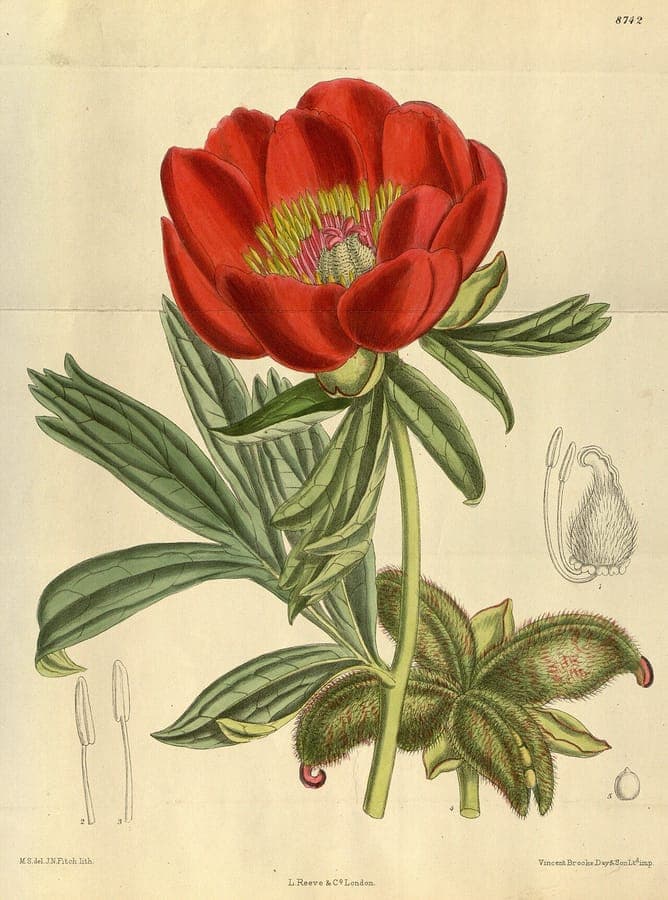
M.S. del., J.N.Fitch lith. / Public domain, via Wikimedia Commons
Scarlet peony: complete guide
Paeonia peregrina
Want to see Scarlet peony: complete guide in your garden?
1 minute, no credit card
Overview
Paeonia peregrina, commonly known as the Scarlet peony, is a herbaceous perennial native to southeastern Europe, thriving in countries like Bulgaria, Greece, and Turkey. In UK and North American gardens, it's prized for its bold red flowers and resilience. Unlike tree peonies, this variety dies back completely in winter and returns with fresh growth each spring. It's an excellent choice for cottage gardens, mixed borders, and naturalised planting schemes.
This peony is not fussy, but it does need the right start. Once established, it blooms reliably year after year. The plant spreads slowly through its root system, forming small colonies over time. It's a long-lived perennial, often surviving 15 years or more with minimal care.
On gardenworld.app, you can design a planting scheme that highlights the Scarlet peony's vibrant colour and upright form, ensuring it stands out without overcrowding.
Appearance & bloom cycle
Paeonia peregrina reaches a height of 60–80 cm and spreads about 50 cm wide. The foliage is deep green, finely divided, and emerges in early spring with a reddish tint. By late May to early June, the plant sends up multiple flowering stems, each topped with a single, semi-double to double bloom measuring 10–12 cm across.
The flowers are a striking, true scarlet red-almost fluorescent in bright sunlight. They have a light, sweet fragrance that attracts pollinators, especially bees and hoverflies. Each bloom lasts 7–10 days, and with proper deadheading and care, the flowering period can extend into mid-June.
After blooming, the foliage remains attractive through summer. In autumn, the leaves turn yellow before dying back completely by late October. New growth emerges from the crown in March.
Ideal location
Plant in full sun to light shade. A minimum of 6 hours of direct sunlight ensures strong stems and abundant flowering. In hot climates (USDA zones 7–8), afternoon shade can help prevent petal scorch.
Choose a spot with good air circulation to reduce fungal diseases. Avoid planting under trees or near large shrubs with aggressive root systems. Once planted, peonies dislike being moved, so pick a permanent location. Give each plant at least 60 cm of space on all sides for healthy development.
Soil requirements
This peony prefers deep, fertile, well-drained loam or clay-loam with a pH of 6.5–7.5. Heavy clay soils should be amended with gypsum or coarse sand to improve drainage. Sandy soils benefit from generous additions of compost or well-rotted manure to retain moisture.
Plant the root tuber with the eyes (buds) facing up, buried 3–5 cm below the soil surface. Planting too deep is a common reason for poor flowering. If your soil is compacted, raise the bed slightly to prevent waterlogging.
Free design
Want to see Scarlet peony: complete guide in your garden? Make a free design now.
Watering
Water deeply but infrequently during spring growth (March to June), especially in dry spells. Aim for 2.5 cm of water per week. Avoid overhead watering to prevent botrytis and powdery mildew.
Once established, the plant is fairly drought-tolerant during summer. Mulch with a 5 cm layer of compost or leaf mould in early spring to conserve moisture and suppress weeds.
Pruning
No pruning is needed during the growing season. After the first hard frost in November or December, cut stems back to 5 cm above ground level. This helps prevent overwintering diseases and keeps the garden tidy. Remove all plant debris from the site to reduce fungal spore carryover.
Maintenance calendar
- March: Apply compost around the base. Watch for emerging shoots.
- April: Keep soil moist. Check for aphids or mildew.
- May: Flowers begin to form. Install discreet peony supports if needed.
- June: Peak bloom. Deadhead spent flowers to prevent seed formation.
- July–August: Minimal care. Do not fertilise.
- September: Reduce watering as foliage matures.
- October: Foliage yellows. Prepare for dieback.
- November–December: Cut back stems. On gardenworld.app, you can generate a custom care calendar tailored to your region and soil type.
Winter hardiness
Paeonia peregrina is hardy in USDA zones 3–8. It tolerates winter temperatures down to -35°C. No winter protection is needed in most climates. Avoid heavy mulching, which can trap moisture and lead to crown rot.
Companion plants
Pair with late-flowering alliums like Allium 'Globemaster' for continuous interest. Nepeta, Salvia nemorosa, and Echinacea purpurea provide contrasting textures and extend the bloom season. Low-growing Geranium macrorrhizum helps cover bare stems as the peony foliage dies back.
Avoid invasive groundcovers like Vinca minor, which can compete for nutrients.
Closing
The Scarlet peony brings vibrant colour and old-world charm to any garden. With straightforward care and a long lifespan, it's a rewarding investment. Plant it right, give it space, and you'll enjoy its bold blooms for years. Look for bare-root divisions in early spring at garden centres across the UK and North America.
For a layout that maximises impact, visit gardenworld.app-where your dream garden takes shape.
Want to see Scarlet peony: complete guide in your garden? Make a free design now.
Upload a photo, pick a style, and get a photorealistic design with plant list in under a minute.
No credit card required


Similar plants
Tree peony (Paeonia x suffruticosa): complete guide
Paeonia x suffruticosa
Discover tree peonies: cultivation, care essentials, and garden placement. Magnificent flowers and long-lived shrub plants.
Paeonia californica: complete guide
Paeonia californica
Discover California peony, a spectacular flowering plant with deep red blooms. Complete growing guide with design tips and care instructions.
Paeonia cambessedesii: complete guide
Paeonia cambessedesii
Discover the rare Balearic peony, an exclusive and botanically unique plant. Growing guide with care tips for this Mediterranean treasure.