
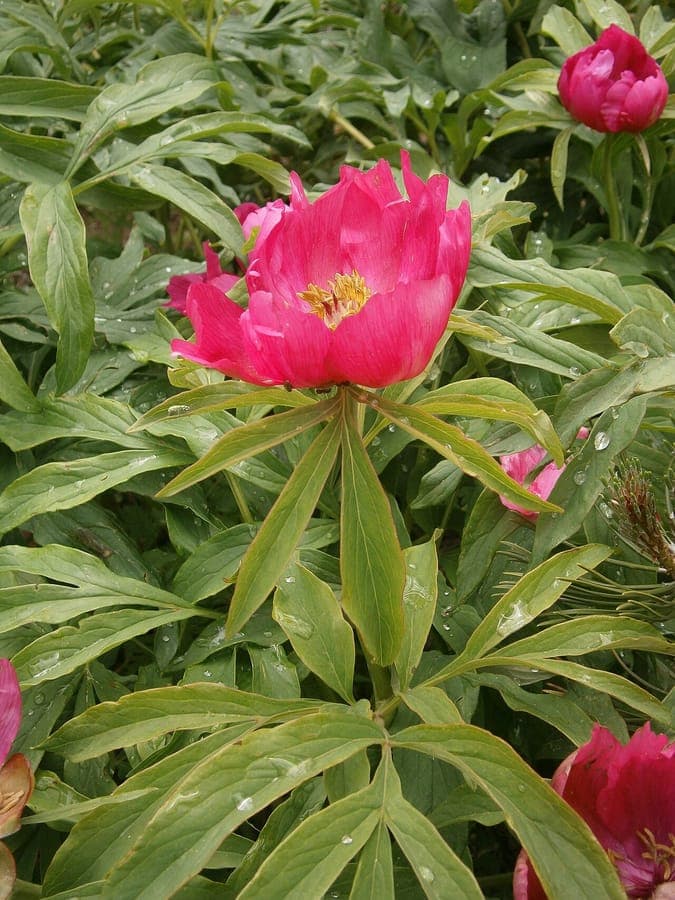
Meneerke bloem / CC BY-SA 3.0, via Wikimedia Commons
Common peony: complete guide
Paeonia officinalis
Want to see Common peony: complete guide in your garden?
Full design in HD: €7.99
Overview
Paeonia officinalis, known commonly as the common peony, is a hardy perennial that has graced gardens for centuries with its bold, romantic blooms and straightforward care. Native to regions across southern Europe - including France, Italy, and the Balkans - this peony thrives in temperate climates and adapts well to UK and North American gardens. It belongs to the Paeoniaceae family and forms a herbaceous perennial, meaning it dies back in winter and re-emerges from the roots each spring.
The plant typically grows 60 to 80 cm tall and spreads slowly over time, forming clumps that can last 20 years or more with proper care. Unlike tree peonies, which have woody stems, the common peony's stems are soft and herbaceous, collapsing naturally in autumn. This makes it a reliable, long-term addition to mixed borders and traditional cottage gardens.
On gardenworld.app, you can create a garden layout that highlights the bold presence of the common peony, pairing it with complementary textures and bloom times.
Appearance & bloom cycle
The common peony blooms in late spring, usually from late May to early June, depending on your zone. The flowers are fully double, densely packed with crimson-red petals, though pink and rare white forms exist. Each bloom measures 10–15 cm across and releases a subtle, sweet fragrance - not overpowering, but noticeable when you're close.
The foliage emerges early, with deep green, deeply lobed leaves that form a lush mound. By bloom time, the plant is full and bushy. After flowering, seed pods develop and split open in late summer, adding ornamental interest to dried arrangements.
Watch for late frosts - they can damage developing buds. If you're in a colder microclimate, consider planting near a wall for slight warmth, but avoid deep shade.
Ideal location
Common peonies need at least 6 hours of direct sun daily. Full sun is best, especially in cooler climates like the UK or northern US. In hotter zones (USDA 7–8), light afternoon shade can help prevent scorching and extend bloom life.
Avoid windy spots or enclosed areas with poor air circulation, as stagnant air encourages fungal issues like powdery mildew. Don't plant too close to large trees or shrubs - their roots will compete for moisture and nutrients.
Soil requirements
This peony prefers fertile, well-drained soil with a pH between 6.5 and 7.5. Heavy clay soils should be amended with compost or grit to improve drainage. Sandy soils benefit from added organic matter to retain moisture.
Plant the tuberous roots with the eyes (buds) 3–5 cm below the soil surface. Planting too deep is a common mistake and often results in little or no flowering. Space plants 80–100 cm apart to allow for air flow and mature spread.
Free preview
Want to see Common peony: complete guide in your garden? Make a free preview of your design.
Watering
Water deeply once a week during the first growing season, especially during dry spells. Aim for about 10 litres per plant. Once established, peonies are fairly drought-tolerant but perform best with even moisture.
Avoid overhead watering - wet foliage increases the risk of fungal diseases. Water at the base, preferably in the morning.
Pruning
Pruning is minimal. In autumn or early winter, cut all foliage down to 5 cm above ground level. This helps prevent diseases like peony rust and eliminates overwintering pests. Do not cut during active growth.
Do not remove spent flowers if you want to enjoy the seed pods, but deadheading can redirect energy to root development in young plants.
Maintenance calendar
- Jan: Check root buds; keep area clear of debris
- Feb: No action needed
- Mar: Add compost; clear any remaining old stems
- Apr: Watch for late frost; plant new tubers if needed
- May: Bloom time; water during dry periods; keep foliage dry
- Jun: Blooming ends; leave seed heads for visual interest
- Jul: No pruning; monitor for mildew
- Aug: Dormant period; no action
- Sep: No action
- Oct: Remove fallen leaves
- Nov: Cut foliage to 5 cm above soil
- Dec: Dormant; protect from heavy mulch
Using gardenworld.app, you can set seasonal reminders tailored to your location and USDA zone, helping you stay on top of care tasks.
Winter hardiness
Paeonia officinalis is extremely cold-hardy, thriving in USDA zones 3–8. It reliably survives winter freezes, with roots surviving temperatures as low as -35°C. The plant dies back completely in winter and requires no special protection, though a light mulch in zone 3 can help in exceptionally harsh winters.
Companion plants
Pair with plants that complement its bloom time and structure. Good companions include Allium (for contrast), Nepeta (to fill space post-bloom), Salvia (long bloom season), and early tulips (for sequential colour). Avoid invasive spreaders like mint or aggressive ground covers that can choke the roots.
A classic combo: plant late tulips alongside peonies - their blooms overlap slightly, and peony foliage hides dying tulip leaves.
Closing
The common peony is a garden staple for good reason. It's long-lived, low-maintenance, and delivers an unforgettable floral display each spring. Buy healthy tubers from trusted garden centres, plant in a sunny, well-drained spot, and avoid common pitfalls like deep planting. With a little patience, you'll enjoy decades of lush, romantic blooms - and a plant that becomes part of your garden's legacy.
Want to see Common peony: complete guide in your garden? Make a free preview of your design.
Upload a photo, pick a style, and get a photorealistic design with plant list in under a minute.
Full design in HD: €7.99


Identify this plant in your own garden
Take a photo of a plant in your garden and see which one it is.
Similar plants
Tree peony (Paeonia x suffruticosa): complete guide
Paeonia x suffruticosa
Discover tree peonies: cultivation, care essentials, and garden placement. Magnificent flowers and long-lived shrub plants.
Paeonia californica: complete guide
Paeonia californica
Discover California peony, a spectacular flowering plant with deep red blooms. Complete growing guide with design tips and care instructions.
Paeonia cambessedesii: complete guide
Paeonia cambessedesii
Discover the rare Balearic peony, an exclusive and botanically unique plant. Growing guide with care tips for this Mediterranean treasure.