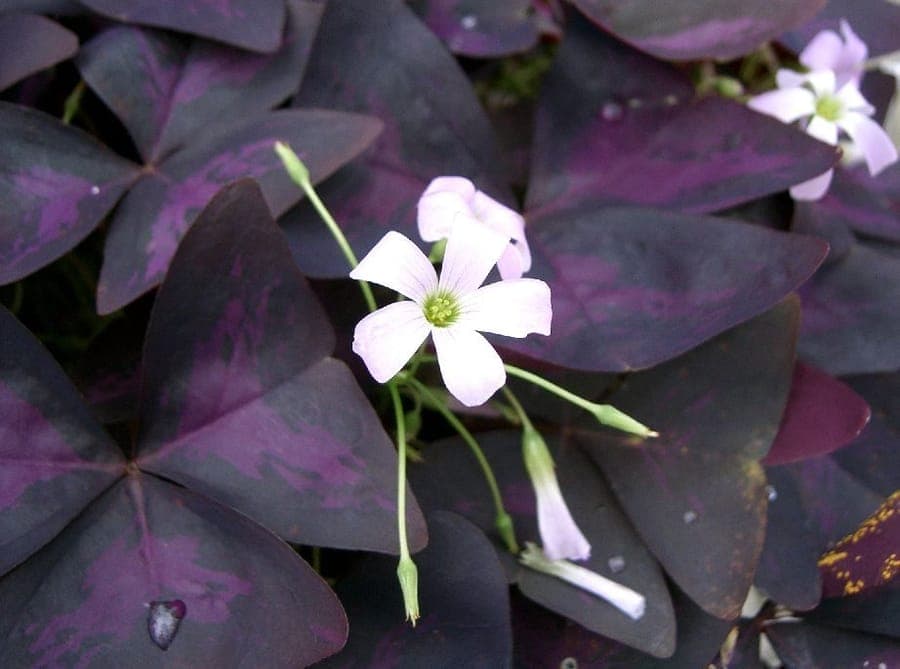
KENPEI / CC BY-SA 3.0, via Wikimedia Commons
Purple shamrock: complete guide
Oxalis triangularis
Want to see Purple shamrock: complete guide in your garden?
Full design in HD: €7.99
Look after your Purple shamrock with the GardenWorld app
Identify plants with your camera and get a care calendar with reminders for this plant.


Overview
Purple shamrock (Oxalis triangularis), also sold as false shamrock, is one of the most popular purple-leaved houseplants around, and with good reason. Its triangular leaflets look like little butterflies perched on slender stalks, and they genuinely move: in the evening or in low light they fold down and close, opening again in the morning. Between the leaves, small pale pink to white flowers appear for much of the year.
The plant belongs to the wood sorrel family (Oxalidaceae) and comes from South America, including Brazil, Paraguay, Bolivia and Argentina. It grows from small, scaly rhizomes that look like tiny tubers. Because of this it behaves like a bulb: after a spell of growth it may suddenly drop all its leaves to rest, then sprout again. Once you know this, it is no cause for alarm.
An important point for cat and dog owners: like all wood sorrels, Oxalis triangularis contains oxalic acid and soluble oxalates and is toxic to pets. You will find what that means in practice further down.
In summer purple shamrock can also go outdoors in a pot or as ground cover in a shady border. If you want your indoor and outdoor planting to work together, gardenworld.app can create a garden design that takes your patio and containers into account as well.
Appearance and bloom cycle
Each leaf is made up of three triangular leaflets 2 to 4 cm long, their points meeting in the centre. In the most widely sold form they are deep purple with a lighter pinkish-violet zone in the middle; there are also green-leaved forms and cultivars with flamed markings, such as 'Mijke'. The leaf stalks are thin and 10 to 25 cm long, so the plant forms a loose, rounded clump 15 to 30 cm tall.
The five-petalled flowers are 1.5 to 2 cm across and held in small clusters above the foliage. They are pale pink, lilac or white with a greenish-yellow eye, as in the photograph. The flowers also close in the evening and in dull weather. Indoors the plant flowers on and off from spring to autumn; outdoors mainly from May to September.
Ideal location
Indoors, purple shamrock wants plenty of light but not fierce midday sun through glass in summer, which scorches the leaves. An east or west window, or a south window with a sheer curtain, is ideal. In poor light the stalks become long and floppy and the colour fades. Turn the pot now and then, as the leaves lean towards the light.
A room temperature of 15 to 24 °C is fine. In prolonged heat above 27 °C the plant is more likely to go dormant. From late May to September the pot can go outside in a spot with morning sun or light shade.
Soil requirements
Use an open, free-draining potting mix. Ordinary houseplant compost with about a third perlite or fine grit works well. The rhizomes rot quickly in soil that stays wet, so a pot with a drainage hole is essential. A shallow, wide pot suits the plant's shallow roots better than a deep one.
Outdoors in the ground, choose a loose, humus-rich soil that does not compact or hold water.
Planting the rhizomes
You can buy purple shamrock as a plant or as loose rhizomes, often described as bulbs. Plant them in spring, from March to May, 2 to 3 cm deep. A pot 15 cm across takes about eight to ten rhizomes, which quickly gives a full clump. Orientation matters little, but laying them flat is best.
Keep the compost lightly moist afterwards. The first leaves usually appear within two to four weeks. An old, crowded pot can be tipped out in spring and the rhizomes divided between several pots, which is the simplest way to propagate the plant.
Free preview
Want to see Purple shamrock: complete guide in your garden? Make a free preview of your design.
Watering
Water when the top 2 to 3 cm of compost feels dry, usually about once a week in the growing season. Water thoroughly and tip away anything left in the saucer after fifteen minutes. Overwatering is the main cause of rotting rhizomes and yellow leaves; the plant copes far better with a little dryness.
From April to September, feed every three to four weeks with half-strength liquid houseplant fertiliser. Do not feed during dormancy.
Pruning
No real pruning is needed. Snip off yellowing or limp leaves at the base, along with spent flower stalks. If the plant has become leggy or flops open, you can cut all the leaves back close to the soil; a fresh, compact clump will grow within a few weeks. Watch for red spider mite and aphids in dry air, and for rust, which shows as small orange spots under the leaves. Remove affected leaves straight away.
Dormancy
After a few months of growth, often in late summer or winter, purple shamrock may let its leaves droop and yellow. This is usually not disease but a rest period. Cut off the foliage, stop watering and put the pot somewhere cool and dark. After two to four weeks, sometimes a little longer, new shoots appear. Move the pot back into the light and gradually resume watering.
Maintenance calendar
March–May: Plant rhizomes or divide a crowded pot. Bright spot, moderate watering.
June–September: Growth and flowering. Feed every three to four weeks. Move the pot outdoors into light shade if you wish.
September: Bring the pot in before nights fall below 10 °C.
October–February: Keep indoors in a bright spot with less water, or allow a dormant period if the leaves die back.
The plant calendar on gardenworld.app is a handy prompt for jobs like these.
Winter hardiness
Oxalis triangularis is not reliably hardy in Britain or the Low Countries. In dry soil the rhizomes can survive brief, light frosts of a few degrees below zero, but in a wet northern European winter they usually rot. Outdoors, treat it as a summer plant.
Overwintering
If the plant spent summer in the ground, lift the rhizomes in September, dry them for a few days and store them in a bag of dry compost or sand at 5 to 12 °C. Replant them in spring. A pot can simply come indoors and carry on growing as a houseplant, or be left dry to rest in a cool place for a couple of months.
Toxicity
All parts of purple shamrock contain oxalic acid and soluble oxalates, which give the plant its sour taste. It is toxic to cats, dogs, rabbits and guinea pigs. Chewing the leaves often causes drooling, vomiting or diarrhoea; large amounts can lower blood calcium and strain the kidneys. The sour taste puts most animals off, but keep the plant out of their reach anyway and call your vet if your pet has eaten some. Eating large amounts is not advisable for people either, especially anyone with kidney stones or gout, so keep it away from young children.
Companion plants
Indoors, the dark foliage looks lovely beside bright green plants. A spider plant (Chlorophytum comosum) or Chinese money plant (Pilea peperomioides) gives contrast, while the silver and purple Tradescantia zebrina echoes the colour. Outside in pots or a shady edge, pair it with coral bells (Heuchera micrantha) and the lime-green leaves of ornamental sweet potato (Ipomoea batatas). In any combination remember that purple shamrock needs a dry rest and is best not potted together with thirsty plants.
Final thoughts
Purple shamrock is a rewarding, lively plant that moves with the light and asks for little: a bright spot, not too much water and an occasional rest. Do bear in mind that it is toxic to pets. Plant a handful of rhizomes in a wide pot this spring and watch the butterflies fold their wings each evening.
Frequently asked questions about Purple shamrock
Is Purple shamrock winter hardy?
Oxalis triangularis is not reliably hardy in Britain or the Low Countries. In dry soil the rhizomes can survive brief, light frosts of a few degrees below zero, but in a wet northern European winter they usually rot.
When and how do you prune Purple shamrock?
No real pruning is needed. Snip off yellowing or limp leaves at the base, along with spent flower stalks.
How much water does Purple shamrock need?
Water when the top 2 to 3 cm of compost feels dry, usually about once a week in the growing season. Water thoroughly and tip away anything left in the saucer after fifteen minutes.
Where does Purple shamrock grow best?
Indoors, purple shamrock wants plenty of light but not fierce midday sun through glass in summer, which scorches the leaves. An east or west window, or a south window with a sheer curtain, is ideal.
What soil does Purple shamrock need?
Use an open, free-draining potting mix. Ordinary houseplant compost with about a third perlite or fine grit works well.

See it in your garden
See Purple shamrock in your garden
One photo of your garden and a few questions. You see the result in about a minute.
Try it with a photoIdentify this plant in your own garden. Identify a plant
Similar plants
Chlorophytum comosum: complete guide
Chlorophytum comosum
Discover everything about Chlorophytum comosum (spider plant). Learn care requirements, propagation, location and maintenance for thriving indoor plants.
Tradescantia zebrina (Inchplant): complete guide
Tradescantia zebrina
Master Inchplant cultivation: colors, growth habits and stunning displays. Complete care guide for this tropical beauty.
Chinese Money Plant: complete guide
Pilea peperomioides
Chinese Money Plant (Pilea peperomioides) is a trendy houseplant from China featuring distinctive round, mint-green leaves. This Instagram-famous plant has become a favorite for modern homes with its elegant appearance and easy-care nature.
