
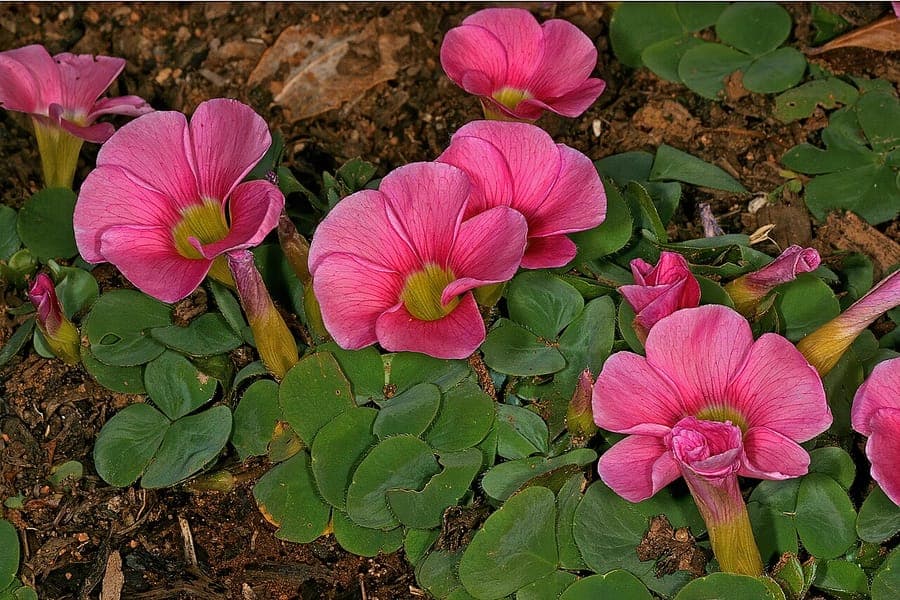
SAplants / CC BY-SA 4.0, via Wikimedia Commons
Purple woodsorrel: complete guide
Oxalis purpurea
Want to see Purple woodsorrel: complete guide in your garden?
1 minute, no credit card
Purple Woodsorrel: Complete Guide
The Purple Woodsorrel (Oxalis purpurea) is a charming groundcover from South Africa, belonging to the family Oxalidaceae. The plant is also known as Herbst-Sauerklee in German and Oxalide pourpre in French. The plant owes its name to the striking purple color of the flowers and often also the leaves. It grows wild in the Cape Provinces and surrounding regions of South Africa, thriving in grasslands and among rocks.
Appearance and Flowering
The plant forms low, compact clumps 10 to 20 cm tall. The leaves are trifoliate (three-part), folding leaflets, deeply purple to red-colored, especially on the undersides. This gives the plant its characteristic appearance even outside the flowering season. Flowers appear September to October (Southern Hemisphere; March to April in Northern Hemisphere) and measure roughly 12 to 15 mm across. The petals are deep purple to magenta, often with a gold center. Each flower opens only one day: morning opening, evening closing. This is an adaptation to sun exposure in sunny regions. The plant grows via small root tubers (tiny underground bulbs) that form toward the end of the growing season.
Ideal Location
Choose a sunny position with full sun (minimum 5 to 6 hours of direct sunlight). Partial shade works but gives fewer flowers and weaker growth. Avoid dense shade. The plant is very flexible with placement: rock gardens, borders, containers, balcony pots, it grows everywhere. In southern areas (zone 9-10), it can overwinter outdoors. In northern regions (zone 7-8), container growing is better. It tolerates coastal wind well.
Soil
Purple Woodsorrel is unfussy about soil type. It grows in sand to clay. Critically important: good drainage. In heavy soil, incorporate 30% sand and 20% gravel. The pH can be neutral to slightly acidic (6.0 to 7.5). In pots, use potting mix blended with 30% perlite or gravel. Feeding is not critical; it is a modest plant. In rich soil it grows lush but flowers less.
Watering
Moderate moisture needs. During growth (March to October in temperate climates), water when the top 2 cm feels dry. This typically means once weekly. Summer rest: in very hot, dry periods (July-August), less water can be given. In winter (November to February), virtually no water: the plant goes dormant. In containers, soil dries faster than in ground. Rainwater is preferred. Waterlogging is not acceptable; roots rot quickly.
Pruning and Shaping
Minimal work needed. Dead flowers can be pinched off (optional; they fall naturally). Dead leaves should be removed in January-February when they turn dark brown. No strict pruning: the plant forms neat mounds naturally. Leave space for spread; it can reach 40-50 cm wide over several years.
Free design
Want to see Purple woodsorrel: complete guide in your garden? Make a free design now.
Maintenance Calendar
January-February: End of winter dormancy. Remove old, brown leaves. Give minimal water as growth starts.
March: Growth accelerates. Water regularly. Tubers can now be planted (propagation).
April-May: Full growth. Normal watering. No fertilizer needed.
June-July: Flowering begins. Give full sun. Light water.
August-September: Peak bloom. Keep very sunny. Maintain watering.
October: Flowering subsides. Tubers form underground. Begin reducing water.
November-December: Complete dormancy. No water. Keep frost-free (see winter hardiness).
Winter Hardiness
Oxalis purpurea is hardy to USDA zone 9a (down to -5 to -8 degrees Celsius). This means:
- Zone 9-10 (Southern Netherlands, Belgium, Southern France): Can remain outdoors with mulch (5 cm leaf cover) after first frost. Plants are much hardier if soil drains well.
- Zone 8 (Central-Northern Netherlands, Northern Belgium, Northern France): Grow as potted plants, kept cool (minimum 0 to 3 degrees Celsius, no water) in winter. Indoors too warm.
- Zone 7 or colder: Dig up tubers after leaf drop (October-November), dry them and store in sand until March.
Damp winters are more dangerous than cold. Ensure perfect drainage outdoors.
Propagation
Easy via root tubers. After flowering (October-November), carefully dig and collect tubers. They are small (cherry-sized to hazelnut). During winter, store in dry sand in a cool, dry location (about 5 degrees Celsius). In March/April, plant in potting mix, shallow depth (just below surface), water sparingly. Growth emerges after weeks.
Seed sowing is possible but tedious; seeds are tiny. Preference: tuber propagation.
Companion Plants
Combine with other sun-loving groundcovers: Armeria maritima (sea thrift), Sedum species (stonecrop), Sempervivum (hens-and-chicks), Festuca. Avoid moisture-loving grasses. In borders: Stipa, Dianthus, Helianthemum (sun roses).
Problems and Diseases
Very healthy. Occasionally: aphids in warm greenhouses (spray with water). Mold in damp winters (ventilate well). Caterpillars very rare. A robust plant.
Interesting Facts
The leaves are light-sensitive: they close at night (nyctinasty), protecting the plant against water evaporation and insect attacks. This makes her very elegant to observe throughout the growing season. In South Africa, the plant grows close to the coast; coastal wind and salt tolerance are thus built-in.
Conclusion
The Purple Woodsorrel is an underrated groundcover for temperate climates, especially for sunny rock gardens and borders. It combines purple blooms with decorative, purple foliage. Caution with damp winters is the only requirement. For zones 7-8, container growing is recommended; for zone 9-10 it can overwinter outdoors with protection. Years of repeated flowering and very low maintenance needs make it ideal for maintenance-free gardens.
Availability: Relatively rare in standard garden centers. Intratuin (Netherlands) sometimes stocks special Oxalis selections. Germany: OBI and Hornbach occasionally carry South African groundcovers. France: Jardiland rarely stocks this rarity. Online specialized suppliers (seed, tubers) are the best source.
Want to see Purple woodsorrel: complete guide in your garden? Make a free design now.
Upload a photo, pick a style, and get a photorealistic design with plant list in under a minute.
No credit card required


Similar plants
Oxalis incarnata: complete guide
Oxalis incarnata
Discover the charming lilac oxalis for your front garden. Full growing guide, care tips and design ideas for this delicate summer bloomer.
Oxalis valdiviensis: complete guide
Oxalis valdiviensis
Learn how to grow Chilean yellow-sorrel with location, soil, watering and care tips. An elegant yellow-flowering ornamental.
Lifeplant: complete guide
Biophytum sensitivum
Lifeplant is a fascinating houseplant with sensitive leaves that fold when touched. Discover how to grow this tropical wonder and where to find it.