
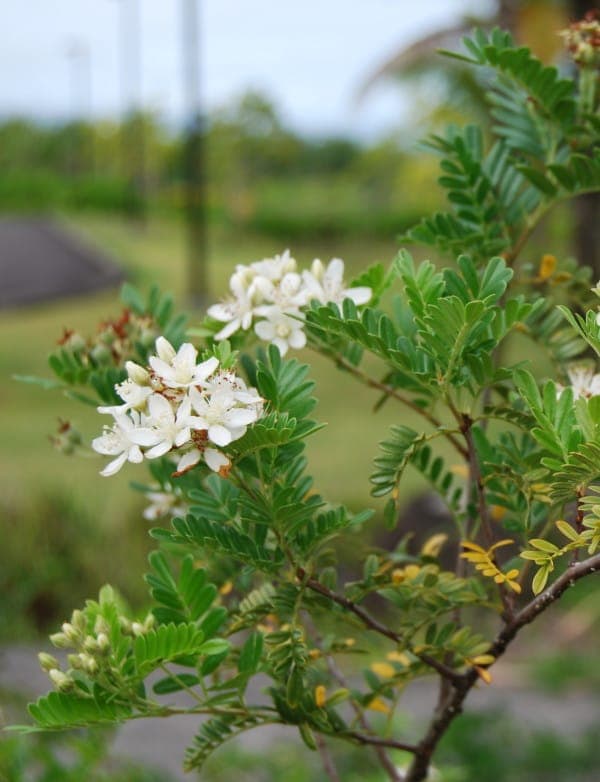
Indeterminate / Public domain, via Wikimedia Commons
Hawaii hawthorn (Osteomeles anthyllidifolia): complete guide
Osteomeles anthyllidifolia
Want to see Hawaii hawthorn (Osteomeles anthyllidifolia): complete guide in your garden?
1 minute, no credit card
Overview
Osteomeles anthyllidifolia - commonly called Hawaii hawthorn or ulei - is a graceful shrub belonging to the rose family (Rosaceae). Native to Hawaii, Taiwan, Japan, the Cook Islands, Tonga and coastal areas of southeast China, this plant was scientifically described in 1821 by (Sm.) Lindl. Its fine, pinnate foliage and clusters of white blossoms give it a distinctive presence that sets it apart from typical garden shrubs.
In its native Hawaiian habitat, the plant grows on open lava slopes, coastal grasslands and dry scrubland. Historically, the tough, straight branches were used by native Hawaiians to craft throwing spears and other tools. Beyond its cultural significance, it has also attracted interest from horticulturists for its ornamental qualities. On gardenworld.app you can find inspiration for designing borders and garden spaces with unusual specimen plants.
Despite its tropical origins, Osteomeles anthyllidifolia adapts surprisingly well to cultivation in warm-temperate gardens, provided it is given excellent drainage and a sunny, sheltered position. Its slow to moderate growth rate and naturally compact shape make it low-maintenance once established.
Appearance and bloom cycle
The foliage of Osteomeles anthyllidifolia is one of its most distinctive features. Each leaf is finely pinnate, composed of numerous small, oval leaflets arranged along a central stalk - giving the plant a delicate, almost ferny appearance that is unusual within the rose family. The leaflets are glossy dark green and remain on the plant year-round in mild climates.
Flowers appear from April through June (in Northern Hemisphere cultivation) in dense, flat-topped clusters. Each individual flower is small, white and five-petalled, typical of the Rosaceae family. They carry a faint sweet fragrance and are attractive to bees and other pollinators. After flowering, small round fruits develop, initially greenish-white, maturing to a bluish or dark purple colour. These berries are enjoyed by birds.
The plant's overall growth habit is an upright to arching shrub. In its native habitat it can reach 2 to 4 metres in height, but in cultivation - particularly in cooler or pot-grown conditions - it typically stays between 60 and 150 cm tall.
Ideal location
Osteomeles anthyllidifolia thrives in full sun to light partial shade. At least six hours of direct sunlight per day supports the best flowering and keeps the plant compact. A sheltered south or west-facing wall position closely mimics the warm, open conditions of its Hawaiian homeland.
The plant does poorly in deep shade, where it becomes leggy, produces fewer flowers and is more vulnerable to fungal issues. Wind protection is helpful, particularly in areas where cold winds are common. However, the shrub is naturally adapted to breezy coastal conditions, so moderate airflow is perfectly acceptable.
In most of Northern Europe, this shrub is best grown in a large container that can be moved indoors or into a frost-free glasshouse for winter. In warmer coastal gardens - particularly in the south of England, western France or along the Mediterranean - it can be attempted in a sheltered border.
Soil
This shrub is not demanding about soil fertility, but it is very particular about drainage. In its native environment it grows on rocky lava soils, sandy coastal substrates and well-drained hillside scree - all of which drain rapidly and retain little moisture. Replicate these conditions in the garden for best results.
The ideal pH range is 5.5 to 7.0. A gritty, free-draining mix works well: combine loam-based compost with at least 30 to 40% coarse horticultural grit or perlite. Avoid heavy clay soils entirely, as waterlogged roots quickly lead to root rot. For container growing, use a specialist Mediterranean or alpine mix, or blend standard multipurpose compost with extra grit.
When planting out, work in a small amount of slow-release fertiliser to encourage establishment. Once the plant is settled, feeding once or twice per year in spring and early summer with a balanced fertiliser is sufficient.
Watering
Once established, Osteomeles anthyllidifolia is notably drought-tolerant. It comes from regions where rainfall can be seasonal and unpredictable, and its root system is well adapted to seeking out moisture in dry, rocky soils. Overwatering is the most common cause of failure with this plant.
During the growing season, water moderately: allow the top few centimetres of soil to dry out between waterings, then water deeply so that moisture reaches the roots. In summer heat, you may need to water more frequently, but always allow good drainage between sessions. Never leave the roots standing in water.
In autumn and winter, reduce watering significantly. Container plants overwintering in a cool, frost-free space should be kept nearly dry - just enough moisture to prevent the roots from desiccating completely. Garden-grown plants in mild climates need little to no supplemental watering outside the growing season.
Free design
Want to see Hawaii hawthorn (Osteomeles anthyllidifolia): complete guide in your garden? Make a free design now.
Pruning
Osteomeles anthyllidifolia naturally maintains a tidy, compact shape and requires only light maintenance pruning. Heavy cutting-back is not necessary and can reduce flowering in the following season, as flower buds are set on current-season wood during the summer months.
After flowering, remove spent flower clusters and any dead or damaged branches. If the plant becomes too large or straggly, it can tolerate moderate shortening in late spring immediately after flowering - but aim to remove no more than one-third of the plant at one time. This allows the shrub to put energy into producing new growth and setting buds for next year.
For young plants, light pinching of growing tips in early spring encourages bushier, denser growth. Always use clean, sharp pruning tools and sterilise blades between plants to avoid transmitting any disease.
Maintenance calendar
January and February: Keep container plants in a bright, frost-free location. Water sparingly. Inspect for pests such as scale insects.
March: Growth resumes. Apply a slow-release balanced fertiliser. Bring container plants back into a sheltered outdoor spot once night frost risk diminishes.
April to May: The flower buds develop. Ensure full sun and do not prune. Water moderately as temperatures rise.
June: Peak flowering. After blooms fade, carry out light tidying and any necessary shaping. Take semi-ripe cuttings for propagation.
July to August: Active growing period. Water in dry spells. Watch for aphids on new growth tips.
September: Fruits ripen. Begin reducing watering. Prepare container plants for the transition indoors.
October to December: Move containers to a frost-free, cool and bright position. Apply a mulch of bark chips around the base of garden-grown plants for root protection.
Winter hardiness
Osteomeles anthyllidifolia is only marginally frost-hardy, rated at approximately USDA zones 9 to 11. It tolerates light frosts down to about -5 degrees Celsius, but prolonged cold or hard freezes will damage or kill the plant. In continental Northern Europe and most of inland Britain, winter protection is essential.
In mild maritime gardens - such as sheltered spots in coastal south England, Brittany or the Mediterranean coast - the plant may survive outdoors if placed against a warm south-facing wall and mulched at the base. A breathable horticultural fleece during cold snaps adds significant protection.
For most growers in temperate Northern Europe, container cultivation is the practical solution. Bring pots under glass - into a cool conservatory, unheated greenhouse or bright garage - before the first hard frosts of November. Keep cool but frost-free over winter and reintroduce to outdoor conditions gradually in spring.
Companion plants
Osteomeles anthyllidifolia associates well with other sun-loving, drought-tolerant and slightly tender plants that share its preference for excellent drainage and warm positions. Mediterranean and Californian-style planting schemes suit it particularly well.
Good companions in a sheltered border include Pittosporum tobira with its leathery leaves and fragrant flowers, Westringia fruticosa (coast rosemary), Cistus species, lavender and rosemary. These all appreciate the same well-drained, sunny conditions. For a more architectural composition, combine with agave or Cordyline to contrast the fine-textured foliage.
In a container garden or on a sheltered terrace, pair it with other tender shrubs such as Plumbago auriculata or Salvia microphylla for a long season of complementary colour. Visiting local garden centres to find varieties suited to your microclimate is always worthwhile, and gardenworld.app can help you visualise how these combinations might look in your own outdoor space.
Closing thoughts
Osteomeles anthyllidifolia is a rewarding plant for gardeners who enjoy growing something a little out of the ordinary. Its connection to Hawaiian cultural history, combined with its genuine ornamental merits - fine pinnate foliage, clusters of white blossom and bird-attracting berries - make it a plant with genuine character.
With a warm, sunny position, sharply drained soil and careful protection through winter, this Pacific shrub can thrive well beyond its natural range and bring an exotic, botanically interesting dimension to any garden or terrace.
Want to see Hawaii hawthorn (Osteomeles anthyllidifolia): complete guide in your garden? Make a free design now.
Upload a photo, pick a style, and get a photorealistic design with plant list in under a minute.
10,000+ gardens designed already
No credit card required


Similar plants
Olearia macrodonta: complete guide
Olearia macrodonta
New Zealand holly: hardy shrub with large toothed leaves. Care, growth and cultivation tips.
Indian plum: complete guide
Oemleria cerasiformis
Everything about Indian plum (Oemleria cerasiformis): cultivation, location, pruning, and wildlife value of this early-flowering Pacific shrub.
Sainfoin: complete guide
Onobrychis viciifolia
Discover sainfoin (Onobrychis viciifolia), a nutrient-rich fodder crop and stunning bloomer from Central and Southeast Europe. Ideal for meadows and natural gardens.