
Michael Wolf / CC BY-SA 3.0, via Wikimedia Commons
Indian plum: complete guide
Oemleria cerasiformis
Want to see Indian plum: complete guide in your garden?
1 minute, no credit card
Overview
Oemleria cerasiformis, commonly known as Indian plum or osoberry, is one of the earliest-flowering shrubs of the Pacific Northwest. A member of the Rosaceae family, it grows natively along the Pacific Coast from British Columbia south to California, thriving in moist woodlands, forest margins, and streamside habitats. In cultivation, it has earned a loyal following among gardeners who value wildlife, early season interest, and low maintenance.
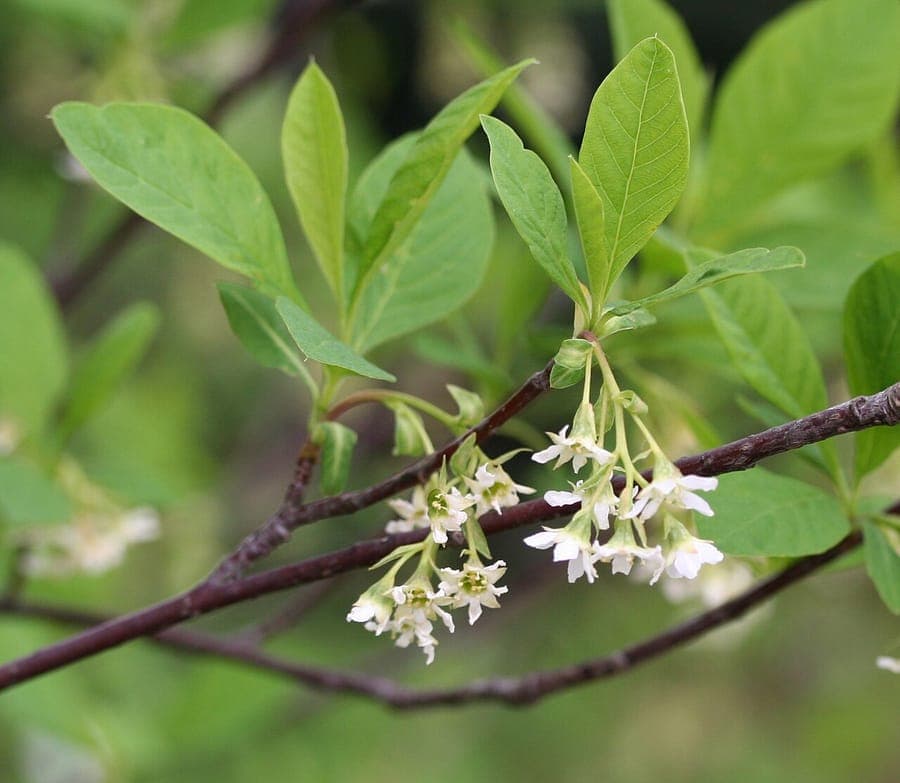
What sets Indian plum apart is the timing of its bloom: in mild years, flowers appear as early as February, long before most other shrubs have stirred from dormancy. These delicate white flower clusters dangle in chains of 5 to 15 cm and carry a light, sweet fragrance that attracts the first bees and hoverflies of the season. For pollinators emerging on mild winter days, Indian plum is often the only available nectar source in the garden.
Oemleria cerasiformis is dioecious, meaning male and female flowers are carried on separate plants. To achieve the small, plum-like fruits - which ripen from pink-red to blue-black - you need at least one male and one female plant planted within 10 to 15 metres of each other. The fruits are technically edible but quite bitter due to the presence of prunasin; birds, however, find them irresistible and the shrub becomes a busy feeding station by midsummer.
Visit gardenworld.app to explore garden designs featuring early-blooming shrubs like Indian plum alongside companion plantings for year-round wildlife interest.
Appearance & bloom cycle
Indian plum is a multi-stemmed, upright deciduous shrub reaching 200 to 500 cm in height and 150 to 300 cm in spread at maturity. The growth habit is naturally vase-shaped, with multiple arching canes rising from the base. Young stems are smooth, green to reddish-brown, and emit a cucumber-like scent when broken - a characteristic that inspired the common name "osoberry" from the Spanish for bear berry.
The leaves are elliptical to oblanceolate, measuring 5 to 12 cm in length, and emerge a fresh mid-green in spring shortly after the flowers. The leaf surface is smooth above and slightly paler beneath. In autumn, the foliage turns yellow-orange before dropping, adding a secondary season of interest to the shrub.
Flowers appear between February and April depending on climate and location. They are small, five-petalled, and creamy white, arranged in pendulous racemes. Male plants produce larger and more numerous flower clusters than females. The fragrance is gentle - described as resembling cucumber and almond blossom combined - and is most perceptible in the morning. The bloom period lasts three to four weeks.
Female plants develop small stone fruits approximately 1 cm across, hanging in loose clusters. They pass through green, pink-red, and finally blue-black as they ripen in July and August. The fruits contain a single elongated stone and thin, slightly bitter flesh. Birds such as thrushes, robins, and waxwings consume them eagerly and are the main dispersal mechanism in the wild.
Ideal location
Indian plum thrives in partial shade to full shade, reflecting its natural habitat beneath the forest canopy of the Pacific Northwest. It also performs well in morning sun with afternoon shade, which suits the typical north- or east-facing garden in northern Europe. Avoid full midday sun on dry, free-draining soils, as this can cause leaf scorch and reduced growth during summer.
This shrub is well suited to shady borders, woodland gardens, or as an informal hedge. It works particularly well planted against a north-facing fence or wall, where its early flowers can be appreciated close to a path or sitting area. The shrub tolerates urban pollution reasonably well, making it a practical choice for town and city gardens.
Because Indian plum blooms so early in the season, consider placing it where it can be viewed from a window or near a main entrance - the sight of white flower chains in February or March is genuinely uplifting in the grey of late winter. Planning your garden layout is straightforward with gardenworld.app.
Soil requirements
Oemleria cerasiformis adapts well to a range of soil types, provided the site does not dry out completely during summer. It grows best in moisture-retentive, humus-rich soils with good drainage and a pH between 5.0 and 7.2. Slightly acidic loam, sandy loam, and clay loam are all suitable, provided organic matter is present.
Before planting, work 10 to 15 cm of well-rotted garden compost or leaf mould into the planting hole to improve moisture retention and soil structure. On free-draining sandy soils, apply a mulch layer of 7 to 10 cm of composted bark or wood chip around the base of the plant after planting to retain moisture and keep the roots cool in summer.
On heavier clay soils, improve drainage by incorporating coarse grit or horticultural sand at a ratio of approximately one part grit to three parts clay. Indian plum tolerates temporary waterlogging but will decline if roots sit in standing water for extended periods. Avoid alkaline soils above pH 7.5, where the plant may show signs of nutrient deficiency including yellowing foliage.
Free design
Want to see Indian plum: complete guide in your garden? Make a free design now.
Watering
For the first year after planting, water Indian plum thoroughly and regularly - at least once a week during dry periods - to encourage deep root establishment. Soak the entire root zone each time, ensuring water penetrates to a depth of at least 30 cm. After the establishment period, the shrub becomes reasonably drought-tolerant on moisture-retentive soils, though growth is markedly better when some moisture is available through summer.
On sandy or free-draining soils, continue watering every two weeks during dry spells even on established plants. Apply water at the base of the plant rather than overhead to keep the foliage dry and reduce the risk of fungal infection, though Indian plum is generally resistant to foliar diseases. Drip irrigation or a soaker hose set at low pressure is ideal for established plants.
In winter, additional watering is rarely necessary unless a combination of dry weather and frost occurs. During dry frost periods, check that the root zone has not desiccated completely, as frozen dry soil can damage the root system of even fully established plants.
Pruning
Indian plum requires minimal pruning and can be left to develop its natural form without intervention. If shaping is desired, prune immediately after flowering in spring - the shrub flowers on old wood and sets flower buds for the following year early in the growing season, so pruning at any other time risks removing next year's flowers.
Routine maintenance consists of removing dead, diseased, or crossing branches in late February or early March, just as growth begins. Use clean, sharp bypass secateurs to make smooth cuts, and disinfect tools between plants to avoid spreading any potential disease. Annual removal of a few of the oldest, most congested stems from the base will keep the shrub vigorous and well-aerated.
For older or overgrown specimens, a rejuvenation programme spread over three years is effective: remove one-third of the oldest canes at the base each year. This stimulates new growth from the root zone and restores flowering vigour without causing the plant undue stress. Hard renovation cuts - removing all stems to near ground level - are possible but slow to re-establish.
Maintenance calendar
February-March: First flowers open; enjoy early pollinators visiting; protect young plants if hard frost threatens with horticultural fleece.
March-April: Leaves expand; remove dead and damaged wood after flowering; apply fresh mulch 7 to 10 cm deep around the base.
May-June: Fruits begin to swell on female plants; water during dry spells; remove any unwanted basal suckers if the shrub is spreading beyond its allotted space.
July-August: Fruits ripen blue-black; birds arrive to feed; water established plants every two weeks on sandy soils.
September-October: Foliage turns yellow-orange; leaf fall begins in October; add a top-dressing of compost around the base.
November-December: Plant fully dormant; no maintenance required; check mulch layer is intact.
January: Inspect for dead or damaged canes; plant remains dormant; flower buds are swelling in readiness for February bloom.
Winter hardiness
Oemleria cerasiformis is fully hardy across the United Kingdom, Benelux, northern France, and most of Germany, tolerating temperatures down to approximately -20 degrees Celsius. It falls within USDA hardiness zones 6 to 9, though in practice it survives zone 5 conditions reliably once established. No winter protection is needed for mature specimens in temperate western Europe.
Young plants in their first winter benefit from a protective mulch of 10 cm of composted bark or straw over the root zone to guard against hard freezes. Once established - typically after two growing seasons - the shrub is fully self-sufficient through winter.
The early flowers are the only vulnerability: a sharp late frost in March or April, not uncommon in northern Europe, can damage open blooms. The frost does not harm the plant itself, but the affected flowers may not set fruit that season. Subsequent flower buds are generally frost-hardy to -5 degrees Celsius, so partial blooms usually continue after a cold snap.
Companion plants
Indian plum combines beautifully with other early-flowering and shade-tolerant plants. Consider the following combinations for a woodland-inspired garden:
- Hamamelis mollis (Chinese witch hazel): flowers in January to February with golden-yellow, spider-like blooms; perfect structural partner.
- Cornus mas (Cornelian cherry): yellow flowers in February-March, ornamental red fruits in summer.
- Ribes sanguineum (Flowering currant): pink to red flowers in March-April, similar moisture requirements.
- Lonicera purpusii (Winter honeysuckle): creamy-white, heavily scented flowers in February-March.
- Helleborus x hybridus (Lenten rose): flowers December to March, excellent ground-level companion.
- Polystichum setiferum (Soft shield fern): evergreen, architectural foliage for the understorey.
- Pulmonaria 'Blue Ensign': blue flowers in March-April, silver-spotted leaves, excellent ground cover in shade.
This combination delivers near-continuous bloom from January through April and provides food and shelter for birds, bees, and other beneficial insects throughout the year.
Conclusion
Indian plum is an underappreciated gem for the shade garden. Its remarkably early bloom, attractive fruit for birds, and genuinely low maintenance requirements make it one of the most rewarding shrubs you can grow in a north-facing or woodland setting. Once established, it asks for almost nothing and delivers both beauty and ecological value season after season.
Whether you are creating a wildlife garden, a shady border, or simply looking for something that will genuinely surprise visitors with white flowers in February, Indian plum deserves a place in your garden. Explore companion planting options and garden layouts at gardenworld.app to find the ideal position for this remarkable shrub.
Want to see Indian plum: complete guide in your garden? Make a free design now.
Upload a photo, pick a style, and get a photorealistic design with plant list in under a minute.
10,000+ gardens designed already
No credit card required


Similar plants
Siberian crab apple: complete guide
Malus x robusta
Complete guide to the Siberian crab apple (Malus x robusta): location, soil, pruning, winter hardiness and the best companion plants for your garden.
Chinese flowering crabapple (Malus x spectabilis): complete guide
Malus x spectabilis
Meet the Chinese flowering crabapple (Malus x spectabilis): a classic spring bloomer with carmine buds and pink blossom.
Potentilla crassinervia: complete guide
Potentilla crassinervia
Potentilla crassinervia, the Corsican cinquefoil, grows wild on Corsica and Sardinia's peaks. Discover how to grow this hardy alpine rock garden gem.