
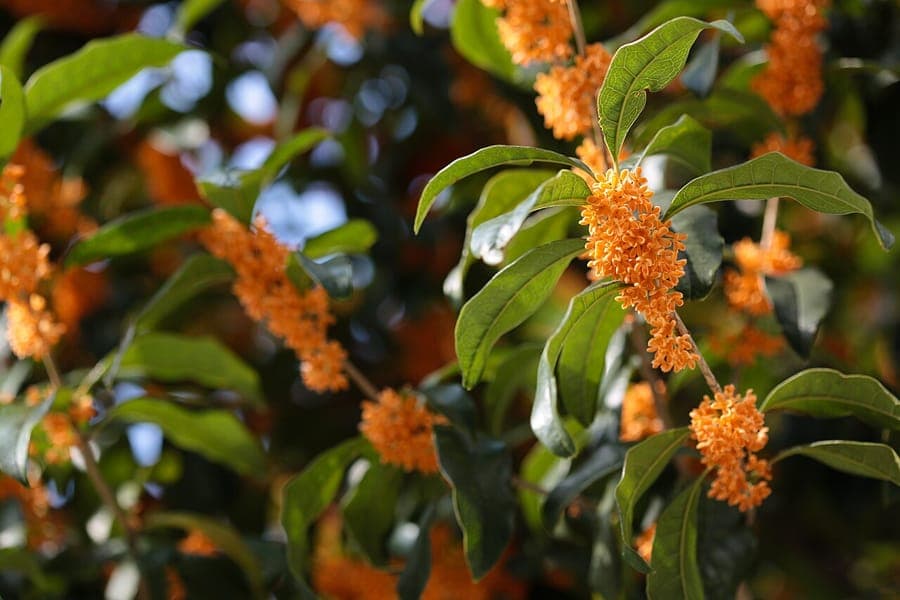
Laitr Keiows / CC BY-SA 3.0, via Wikimedia Commons
Sweet Osmanthus: complete guide
Osmanthus fragrans
Want to see Sweet Osmanthus: complete guide in your garden?
1 minute, no credit card
Overview
Sweet Osmanthus (Osmanthus fragrans) is a half-hardy to winter-hardy evergreen to deciduous shrub of Asian origin, native to China, Japan, and Himalayan regions. Belonging to the Oleaceae family (Olive family), this plant is celebrated for its intensely fragrant, tiny white to yellow flowers and glossy, leathery foliage. It represents an ideal choice for gardeners seeking fragrant plants with extended seasonal flowering and year-round attractive foliage.
Sweet Osmanthus reaches approximately 1.5-3 meters in height in garden conditions and can grow taller in mild climates. Under favorable conditions, the plant flowers twice yearly: in spring and autumn. This extended flowering period makes it a valuable accent in gardens throughout the year.
Appearance and bloom
The foliage of Osmanthus fragrans consists of small to medium-sized leaves, approximately 4-8 centimeters long, leathery, glossy dark green, and finely serrated. Leaves grow opposite and form a dense canopy. Foliage remains ornamentally attractive year-round.
Flowers are extremely small, approximately 3-5 millimeters in diameter, white to yellow-colored, and appear in dense clusters in leaf axils. Flowers produce intensely sweet fragrance that intensifies at night. This fragrance is extraordinarily valuable: even a single flowering plant can perfume an entire garden room. Flowers appear seasonally: October-November and May-June in mild climates.
Ideal location
Sweet Osmanthus performs optimally in part-shaded positions receiving minimum 4-6 hours of direct daily sunlight. The plant tolerates full shade but flowers less abundantly in reduced light. A location with morning sun and afternoon shade is ideal in very hot climates.
This plant excels as a freestanding shrub, trained tree, screen, or wall-trained specimen. It suits shelterbelts and mixed borders. In cold climates, it can be container-grown in greenhouse/conservatory settings. This versatility allows flexible garden integration.
Soil
Sweet Osmanthus requires well-draining, moisture-retentive soil. Unlike many Mediterranean plants, it appreciates regular moisture during the growing season. The plant tolerates both acidic and alkaline soils but performs best in neutral to slightly acidic soil (pH 6.0-7.0).
At planting, incorporate organic material to improve moisture retention. The plant values rich, humus-rich soil, so add well-composted organic matter during planting. In containers, use fruit garden potting mix or heavy potting soil, not light sandy mixtures.
Watering
Sweet Osmanthus appreciates regular moisture and resents drying out. During the growing season (April-September), water when the top 5 centimeters of soil feel dry. Provide drip irrigation or thorough watering during very dry periods.
During winter, water less frequently but ensure the plant never fully dries out. In containers, water demands more attention, especially during hot, dry periods. These moisture requirements distinguish Osmanthus fragrans from many other Mediterranean materials that tolerate drought.
Free design
Want to see Sweet Osmanthus: complete guide in your garden? Make a free design now.
Pruning and care
Sweet Osmanthus can be pruned for shape and leafiness. Prune lightly after flowering (December and July), removing faded twigs and eliminating congested branches. The plant responds well to more substantial pruning if needed for form control.
Remove dead foliage carefully and ensure good air circulation by gently thinning densely growing branches. Heavy pruning is not required: the plant develops toward natural form. Spring application of balanced fertilizer encourages vigorous growth and flowering.
Maintenance calendar
March to April: Light pruning after previous season's growth. Check moisture levels. Apply fertilizer early April.
April to May: Spring flowering period may begin in mild areas. Enjoy flowers and fragrance. Ensure regular moisture.
May to June: Peak spring flowering. Plant grows actively. Water regularly. Remove spent flowers for tidiness.
July to August: Summer growth period. Water regularly in dry weather. Light pruning acceptable to maintain shape.
September to October: Autumn flowering period begins. Enjoy fragrance. Water regularly as growth continues.
November to December: Peak autumn flowering. Plant grows slowly now. Remove spent flowers. Gradually reduce watering.
January to February: Dormant period in cold climates. In mild climates, growth may continue. Minimal watering, only as needed.
Winter hardiness
Sweet Osmanthus is frost-sensitive and suitable for USDA zones 8-11 (temperate coastal regions and warm subtropical zones). In zones 6-7, it can overwinter but will experience frost damage below -10 degrees Celsius. In cold climates, container cultivation is recommended.
In regions with severe winters, the plant can be grown in a protected location against a wall or in a greenhouse/conservatory. Snow cover provides some protection. In zone 8, autumn frost protection may benefit during unusually cold years.
Companion plants
Sweet Osmanthus combines beautifully with plants sharing similar moisture preferences:
- Camellia japonica: Related evergreen, similar flowering period
- Ilex: Evergreen screening, attractive berries
- Viburnum: Fragrant flowers, attractive foliage
- Rhododendron: Group planting, similar soil preferences
- Laurus nobilis (Bay Laurel): Mediterranean appearance, attractive foliage
- Trachelospermum (Jasmine): Climbing plant for wall training
- Mahonia: Fragrant yellow flowers, blue-black berries
Closing thoughts
Sweet Osmanthus is a fragrant, beautiful shrub for temperate to warm gardens. With intensely scented flowers twice yearly and glossy foliage, it offers substantial year-round value. Ideal for shelterbelts, borders, and fragrant garden corners.
Ready to acquire Sweet Osmanthus? For additional advice about this plant and other fragrant selections, visit gardenworld.app for personalized garden designs.
Want to see Sweet Osmanthus: complete guide in your garden? Make a free design now.
Upload a photo, pick a style, and get a photorealistic design with plant list in under a minute.
No credit card required


Similar plants
Rough menodora: complete guide
Menodora scabra
Full guide to Menodora scabra: a drought-tolerant desert subshrub with bright yellow flowers, ideal for rock gardens and xeriscapes.
Fraxinus dipetala: complete guide
Fraxinus dipetala
California ash or two-petal ash from southwestern USA. Beautiful spring flowers, drought-tolerant. Experimental choice for warm Mediterranean front gardens.
Syringa komarowii: complete guide
Syringa komarowii
Syringa komarowii is a striking lilac from central China with elegant flower spikes and lovely foliage. Discover the complete care guide here.