
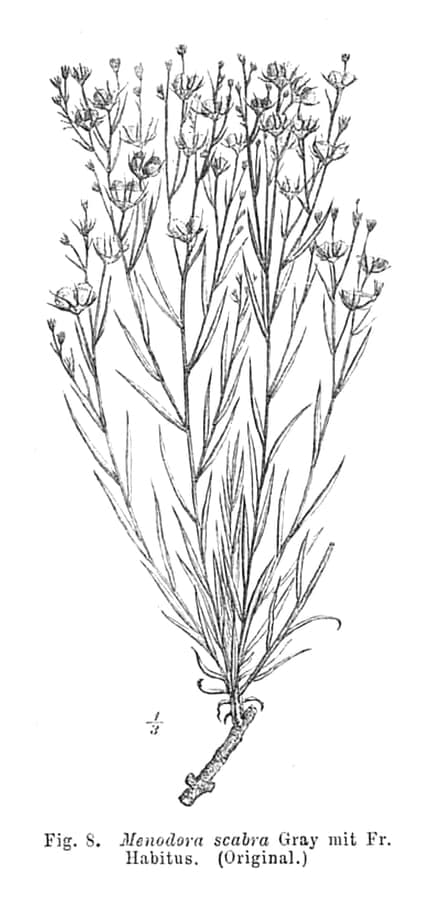
E. Knoblauch? / Public domain, via Wikimedia Commons
Rough menodora: complete guide
Menodora scabra
Want to see Rough menodora: complete guide in your garden?
1 minute, no credit card
Overview
Menodora scabra, commonly known as rough menodora, is a compact and remarkably resilient subshrub belonging to the olive family (Oleaceae). Native to the arid highlands and rocky slopes of Arizona, New Mexico, Texas, Colorado, Utah, and northern Mexico, this plant thrives in some of the harshest conditions that the American Southwest has to offer. Despite its modest stature, it rewards patient gardeners with cheerful yellow flowers and an extraordinary ability to survive on very little water. At gardenworld.app you can explore design ideas that feature drought-adapted plants like this one for beautiful, low-maintenance front gardens.
The species epithet 'scabra' is Latin for rough, a direct reference to the sandpaper-like texture of its stems and leaves. In the wild, rough menodora inhabits elevations from 600 to 2,200 metres, growing in open grasslands, desert shrublands, and on rocky hillsides where summer heat and seasonal drought are the norm. It is classified as a subshrub because its base becomes woody over time, while the upper portions remain somewhat herbaceous. This growth habit allows it to regenerate quickly after damage by cold or drought.
Appearance and bloom cycle
Menodora scabra typically reaches a height of 20 to 50 cm, forming a multi-stemmed, branching mound. The stems are upright to slightly arching, greyish-green, and noticeably rough to the touch due to minute hairs and glands on the surface. The leaves are small, opposite, linear to lance-shaped, and similarly rough in texture.
The flowers are undoubtedly the plant's most attractive feature. They are a clear, bright yellow, funnel-shaped, and produced in small clusters at the tips of the stems. Blooming occurs primarily from April to July, with the exact timing depending on altitude and local climate. After flowering, the plant produces conspicuous yellowish seed capsules that add ornamental interest through summer and early autumn. The flowers are visited by various native bees and hoverflies, making Menodora scabra a useful plant for pollinator-friendly garden designs.
Ideal location
This desert subshrub performs best in a fully sunny position receiving at least six hours of direct sunlight per day. In its native habitat it grows in open, exposed areas with little or no shade from taller vegetation. In garden settings, it will tolerate some afternoon shade in very hot climates, but insufficient light leads to weak, leggy growth and reduced flowering.
Choose a spot that is not subject to the regular irrigation intended for neighbouring water-hungry plants. Rough menodora is an excellent candidate for rock gardens, gravel gardens, and dry slope plantings. It integrates well into xeriscape designs alongside other drought-tolerant species. Container cultivation is possible, though adequate drainage is essential.
Soil
The soil requirements of Menodora scabra are straightforward: lean, well-drained, and ideally slightly alkaline. In nature it grows on sandy, loamy, or gravelly soils with a pH of 6.6 to 8.4. It tolerates calcareous and even quite poor soils with ease, making it suitable for many garden situations in temperate climates where limestone or chalk substrates are common.
Poor drainage is the greatest risk. Waterlogging during cool, wet periods can cause rapid root rot and plant death. Amend heavy clay soils with coarse sand and perlite, or simply plant on a raised bed or slope where water moves away naturally. Fertilising is rarely beneficial - too much nutrient encourages lush foliage at the expense of flowers. A single light application of a cactus or rock garden feed in early spring is more than sufficient.
Free design
Want to see Rough menodora: complete guide in your garden? Make a free design now.
Watering
Once established, Menodora scabra is exceptionally drought-tolerant. In its natural range it survives prolonged dry spells by drawing on deep, fleshy root systems that store moisture. Young plants in their first season, however, need regular watering to promote root establishment.
Water newly planted specimens every two weeks during the growing season, allowing the soil to dry out completely between sessions. Established plants need only three to four supplemental waterings per year during periods of prolonged drought. In temperate climates with regular summer rainfall, additional irrigation is seldom necessary. Overwatering is by far the most common mistake: symptoms include wilting despite moist soil, yellowing leaves, and eventually crown and root rot.
Pruning
Menodora scabra demands minimal pruning. In early spring, just as new growth begins, remove any dead or frost-damaged stems at their base. This keeps the plant compact and encourages vigorous new shoots. After the main flush of bloom, lightly trimming faded flower clusters back to a healthy node may encourage a modest second flowering in late summer, though this is not guaranteed.
Avoid cutting hard into old wood in autumn or winter, as this can weaken the plant and increase susceptibility to frost damage. A light cosmetic tidy in early spring is all that is really needed. The plant recovers quickly from pruning and pushes out new growth within a few weeks.
Maintenance calendar
January-February: leave undisturbed; check that drainage is functioning during wet spells. March: cut back dead stems; apply a very light feed if desired. April-May: enjoy the first flowers; keep the soil on the dry side. June-July: peak bloom period; water only during genuine drought. August: deadhead if a second flush is desired; maintain dry conditions. September-October: seeds ripen; collect or allow self-seeding. November-December: no action needed; ensure drainage is good before frost sets in.
Winter hardiness
Menodora scabra is hardy in USDA zones 5 to 9, meaning it can survive minimum temperatures of around -28°C in the coldest zones, though zone 6 is generally cited as a safe practical lower limit for reliable survival. In its native range at higher elevations, the plant regularly experiences frost, albeit under dry conditions.
In mild-winter garden settings the plant overwinters without protection as long as the soil stays well-drained. Wet frost is considerably more damaging than dry frost. In regions with wet winters, a mulch of coarse gravel around the crown helps shed excess moisture. Potted plants should be moved under cover during sustained hard frost periods. Visit gardenworld.app for advice on designing resilient gardens that thrive through winter and summer alike.
Companion plants
Rough menodora partners beautifully with other drought-tolerant rock garden plants. Penstemon species in shades of red, pink, or blue-purple create vivid contrasts with the yellow flowers. Eriogonum umbellatum and other buckwheats provide complementary tones. Salvia dorrii, with its striking blue spikes, makes an excellent neighbour. Ornamental grasses such as Bouteloua gracilis add fine texture and movement.
For a naturalistic desert planting, combine with Agave, Yucca, Calylophus hartwegii, and low-growing Echinacea or Gaillardia. Smaller alpine plants like Dianthus and Campanula also work well at the front of a rock garden border alongside Menodora scabra.
Closing
Menodora scabra is one of those unassuming plants that continually surprises with its toughness and charm. It asks for almost nothing beyond sunshine and good drainage, yet it rewards with weeks of bright yellow bloom and a quiet, structural presence through the rest of the year. For anyone seeking a genuinely low-water, ecologically valuable subshrub for a rock garden or xeriscape, rough menodora deserves a prominent place on the planting list.
Want to see Rough menodora: complete guide in your garden? Make a free design now.
Upload a photo, pick a style, and get a photorealistic design with plant list in under a minute.
10,000+ gardens designed already
No credit card required


Similar plants
Fraxinus dipetala: complete guide
Fraxinus dipetala
California ash or two-petal ash from southwestern USA. Beautiful spring flowers, drought-tolerant. Experimental choice for warm Mediterranean front gardens.
Syringa komarowii: complete guide
Syringa komarowii
Syringa komarowii is a striking lilac from central China with elegant flower spikes and lovely foliage. Discover the complete care guide here.
Jasminum simplicifolium: complete guide
Jasminum simplicifolium
Discover Jasminum simplicifolium (Asian jasmine climber), an elegant vine with fine foliage. Ideal for warm, sheltered garden spots.