
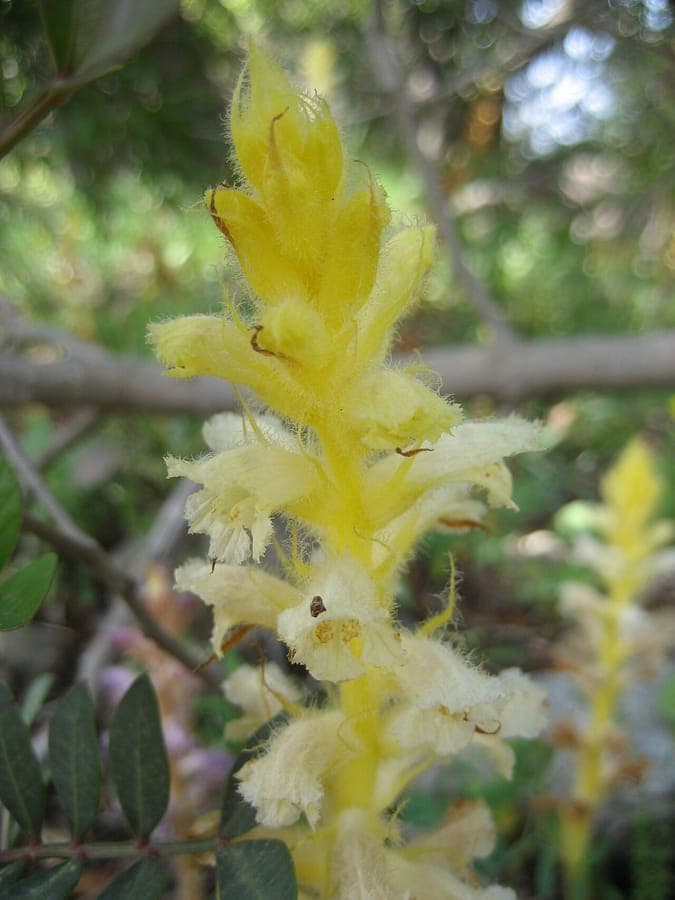
Maarten Sepp / CC BY-SA 4.0, via Wikimedia Commons
Orobanche pubescens: complete guide
Orobanche pubescens
Want to see Orobanche pubescens: complete guide in your garden?
1 minute, no credit card
Overview
Orobanche pubescens, known as Hairy broomrape, is a fascinating parasitic plant from the Orobanchaceae family. This plant parasitizes brambles (Rubus spp.) and other host plants. It is a rare and interesting addition for nature lovers and ecological gardeners interested in the complex relationships in nature.
Although technically a parasite, Orobanche pubescens is not a harmful organism in home gardens. The plant grows wild in Southeast Europe and reproduces via seed. In gardens where brambles grow, this plant can sometimes quietly establish itself without causing damage.
Appearance and blooming
Orobanche pubescens is a striking plant with an unusual growth pattern. The plant grows entirely underground before producing striking flowers. The stems are hairy (hence pubescens - hairy) and variable in height, usually 10-30 centimeters.
Flowers appear in May to June and are brown-red to purplish in color. They are approximately 1-1.5 centimeters long and arranged in a dense spike. The inflorescence is interesting and striking, especially when multiple plants grow together.
After blooming, seed pods form with numerous very small seeds dispersed by wind. The flowers have a heavy, peculiarly sweet scent.
Preferred habitat
Orobanche pubescens grows best on dry slopes and in grasslands where brambles occur. Sunny to part-shaded locations are suitable, as long as the host plant (Rubus spp.) is present.
The plant cannot be directly grown without host plants. Seeds will not germinate without chemical signals from roots of host plants in proximity. This makes Orobanche pubescens a plant for natural grasslands where brambles already grow.
In enclosed gardens without brambles, this plant will not establish. So it is a plant for semi-wild areas or natural zones of larger gardens.
Soil and environment
Orobanche pubescens is undemanding with soil type as long as brambles can grow there. The plant prefers dry to moderately moist soils. Chalky soils seem favorable. Wet, heavy clay soils are less suitable.
The plant has no own root system but makes contact with bramble roots via special suction roots (haustoria). This underground connection provides nutrient transport from host to parasite.
Free design
Want to see Orobanche pubescens: complete guide in your garden? Make a free design now.
Biological interaction
The relationship between Orobanche pubescens and Rubus (bramble) is a classic example of parasitism. The Orobanche plant produces no chlorophyll and is completely dependent on nutrients from the host plant.
However, this is not harmful to the bramble in most cases - the bramble is not weakened or sickened by the presence of this parasite. In many natural ecosystems, host and parasite live in relative harmony.
Cultivation in gardens
Orobanche pubescens cannot be directly cultivated from seed at home without special equipment and knowledge. Seed germination requires specific conditions and contact with host root secretions.
The best approach is to allow natural establishment in gardens where brambles are already present. This usually happens spontaneously without direct help. Seeds from wild plants can establish on available host plants.
For lovers of rare parasitic plants, young plants can sometimes be obtained from specialist nurseries, although this is rare.
Winter hardiness
Orobanche pubescens is completely winter-hardy in Europe. The plant persists through winter as an underground structure and regrows each spring when soil temperatures rise.
The underground connection with bramble roots provides protection from frost. This is therefore not a concern for gardeners.
Ecological significance
Orobanche pubescens plays an interesting role in natural ecosystems. While it is a parasite, it also serves as a food source for certain insects and can attract pollinators.
The presence of parasitic plants contributes to biodiversity and ecological balance in natural gardens. For those interested in the full ecological complexity of gardens, such plants are fascinating.
Health aspects
Orobanche pubescens is not toxic or harmful to humans. The plant can be touched without risk. No special precautions are needed upon exposure.
Conclusion
Orobanche pubescens is a fascinating plant for nature lovers interested in the complexity of plant ecology. Although not a traditional garden plant, this parasite adds value to natural grasslands and ecological gardens where brambles grow. For designing ecological gardens full of natural interactions, visit gardenworld.app for expert advice. Gardenworld.app helps you create gardens that are not only beautiful but also ecologically valuable and full of natural fascination.
Want to see Orobanche pubescens: complete guide in your garden? Make a free design now.
Upload a photo, pick a style, and get a photorealistic design with plant list in under a minute.
No credit card required


Similar plants
Northwestern Indian paintbrush: complete guide
Castilleja angustifolia
All about Castilleja angustifolia, the northwestern Indian paintbrush from dry western US steppes. Growing, care, and companion plant advice.
Wavyleaf Indian paintbrush: complete guide
Castilleja applegatei
Everything about Castilleja applegatei, the wavyleaf paintbrush from Oregon and California. Host plants, care, location, and garden use covered.
Bushy bird's-beak: complete guide
Cordylanthus ramosus
Complete guide to Cordylanthus ramosus, the hemiparasitic annual of western US steppes: ecology, host plants, cultivation and uses.