
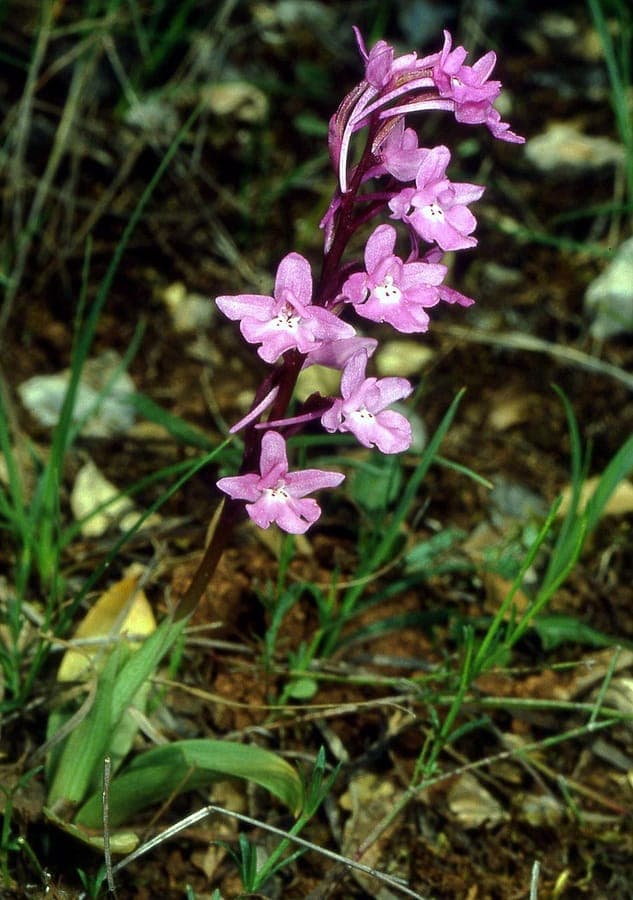
Orchi / CC BY-SA 3.0, via Wikimedia Commons
Orchis quadripunctata: complete guide
Orchis quadripunctata
Want to see Orchis quadripunctata: complete guide in your garden?
1 minute, no credit card
Overview
Orchis quadripunctata, also known as Four-spotted orchis or Four-spotted orchid, is a fascinating wild orchid from the Orchidaceae family. This plant occurs naturally in the eastern Mediterranean region, particularly in Greece, Italy, Turkey, and the Balkans. This orchid is renowned for its characteristic purple flowers marked with four dark purple spots on the lip (labellum). In gardens in the Netherlands and Belgium, this plant can be cultivated with care and effort in suitable microhabitats.
Appearance and Bloom
Orchis quadripunctata is a relatively small orchid that typically grows 15 to 40 centimeters tall. The plant produces two underground tubers located beneath the soil. The leaves are narrow, pointed, and dark green, mostly grouped in the lower half of the stem.
The flowers are the true beauty of this plant. They appear in dense, pyramid-shaped flower spikes from April to May. Each bloom is purple to purplish and bears the characteristic four dark purple spots on the pale lip. The flowers have a soft fragrance. This orchid is a delicate grower due to its preference for specific soil types and careful horticultural practices.
Ideal Location
Orchis quadripunctata thrives best in partial shade with some direct sunlight (3 to 4 hours daily). The plant dislikes full sun, especially in hot, dry environments. Places beneath the canopy of deciduous trees or against north-facing facades work well.
The plant prefers slightly moister soil than many Mediterranean plants. A location with adequate moisture during spring and early summer months is ideal. Avoid very dry spots. The plant fits well in shade gardens or beneath partial shade of deciduous trees.
Soil
Orchis quadripunctata demands very specific soil requirements. The plant thrives best on slightly moist, nutrient-rich woodland soil with abundant organic matter and a moderately acidic to neutral pH. This orchid performs poorly on very dry sandy soils or heavy clay soils without substantial amendment.
The presence of mycorrhizal fungi is essential for this orchid's success. Mix the soil beforehand with leaf mold, finely composted material, or sheep manure to establish proper mycorrhizal associations. The plant requires good soil support.
Free design
Want to see Orchis quadripunctata: complete guide in your garden? Make a free design now.
Watering
Orchis quadripunctata requires moderately moist soil during the growing season from October to June. The plant dormantly rests after blooming and requires less water during summer dormancy (July to September). During that period, soil should be somewhat drier.
During winter months when tubers rest underground, water only very cautiously. Adjust watering according to conditions: more in wet springs, less in dry winters. Waterlogging must be absolutely avoided.
Pruning
Orchis quadripunctata requires virtually no pruning work. When flowers fade, you can carefully cut off the flower stem to conserve energy for tuber development. The leaves should remain until autumn so they can channel energy into the underground tubers.
Remove only truly dead leaves and stems.
Maintenance Calendar
- October to February: Tubers develop underground. Minimal care needed.
- March to May: Growth and blooming. Plant needs adequate moisture.
- June to August: Tubers ripen. Soil dries out.
- September: Preparation for dormancy period. Some moisture still needed.
Winter Hardiness
Orchis quadripunctata is fully winter-hardy in Dutch and Belgian climates. The tubers can easily endure very cold winters of -15 to -20 degrees Celsius. Protective measures are only necessary in extreme winters or in very exposed locations.
During the growing season, late frosts can cause damage. Plant in locations somewhat protected against unexpected frost in May.
Companion Plants
You can combine Orchis quadripunctata with other small wild orchids and woodland plants:
- Ophrys species (bee orchids)
- Dactylorhiza (marsh orchids)
- Helleborus (Christmas rose)
- Anemone blanda (blue anemone)
Conclusion
Orchis quadripunctata is a beautiful, delicate wild orchid that can be successfully cultivated under suitable conditions. Although this plant is protected in many European regions and cannot be collected from the wild, cultivated specimens can sometimes be obtained from specialized orchid nurseries. For your front garden where you wish to grow this plant, it is essential to create a moist, woodland-like environment. For more inspiration in the field of wild and natural gardens, visit gardenworld.app, where you can have personal garden designs created. On gardenworld.app, you will also find advice for creating nature-oriented garden designs.
Want to see Orchis quadripunctata: complete guide in your garden? Make a free design now.
Upload a photo, pick a style, and get a photorealistic design with plant list in under a minute.
No credit card required


Similar plants
Ram's-head lady's slipper: complete guide
Cypripedium arietinum
Everything you need to know about growing Cypripedium arietinum, a rare woodland orchid for cool, moist garden settings. Soil, care and planting tips.
Sparrow's-egg lady's slipper: complete guide
Cypripedium passerinum
Everything about growing Cypripedium passerinum, a cold-hardy subarctic orchid suited to cool, moist, shaded garden spots. Soil, care and companion plants.
Algerian Butterfly-orchid: complete guide
Platanthera algeriensis
Everything about Platanthera algeriensis, the rare Mediterranean orchid with greenish flowers native to Algeria, Morocco, Corsica and Spain.