
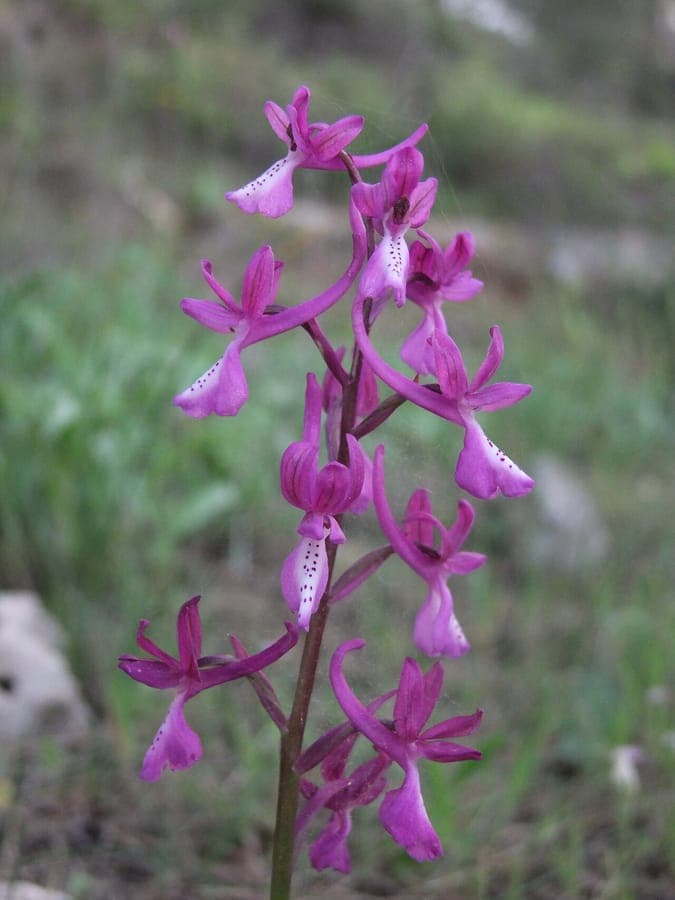
דרור פייטלסון / CC BY 2.5, via Wikimedia Commons
Orchis anatolica: complete guide
Orchis anatolica
Want to see Orchis anatolica: complete guide in your garden?
1 minute, no credit card
Overview
Orchis anatolica is a beautiful wild orchid native to Southeast Europe, particularly the Anatolian region of modern-day Turkey. This elegant plant belongs to the Orchidaceae family and grows naturally in grasslands and dry mountainous areas. In the modern garden, this orchid deserves more attention for its robustness and captivating pink-purple flowers.
As a wild plant, Orchis anatolica is highly suitable for natural gardens, wildflower borders and meadows. The plant is winter-hardy throughout most of Europe and requires minimal maintenance once established. This makes it an ideal choice for gardeners interested in native or Mediterranean flora.
Appearance and blooming
Orchis anatolica grows as a compact plant reaching 20-40 centimeters in height. The leaves are elongated and green, typically 5-8 leaves per plant, arranged in a rosette pattern along the stem.
Flowers appear in April to May and are very striking. They are colored in pink to purple-pink tones with irregular, intricate flower morphology characteristic of the genus Orchis. Each flower is approximately 1 centimeter in size and arranged in a dense spike at the top of the plant.
After blooming, small seed pods form that ripen in summer. The plant disappears underground and rests for winter in July-August.
Ideal location
Orchis anatolica grows best in full sun to part-shade locations. Minimum 4-6 hours of direct sunlight daily is ideal, but can also thrive in lighter shade. The plant tolerates windy conditions well.
Choose an open spot in a lawn or in dry borders where the plant can bloom in spring before other plants have fully developed. A spot against a warm wall or in a largely exposed sunny garden is fine, provided drainage is good.
Avoid wet, shady spots or places under leafy shrubs where the plant won't receive adequate spring sunlight.
Soil
Orchis anatolica is very undemanding with soil type and grows in virtually all soils as long as drainage is good. The plant flourishes in poor, sandy or chalky soils and actually performs better in less fertile grounds than in very nutrient-rich garden soils.
A pH between 6.5 and 8.0 is acceptable. In very heavy clay soils, adding sand, gravel or compost can be beneficial to improve drainage. The plant cannot tolerate stagnant water conditions and will rot in permanently wet soils.
Mulching is not necessary and can actually be harmful, as the plant prefers dry conditions after the growing season.
Watering
Orchis anatolica has very limited water requirements once established. Actually, water is only needed in exceptionally dry spring periods when shoots are growing rapidly. After blooming and in summer - no supplemental water is needed.
In the first year after planting: occasional water during dry periods helps with root establishment. Once the plant has established itself (after 1-2 seasons), water only in extreme dry periods.
Winter watering must absolutely be avoided - the resting tubers should remain dry. Excessive water can cause tuber rot and plant death.
Free design
Want to see Orchis anatolica: complete guide in your garden? Make a free design now.
Maintenance and care
Orchis anatolica requires very minimal maintenance. After blooming, when the foliage dies back in summer, simply leave it. No pruning or removal of dead material is needed.
If planting as naturalization in meadows, allow grass to grow as desired, but mowing is not needed until June-July after the seed has ripened. This supports natural spread.
Remove weeds in the first year around new plantings, but once established you don't need to do much to the plant.
Winter hardiness
Orchis anatolica is very winter-hardy to about -15 degrees Celsius. The tubers can overwinter underground without problems throughout most of Europe including the Netherlands, Belgium and northern France.
The underground resting tubers can even survive extreme winters. In very severe, prolonged winters, winter mulch around plant locations can help, but is not essential. Avoid blankets or protection that traps moisture, as this promotes rot.
Companion plants
Orchis anatolica forms beautiful combinations in wildflower borders with other spring-blooming plants. Combine with wild tulips, anemones, fritillaria and other small spring-flowering bulbs.
In meadows, plant together with other wild grasses and flowering herbs. Scabiosa, field scabious, wild marjoram and other Mediterranean herbs work well. After Orchis blooming, the soil space can be taken over by summer bloomers.
Avoid strong competition with large-growing plants that cast shade in spring.
Botanical background
The plant belongs to the genus Orchis, a large group of wild orchids spread throughout Europe and the Mediterranean. The species anatolica is named after Anatolia, the traditional name for the region in modern Turkey where it occurs.
Data suggests that different populations may show slightly variable flower colors, ranging from pink to purple. This is completely normal variation.
Propagation
Orchis anatolica propagation is primarily by seed. The seeds are extremely small and depend on mycorrhiza fungi (soil fungi) for germination success. Home seed propagation is difficult and usually unsuccessful without specialized techniques.
Easiest is to purchase young plant specimens from nurseries and plant them. Once established, the plant will usually propagate itself from seed fall in suitable garden conditions.
Conclusion
Orchis anatolica is a delight for wild orchid and Mediterranean plant enthusiasts. Its robustness, winter hardiness and captivating flowers make it a worthwhile addition to gardens in temperate climates. For designing wildflower borders and natural meadows, visit gardenworld.app for expert advice on your specific garden situation. Gardenworld.app also offers ideas for creating engaging natural garden landscapes full of charm and ecological value.
Want to see Orchis anatolica: complete guide in your garden? Make a free design now.
Upload a photo, pick a style, and get a photorealistic design with plant list in under a minute.
No credit card required


Similar plants
Ram's-head lady's slipper: complete guide
Cypripedium arietinum
Everything you need to know about growing Cypripedium arietinum, a rare woodland orchid for cool, moist garden settings. Soil, care and planting tips.
Sparrow's-egg lady's slipper: complete guide
Cypripedium passerinum
Everything about growing Cypripedium passerinum, a cold-hardy subarctic orchid suited to cool, moist, shaded garden spots. Soil, care and companion plants.
Algerian Butterfly-orchid: complete guide
Platanthera algeriensis
Everything about Platanthera algeriensis, the rare Mediterranean orchid with greenish flowers native to Algeria, Morocco, Corsica and Spain.