
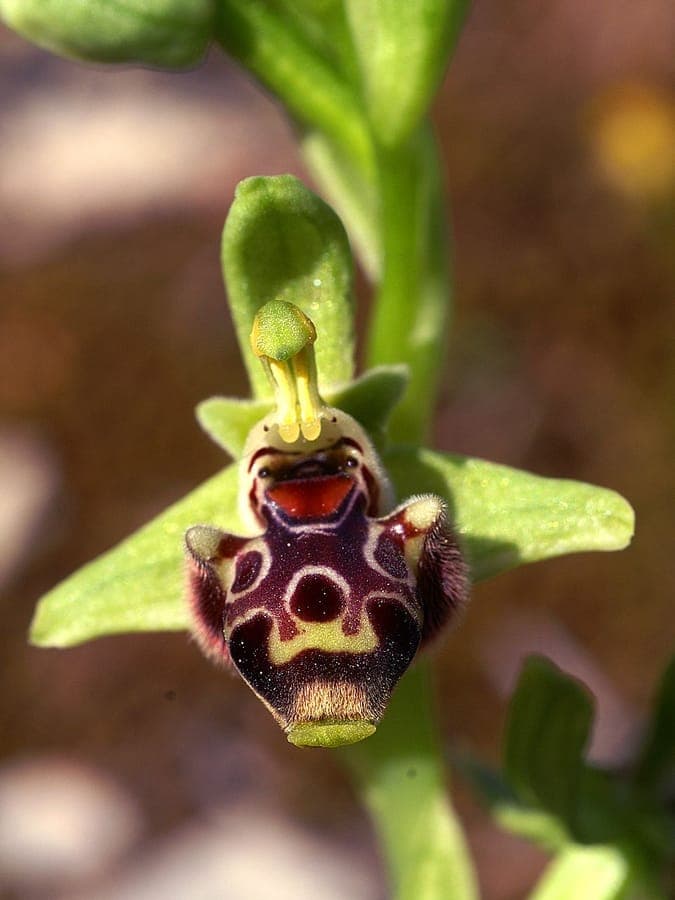
Orchi / CC BY-SA 3.0, via Wikimedia Commons
Nabel-Ragwurz: complete guide
Ophrys umbilicata
Want to see Nabel-Ragwurz: complete guide in your garden?
1 minute, no credit card
Nabel-Ragwurz: Complete Guide
The Nabel-Ragwurz (Ophrys umbilicata), also called Bumble Bee Orchid, is a fascinating member of the Orchidaceae family. This lime-loving terrestrial orchid grows naturally in southern Europe, Greece, Cyprus and Iran, where it has fully adapted to Mediterranean conditions. The plant is named after the characteristic navel-like structure on the flower's lip.
Appearance and Bloom
Flowers appear from March to April in dense spikes with typically 4 to 8 flowers per stem. Each bloom measures roughly 12 to 15 mm across. The sepals are green to yellow-green, while the petals are much smaller. The lower lip (labellum) is brown to dark purple with a characteristic glossy, velvety surface that attracts insects. The center of the lip often displays yellow or white markings resembling a nectar guide, luring bees and insects toward the pollen. This is nature's masterpiece of mimicry: the plant imitates the appearance of female bees to entice male bees into pollination. Plant height ranges from 15 to 30 cm, with 2 to 4 elliptical basal leaves that overwinter.
Ideal Location
Choose a position with full sun to partial shade. A minimum of 4 to 6 hours of direct sunlight daily is essential for optimal flowering. In hot Mediterranean regions, some midday shade benefits the plant. In temperate climates (northern Europe), full sun is mandatory. A south-east or south-west facing terrace or open border position is ideal. Avoid sheltered corners; light air movement helps prevent moisture condensation.
Soil
The Nabel-Ragwurz strongly prefers alkaline soil. Soil must be neutral to alkaline (pH 7.0 to 8.5). Heavy, compacted soil is disastrous; this plant demands excellent drainage. Amend the planting area with at least 30% limestone gravel or tufa (5 to 10 mm grain). Also add 20 to 30% leaf mould for structure. The mix must drain rapidly - water should not remain at the surface for more than a few hours. In pot culture, use a mix of coarse gravel, limestone chunks and minimal humus (1:1:1 by volume). Well-draining terracotta pots (at least 10 cm deep) are suitable.
Watering
Tolerate long dry periods willingly. During the growing period (October to May), water only when soil feels dry 2 cm down. This typically means once weekly to every ten days. Summer dormancy (June to September): virtually no water. The goal is an artificial dry period after flowering, just as in the wild habitat where summer rains are rare. Rainwater is preferred over tap water due to lower salt concentration. Avoid waterlogging absolutely: roots rot quickly in wet conditions.
Free design
Want to see Nabel-Ragwurz: complete guide in your garden? Make a free design now.
Pruning
Minimal work required. Remove dead flower stems after blooming (mid-May to June). Cut stems back to 2 to 3 cm above ground. Dead leaves are gently removed. No hard pruning: this is not a plant for strict shaping. Leave basal leaves to overwinter unless they clearly rot.
Maintenance Calendar
October: Season start. Check drainage and pH. Repot if needed (once per three years). Begin moderate watering when buds appear.
November-December: Water cautiously. Minimal feeding (no fertilizer needed). Check for fungal issues in wet periods.
January-February: Blooming period begins. Maintain water, no misting on flowers.
March-April: Peak flowering. No fertilizer, normal watering.
May: Flowering ends. Remove dead stems. Begin reducing water slightly.
June-August: Complete rest. No water, full sun. This period is critical for next year's flower formation.
September: Very light watering, begin regrowth.
Winter Hardiness
Ophrys umbilicata is hardy to USDA zone 8 (down to -10 to -5 degrees Celsius). In the Netherlands, Belgium and northern France (zones 8-9), it can remain outdoors with protection. Spread 5 to 8 cm of mulch (limestone gravel, not peat) after the first frost (October-November) to insulate roots. In southern regions (zone 9-10, for instance southern France), outdoor overwintering is more reliable. North of zone 8: treat as a potted plant in a greenhouse or cool frame (minimum 5 to 8 degrees Celsius at night).
Companion Plants
Combine with other Mediterranean lime-loving ground covers: Anthericum liliastrum (St Bernard's lily), Arabis caucasica (rockfoil), Helianthemum (sun roses). In rock gardens: Festuca, Sedum tectorum, small Jovibarba. Avoid moisture-loving grasses and nutrient-hungry plants like Sedum spectabile or Geranium. They compete for nutrition and space.
Conclusion
The Nabel-Ragwurz is no routine plant, but for orchid lovers and admirers of unique Mediterranean flora, an extraordinary treasure. Its rarity in cultivation and refined flower displays make it a collector's plant. Take time with good drainage and gentle summer dormancy: these two elements determine success. The rewards are large, characterful blooms and years of repeated flowering. With proper care, an established plant can last two to three decades.
Availability: Very limited. Specialized orchid growers in the Netherlands (Intratuin specialist departments) and Belgium occasionally stock seedlings. Germany: OBI garden centers rarely stock exotic orchids, but Hornbach in university towns may assist. France: Jardiland typically does not stock this rarity. Purchase online from recognized orchid breeders.
Want to see Nabel-Ragwurz: complete guide in your garden? Make a free design now.
Upload a photo, pick a style, and get a photorealistic design with plant list in under a minute.
No credit card required


Similar plants
Ram's-head lady's slipper: complete guide
Cypripedium arietinum
Everything you need to know about growing Cypripedium arietinum, a rare woodland orchid for cool, moist garden settings. Soil, care and planting tips.
Sparrow's-egg lady's slipper: complete guide
Cypripedium passerinum
Everything about growing Cypripedium passerinum, a cold-hardy subarctic orchid suited to cool, moist, shaded garden spots. Soil, care and companion plants.
Algerian Butterfly-orchid: complete guide
Platanthera algeriensis
Everything about Platanthera algeriensis, the rare Mediterranean orchid with greenish flowers native to Algeria, Morocco, Corsica and Spain.