
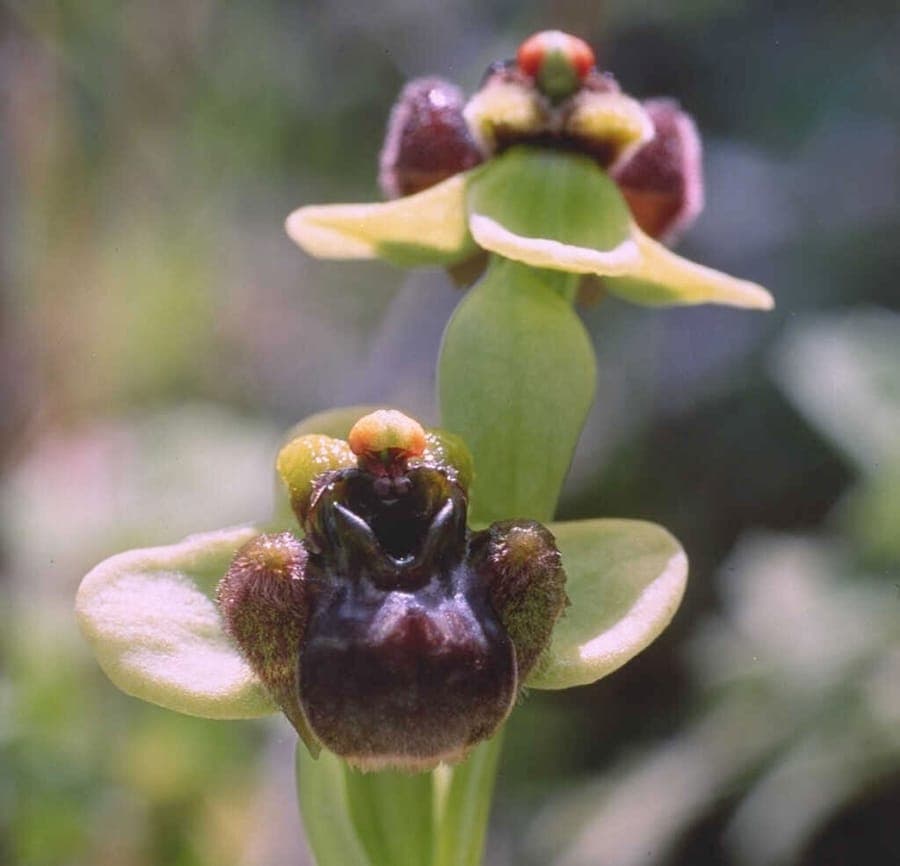
Gunnar Norman / CC BY-SA 3.0, via Wikimedia Commons
Bumblebee orchid: complete guide
Ophrys bombyliflora
Want to see Bumblebee orchid: complete guide in your garden?
1 minute, no credit card
Overview
The bumblebee orchid (Ophrys bombyliflora), also called bombylio-orchid or bee-like orchid, is one of the most fascinating and rare orchids from the Mediterranean region. This Orchidaceae family plant is famous for its flowers that remarkably resemble bees or other insects - a sophisticated form of insect mimicry the plant uses for pollination. With its delicate, brownish-red flowers with yellow accents, this plant creates a bewitching effect in all Mediterranean gardens.
The plant is native to southeastern Spain, the Balearic Islands, Corsica, Sardinia, Sicily, southern Italy, Greece and the Aegean islands. The bumblebee orchid grows in dry meadows and herbland and blooms in March and April, precisely when male bees are active and pollinate the plant through sexual deception.
Appearance & bloom
The bumblebee orchid forms a small cluster of grass-like, linear leaves at the plant's base. The leaves grow in a rosette and reach approximately 10-15 centimeters length. The flowering stem emerges above and reaches 15-30 centimeters height.
The flowers are the true marvel of this plant. Each flower remarkably resembles a female bee or bumblebee. The flower consists of two upward-pointing sepals (upper petals) that are yellow and two narrow, brownish petals. The labellum (lower lip) is large, dark brown to reddish-brown, with a characteristic glossy, hairless surface resembling bee body texture. The labellum often features yellow or white markings and a central groove.
The flower's scent is very important - it produces chemical pheromones that imitate the sexual scent of female bees. This attracts male bees that attempt to copulate with the flower, resulting in pollination. This phenomenon is known as "pseudocopulation".
The plant blooms from March through April in southern Europe. In cooler areas this may extend to May. Each plant can produce 2 to 8 flowers per season.
Ideal location
The bumblebee orchid grows in open, sunny meadows and mountain slopes. Plant in sunny, sheltered locations with at least six hours direct daily sunlight. The plant feels at home in meadows where grasses and herbs grow naturally, not in intensively managed garden borders.
The plant grows on calcareous, dry soil. Ensure the plant drains well and does not grow in marsh conditions. Alpine meadows and hilly grasslands are ideal growing habitats.
Avoid dark, shady locations. The plant needs full sun for good flowering.
Soil
The bumblebee orchid grows in calcareous, dry soils with pH between 7.0 and 8.0. The plant tolerates nutrient-poor soil well and actually grows better in nutrient-sparse conditions. Heavy clay or loam soils with good drainage are ideal.
The plant has a mutualistic relationship with certain fungal species (mycorrhizae) that are essential for growth. This makes the plant difficult in cultivation - you cannot simply place seeds in potting soil and grow successfully. The plant requires the presence of the right fungal partner in the soil.
It is better to let the plant grow in its natural habitat than attempt cultivation in gardens.
Free design
Want to see Bumblebee orchid: complete guide in your garden? Make a free design now.
Watering
The bumblebee orchid requires moderate moisture during the growing season (October-April) and dry conditions during rest (May-September). In the wild the plant grows in regions with winter rainfall and severe summer drought.
In cultivation provide moderate water in winter and fall when new growth appears. Reduce water in spring and nearly stop in summer as leaves die back naturally. This imitates the plant's natural growth pattern.
Excessive water is harmful and leads to fungal infection and rot.
Pruning
The bumblebee orchid requires no pruning. Let the plant follow its natural growth pattern.
After flowering the leaves die back naturally. This is normal and does not require intervention. The plant rests in summer.
Maintenance calendar
October: Plant begins emerging from dormancy. August provides slight water. November-December: Growth accelerates. Regular water. January-February: Preparation for blooming. Continuous water. March-April: Flowering period. Enjoy unique insect-like flowers. May: Flowering ends. Water gradually decreases. June-September: Complete dormancy. Minimal watering.
Winter hardiness
The bumblebee orchid is hardy in USDA zones 7 through 10. In cold regions (zone 6 and colder), this plant must overwinter indoors in pots. The plant grows well in cool temperate climates.
The plant can overwinter outdoors in regions where temperatures do not drop below minus 5 degrees Celsius.
Companion plants
The bumblebee orchid naturally grows in mixed grassland and alpine meadows. Plant this orchid with drought-tolerant grasses, herbland flowers and other Mediterranean flora. Avoid planting fast-growing plants directly beside this orchid, as they may overgrow it.
The plant is sufficiently important in itself - no companion or contrast needed. Let it grow in its own space.
Closing
The bumblebee orchid is an exceptionally rare plant for gardeners inspired by nature's ingenious pollination systems. This plant symbolizes the incredible co-evolution between plant and insect. Although difficult to grow, the plant offers a fascinating glimpse into the natural world.
You can find this orchid through specialized orchid dealers or in botanical gardens in southern Europe. Unfortunately the plant is strictly protected in many areas and cannot be collected from nature. Many countries have strict export restrictions. Purchase only from legal, certified grower sources. Visit gardenworld.app for more information on Mediterranean orchids and natural garden design.
Want to see Bumblebee orchid: complete guide in your garden? Make a free design now.
Upload a photo, pick a style, and get a photorealistic design with plant list in under a minute.
No credit card required


Similar plants
Ram's-head lady's slipper: complete guide
Cypripedium arietinum
Everything you need to know about growing Cypripedium arietinum, a rare woodland orchid for cool, moist garden settings. Soil, care and planting tips.
Sparrow's-egg lady's slipper: complete guide
Cypripedium passerinum
Everything about growing Cypripedium passerinum, a cold-hardy subarctic orchid suited to cool, moist, shaded garden spots. Soil, care and companion plants.
Algerian Butterfly-orchid: complete guide
Platanthera algeriensis
Everything about Platanthera algeriensis, the rare Mediterranean orchid with greenish flowers native to Algeria, Morocco, Corsica and Spain.