
Anton Hartinger / Public domain, via Wikimedia Commons
Round-leaved restharrow: complete guide
Ononis rotundifolia
Want to see Round-leaved restharrow: complete guide in your garden?
1 minute, no credit card
Overview
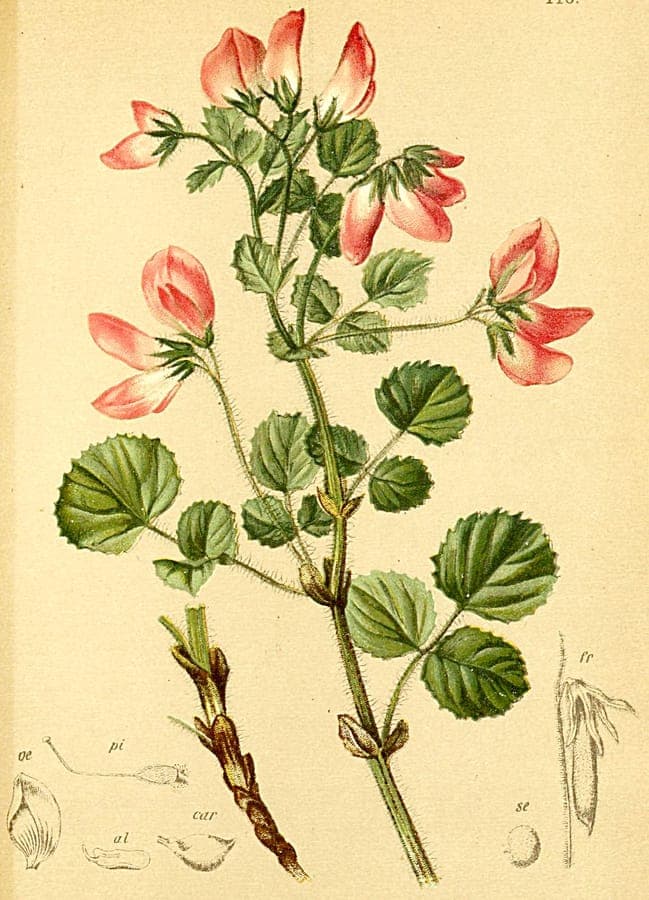
The Round-leaved Restharrow, scientifically known as Ononis rotundifolia, is a compact alpine plant native to the mountains of southern Europe. This species is recognized for its deep purple flowers and adapted growth habit, making it perfect for alpine gardens and rocky sites. In the wild, this plant grows on mountain meadows and rocky slopes at elevations between 800 and 2500 meters.
Appearance and bloom
The Round-leaved Restharrow grows to approximately 30 to 50 centimeters, forming compact, upright bushy shrubs. The leaves are rounded to oval, dark green, and hairy, giving it interesting texture. From May to August, the plant produces numerous deep purple to pink flowers appearing in small clusters along the stems. The flowers are papilionaceous with distinctive form. After flowering, small seed pods develop.
Ideal location
The Round-leaved Restharrow thrives in full sun with at least 6 to 8 hours of direct sunlight daily. Plant in alpine gardens, rock gardens, or border fronts where good drainage is essential. Protection from intense midday sun in very hot climates can prevent scorching. Preference for higher locations with good air circulation.
Soil
This plant requires well-drained, not overly fertile soil with a pH between 6.5 and 8.0. Loose, stony soils are ideal as naturally found in alpine regions. The Round-leaved Restharrow tolerates dry conditions well once established. Preference for nutrient-poor soils offers better flowering than very fertile soils.
Free design
Want to see Round-leaved restharrow: complete guide in your garden? Make a free design now.
Watering
Once established, the Round-leaved Restharrow is very drought tolerant. During the first season, keep moderately moist until a deep root system becomes established. In established plants, regular watering is not needed except during extreme drought conditions. Over-watering must be absolutely avoided.
Pruning
Minimal pruning is needed. In late winter, dead branches and faded flowers can be gently removed. The plant can be lightly trimmed after flowering to promote more compact growth. Very heavy pruning must be avoided as it can disrupt the plant's overall shape.
Maintenance calendar
March-April: Inspect plant for winter damage; no feeding needed. May-July: Keep moderately moist during blooming. August: Minimize feeding after blooming. September-October: Prepare for winter with slight water reduction. November-February: Rest period with minimal care.
Winter hardiness
The Round-leaved Restharrow is hardy to -20C and blooms in zones 5-8. This is a very hardy plant resistant to severe mountain winters. No special winter protection needed in most climates. In extremely wet winters, drainage system inspection may be necessary.
Companion plants
The Round-leaved Restharrow combines well with other alpine plants such as thyme, stonecrop, and alpine asters. Associate with small growing conifers and rocks for structure. Also suitable for garden rockeries with other mountain plants. In pots, combine with other succulents.
Closing remarks
The Round-leaved Restharrow is a robust, reliable alpine plant that can provide years of enjoyment. With minimal maintenance and correct drainage, this plant grows successfully in various climates. Perfect for gardeners seeking easy, reliable alpine plants. Visit gardenworld.app/nl and gardenworld.app/en for more garden inspiration.
Want to see Round-leaved restharrow: complete guide in your garden? Make a free design now.
Upload a photo, pick a style, and get a photorealistic design with plant list in under a minute.
No credit card required


Similar plants
Tall Silky Lupine: complete guide
Lupinus elatus
Tall silky lupine is a fast-growing Californian perennial with silvery foliage and blue-purple flower spikes, ideal for a prairie-style garden.
Garfield Lupine: complete guide
Lupinus garfieldensis
The Garfield lupine is a rare, fast-growing American perennial for alkaline, dry grassland gardens, with striking blue flower spikes.
Lupinus elegans: complete guide
Lupinus elegans
Lupinus elegans, the elegant lupine, is a spectacular blooming plant from Mexico with blue flower spikes. Care, cultivation and garden use.