
Mason Brock (Masebrock) / Public domain, via Wikimedia Commons
Bigfruit evening primrose: complete guide
Oenothera macrocarpa
Want to see Bigfruit evening primrose: complete guide in your garden?
1 minute, no credit card
Overview
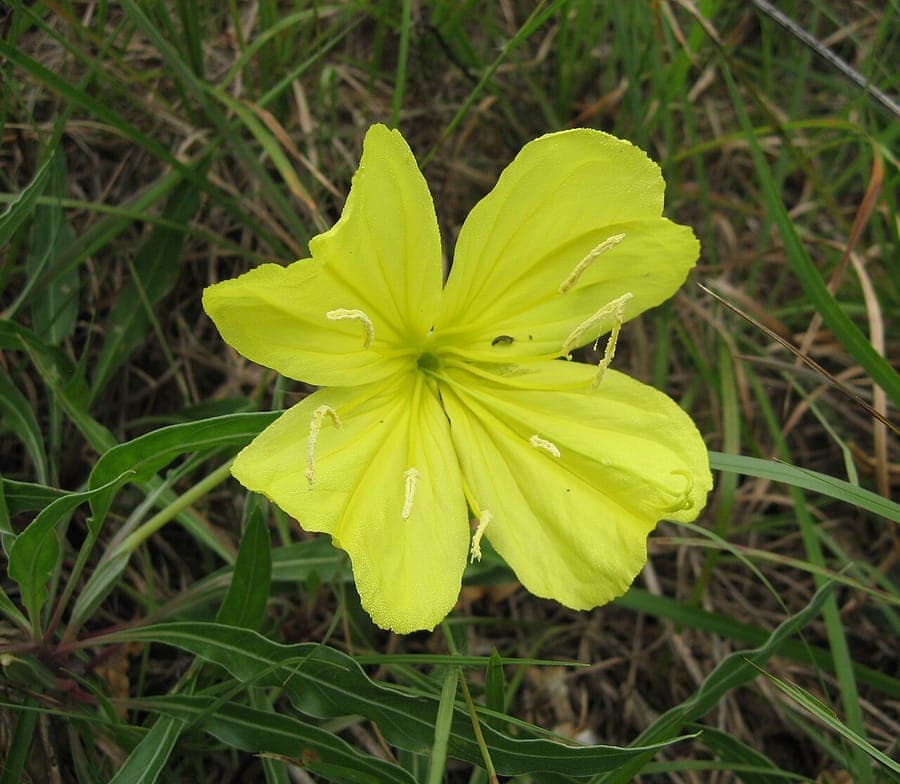
Bigfruit evening primrose, botanically known as Oenothera macrocarpa, is a low-growing herbaceous plant from the Onagraceae family, native to the American Midwest states of Missouri, Kansas, and Oklahoma extending to Mexico. This plant is celebrated for its large, vibrant yellow flowers that open in evening hours and emit subtle fragrance. For gardeners seeking a plant offering extended summer bloom with minimal maintenance, Oenothera macrocarpa is a perfect choice.
This plant is highly drought-tolerant and xeric-suitable, making it ideal for hot, dry gardens, rock gardens, and gravel areas. On gardenworld.app, you can integrate this cheerful blooming plant into modern, low-maintenance gardens.
Appearance & Bloom
Bigfruit evening primrose typically grows 20 to 30 cm tall with a spread of 30 to 50 cm, creating a compact, low-growing form. The plant forms a tough clump of slender, linear foliage that is gray-green to dark green. During summer (May to September), large, golden-yellow flowers appear on long stems. The flowers can reach 5-6 cm in diameter and are very showy. They typically open in evening and close in morning, though in sunlight they remain open.
The blooming is abundant and lasts many months. After blooming, large seed capsules develop (hence the name 'macrocarpa'), adding interesting structure. The foliage remains green through winter, providing winter interest.
Ideal Location: Full Sun
Bigfruit evening primrose thrives best in full sun, requiring a minimum of 6-8 hours of direct sunlight daily. In shade, the plant blooms far less and will become leggy. This is a plant for sunny, hot spots. Ensure an open, unshaded location. South-facing or west-facing locations are ideal.
The plant also thrives on hot, dry slopes and other challenging, hot microclimates.
Soil & Drainage Requirements
Bigfruit evening primrose prefers very well-draining, dry to moderately moist conditions. Heavy clay or constantly wet soils must be absolutely avoided. Sandy or gravel-based soils are ideal. Add sand to heavier soils to improve drainage.
The plant tolerates various pH values (slightly acidic to neutral). Minimal nutrition is desired; nutrient-rich soils lead to lush growth at the expense of flowers. Lean soils are fine.
Free design
Want to see Bigfruit evening primrose: complete guide in your garden? Make a free design now.
Watering: Very Sparing
Once established, Bigfruit evening primrose is extremely drought-tolerant and requires minimal watering. Water only during exceptionally dry periods (months without rain). The plant will decline in very wet summers. In container culture, water moderately, only when the mix becomes completely dry.
Excessive water can lead to root rot; this is the primary cause of failure with this plant.
Maintenance & Pruning
Bigfruit evening primrose requires minimal pruning. Deadheading can be done if desired, but best practice is to allow seed setting. Remove dead or damaged stems in late winter. The plant will self-seed.
In late winter (March), cut back yellowed, dead growth. This helps keep the plant compact.
Maintenance Calendar
- January - March: Remove dead growth in March. Plant begins emerging.
- April - May: First flowers appear. No water needed unless extremely dry.
- June - August: Peak of bloom. Regularly enjoy yellow flowers. No water needed.
- September - October: Blooming continues. Seed capsules create interest.
- November - December: Plant goes to rest. No care needed.
Winter Hardiness
Bigfruit evening primrose is winter hardy to USDA zone 4-5, with temperatures down to approximately -25 to -30 degrees Celsius. In temperate regions, it can overwinter outdoors in most areas provided good drainage. The plant is unproblematic in wet winters if drainage is adequate.
Propagation
The plant self-seeds and forms new plants along margins. This is usually desirable, as it creates cozy clusters. You can also harvest seed from seed capsules.
Companion Plants
Bigfruit evening primrose combines beautifully with:
- Phlox subulata: Pink-red with low-growing form.
- Nepeta: Lavender-blue.
- Sedum: Yellow-green or purple foliage.
- Santolina: Gray foliage with yellow.
- Lavandula: Purple lavender.
Available at garden centres.
Conclusion
Bigfruit evening primrose is a cheerful, highly maintenance-friendly plant for hot, dry gardens. Its large yellow flowers bring much joy throughout the long summer. For those wanting a low-maintenance garden with plenty of color, this is a perfect choice.
Want to see Bigfruit evening primrose: complete guide in your garden? Make a free design now.
Upload a photo, pick a style, and get a photorealistic design with plant list in under a minute.
No credit card required


Similar plants
Shortfruit evening primrose: complete guide
Oenothera brachycarpa
Everything about Oenothera brachycarpa - the shortfruit evening primrose from the American Southwest. Growing tips, placement and care for your garden.
Sundrops (Oenothera tetragona): complete guide
Oenothera tetragona
Everything about Oenothera tetragona - the cheerful daytime-blooming sundrops perennial. Growing tips, placement, pruning and care for a long summer display.
Seabeach evening primrose: complete guide
Oenothera humifusa
Full guide to Oenothera humifusa, the seabeach evening primrose native to the US Atlantic coast. Yellow blooms, silvery foliage, drought-tolerant.