
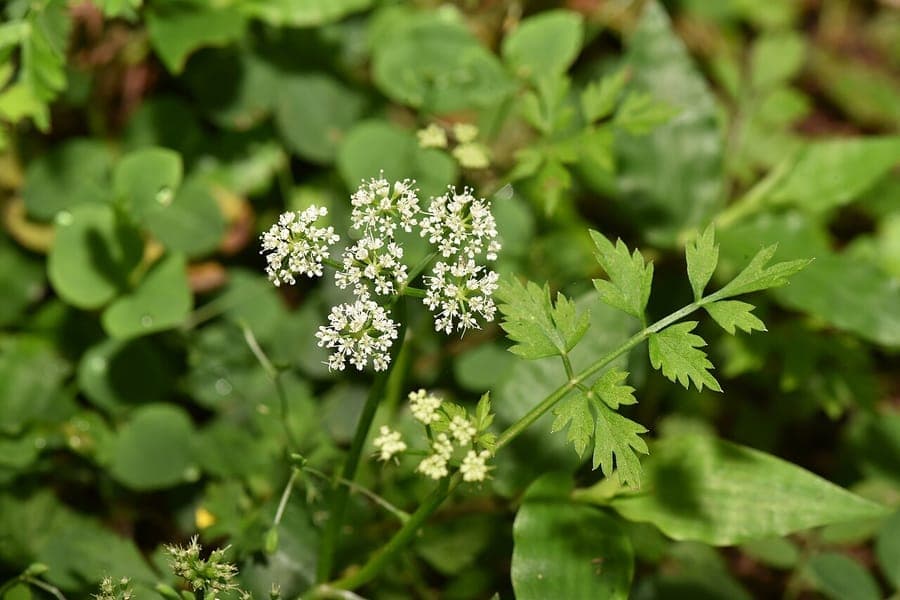
Yung-Lun Lin / CC BY 4.0, via Wikimedia Commons
Oenanthe javanica: complete guide
Oenanthe javanica
Want to see Oenanthe javanica: complete guide in your garden?
1 minute, no credit card
Overview
Oenanthe javanica, commonly called Chinese-celery, Java water-dropwort, or Minari in Korean, is a fascinating semi-aquatic plant belonging to the Apiaceae family (same family as cumin and parsley). This species grows naturally from Southeast Siberia through tropical and subtropical Asia. Today it has invaded parts of Europe and America, establishing naturally in moist habitats.
Like many Asian plants, Oenanthe javanica combines culinary value with decorative forms. On gardenworld.app, gardeners can integrate this plant into water features and moist gardens, not merely for beauty but also as a food crop. This makes it unusual among traditional ornamental plants.
Appearance and growth
Oenanthe javanica grows as a creeping, stoloniferous plant rapidly spreading over moist soil or water surfaces. Leaves are fine, feathery, light green and resemble parsley or dill, though thicker and fuller. Leaf stems are round and smooth.
The plant typically reaches 30 to 60 centimeters in height if grown vertically, but can sprawl much wider if trained horizontally across water. In summer to autumn, small white or pale pink flowers appear in modest umbels (umbrella-shaped flower clusters), attractive to pollinators.
The plant spreads both through seed formation and stolon fragmentation, making it highly reproductive and (in some regions) invasive. In garden situations, this must be carefully managed.
Ideal location
Oenanthe javanica thrives in locations with abundant sunlight (at least 6 hours daily) to light shade. In moist habitats or ponds, choose sunny positions for optimal growth. In normal garden terrain, plant in low areas where water collects or where artificial irrigation is feasible.
The plant tolerates stagnant water better than most other garden plants, making it valuable for moist spots where drainage is poor. This makes it invaluable for gardeners struggling with moisture problems.
Soil
Oenanthe javanica requires no traditional dry-soil preparation. In fact, it grows best in rich, moist soil or even completely submerged in water. If planted in normal garden soil, add copious compost and ensure soil remains moister than typical garden plants.
In pond use, plant in muddy sediment along banks or in shallow zones. The plant can also be grown in pots with water-filled bottoms. In aquaria or water basins, it grows on very fine silt or aquarium-grade gravel.
PH preference is between 6.5 and 7.5, neutral to slightly acidic. Nutrient-rich soil or water helps growth, so add organic material.
Free design
Want to see Oenanthe javanica: complete guide in your garden? Make a free design now.
Watering
Watering is practically non-applicable to Oenanthe javanica in the traditional sense. The plant thrives with excessive moisture rather than water-deficit. In moist gardens, regular watering or even light flooding is beneficial.
For non-aquatic growth in normal gardens, ensure soil never completely dries. Water daily during growing season, especially in warm months. If the plant appears wilted or leaves yellow, this signals water stress: water immediately.
In pond environments, natural rainwater supplementation and moisture retention through low placement suffices.
Pruning
Oenanthe javanica requires regular trimming to manage invasive growth. Cut top growth back to approximately 15 centimeters height whenever the plant becomes too dominant. This encourages bushier growth and prevents plant matter dominating the water feature.
In aquaria, frequent trimming is necessary; this plant grows very rapidly. Remove excessively long stems and seed-heads to control plant coverage.
When growing as a food crop, harvest young foliage for culinary use; this prevents flowering and encourages more leaf production.
Maintenance calendar
April-May: Start growing season. Regular watering. Initial trimming as needed.
June-August: Peak growth. Frequent trimming (possibly weekly). Flowers appear.
September-October: Growth slows as temperature drops. Reduce trimming.
November-March: Dormancy in temperate zones. Plant may die back in frost; manage water.
Winter hardiness
Oenanthe javanica is tender in temperate zones, cannot withstand winter frosts (below minus 10 degrees Celsius). In USDA zones 8-10 it can overwinter. In colder climates, grow as an annual or bring indoors in containers.
In subtropical and tropical climates it grows year-round.
Companion plants
Oenanthe javanica grows beautifully alongside other moisture-lovers:
- Mentha aquatica (Water mint) for similar growth preference
- Lysichiton americanus (Swamp Lantern) for larger foliage
- Acorus gramineus (Sweet flag) for vertical accent
- Pontederia cordata (Pickerel rush) for purple flowers
- Sagittaria (Arrowhead) for structural contrast
All these plants tolerate moist to aquatic conditions and combine well for varied texture and color.
Closing
Oenanthe javanica represents a unique combination of garden beauty and culinary value. This plant solves moisture problems in gardens while delivering edible leaves for Asian cuisine. With regular maintenance and trimming, it remains controlled and adds seasonal flowers. Begin integrating Oenanthe javanica into your moist garden spaces today on gardenworld.app and discover how this Asian jewel provides both beauty and nutrition.
Want to see Oenanthe javanica: complete guide in your garden? Make a free design now.
Upload a photo, pick a style, and get a photorealistic design with plant list in under a minute.
No credit card required


Similar plants
Whorled carrot: complete guide
Daucus involucratus
Daucus involucratus is a Mediterranean umbellifer with white flower heads framed by lacy bracts. Growing this gravel garden gem.
Daucus muricatus: complete guide
Daucus muricatus
Daucus muricatus, the spiny wild carrot, grows wild on Mediterranean coasts. Discover sowing, June-July bloom, and wildflower meadow use.
Daucus pumilus: complete guide
Daucus pumilus
Daucus pumilus is a dwarf wild carrot relative with white lacy umbels, thriving on dunes and coastal rock in poor, fast-draining soil.