
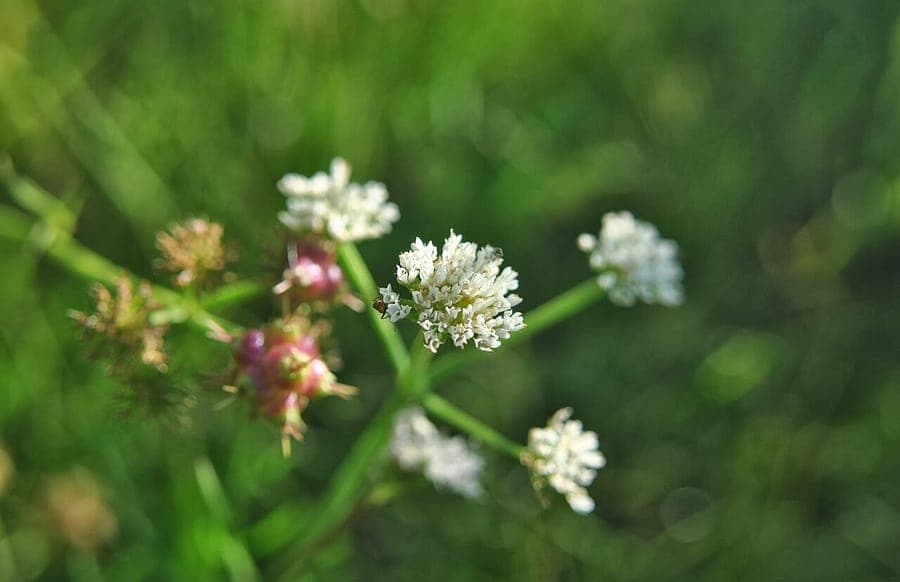
Andrés González / CC BY-SA 4.0, via Wikimedia Commons
Round-headed water-dropwort: complete guide
Oenanthe globulosa
Want to see Round-headed water-dropwort: complete guide in your garden?
1 minute, no credit card
Overview
The round-headed water-dropwort (Oenanthe globulosa) is a charming, delicate aquatic herb from the Apiaceae family, characterized by its fine feathery foliage and white globe-shaped flower clusters. Native to Mediterranean and southwest Turkish regions, this plant thrives in moisture-retaining soils and shallow water zones. With its airy foliage and elegant white blooms, this species adds delicate texture and movement to water gardens. The plant grows slowly but steadily, reaching mature size within two to three growing seasons.
This species is renowned as a classic margin and marsh plant, widely used in traditional Mediterranean gardens. The finely dissected, feathery leaves create an airy and refined appearance. White flowers in globular clusters appear in April and May, providing refreshing color after dark winter months.
Appearance & bloom
The round-headed water-dropwort features extremely fine, feathery dissected leaves arranged along slender stems. The leaves have a delicate, hair-like structure that allows light to pass through from all directions. Mature plants reach heights of 40 to 60 centimeters.
The flowers are remarkable and form dense, globe-shaped clusters approximately 2 to 3 centimeters in diameter. Individual florets are tiny and white with subtle fragrance. These flowers are highly attractive to honeybees and other pollinators. The flowering period extends from April through May in southern Europe and may reach June in more northern areas.
After flowering, the plant produces seed which propagates via natural seeding. These seeds disperse along waterlines and muddy soils, generating new plants the following season.
Ideal location
The round-headed water-dropwort thrives in locations with good sunlight to partial shade. Minimum four to six hours of daily sunlight is needed for optimal flowering. In southern regions, afternoon shade is actually beneficial during intense summer heat.
This plant prefers marshy conditions: growing spots with continuous moisture to moderate water coverage. Plant the water-dropwort at pond edges, in shallow marsh gardens or along waterways where water remains continuously present but not too deep. Ideal water depth is 5 to 20 centimeters, though the plant also grows well in purely wet soils without stagnant standing water.
The plant cannot tolerate dry conditions. Such stress inhibits growth and prevents flowering.
Soil
The round-headed water-dropwort requires highly moisture-retaining soils, preferably with high humus content. Marsh soil rich in organic matter is ideal. The plant loves heavy clay soils where water remains longer. A pH between 7.0 and 7.5 is optimal, though this plant also tolerates somewhat alkaline soils.
When planting, prepare a mixture of horticultural soil and peat moss in equal proportions. This ensures moisture retention and aeration. Ensure the base of the plant receives regular water, especially during growth months April through October.
In highly moisture-retaining soils, the plant grows faster. In more typical garden soils, growth slows and additional watering effort is required.
Free design
Want to see Round-headed water-dropwort: complete guide in your garden? Make a free design now.
Watering
The round-headed water-dropwort requires continuous moisture. This is a water-loving herb that needs regular water to function properly. During growth seasons (April through October), watering is needed at least two to three times weekly. Ensure the soil remains continuously moist but not stagnantly waterlogged.
In warmer weather, when evaporation increases, daily watering may be necessary. Check soil moisture regularly by inserting your fingers into the soil. If the soil feels dry, water immediately.
In winter, when the plant is dormant, watering can be reduced to once weekly, provided the soil never completely dries out.
Pruning
The round-headed water-dropwort requires minimal pruning. Simply remove wilted or damaged leaves and stems as they appear. This encourages the plant to grow more compactly.
At the end of the growing season (September-October), you can cut the entire plant back to approximately 15 centimeters height. This prevents the plant from becoming too coarse and tall. The plant will regrow vigorously the following spring.
Also remove flowering residues after blooming to help the plant store energy for the rest of the season.
Maintenance calendar
April: Plant begins new growth. Water regularly and add fertilizer. May: Flowering peak. Enjoy white globe-shaped flowers. June: Flowering ends. Remove wilted stems. July-September: Maintain continuous moisture. Check and water regularly. October: Prepare plant for dormancy. Cut back to 15 cm height. November-March: Plant rests. Minimal watering needed.
Winter hardiness
The round-headed water-dropwort is hardy in USDA zones 7 through 10. In cold regions (zone 6 and colder), frost damage may occur. In these areas, above-ground parts may die back, but the root systems usually survive underground and re-emerge in spring.
If you live in a cold zone, plant the water-dropwort in a protected corner of your garden, perhaps against a warm wall or in a sheltered marsh garden. Add a mulch layer of leaves or straw for extra insulation.
In milder regions, the plant may remain partially green through winter.
Companion plants
The round-headed water-dropwort combines beautifully with other marsh and aquatic herbs. Plant alongside slender grasses, reed mace, or other delicate water flora to create a natural wetland tableau. The white flowers contrast nicely with purple or yellow blooms of other marsh plants.
For pond edges, place the water-dropwort beside broader foliage of other marsh plants such as irises or sharp-edged sedges. This creates depth and structure. Avoid placing fast-growing plants directly beside the water-dropwort, as these may overshadow this delicate species.
Closing
The round-headed water-dropwort is an elegant choice for gardeners wishing to refine their marsh gardens or pond edges. With regular watering and basic care, this plant will contribute to the beauty of your water garden for years. Its fine texture and delicate flowers bring tranquility and natural beauty to any moist space. Find this aquatic herb at quality European garden centers. Learn more on gardenworld.app about designing water gardens with delicate aquatic plants.
Want to see Round-headed water-dropwort: complete guide in your garden? Make a free design now.
Upload a photo, pick a style, and get a photorealistic design with plant list in under a minute.
No credit card required


Similar plants
Whorled carrot: complete guide
Daucus involucratus
Daucus involucratus is a Mediterranean umbellifer with white flower heads framed by lacy bracts. Growing this gravel garden gem.
Daucus muricatus: complete guide
Daucus muricatus
Daucus muricatus, the spiny wild carrot, grows wild on Mediterranean coasts. Discover sowing, June-July bloom, and wildflower meadow use.
Daucus pumilus: complete guide
Daucus pumilus
Daucus pumilus is a dwarf wild carrot relative with white lacy umbels, thriving on dunes and coastal rock in poor, fast-draining soil.