
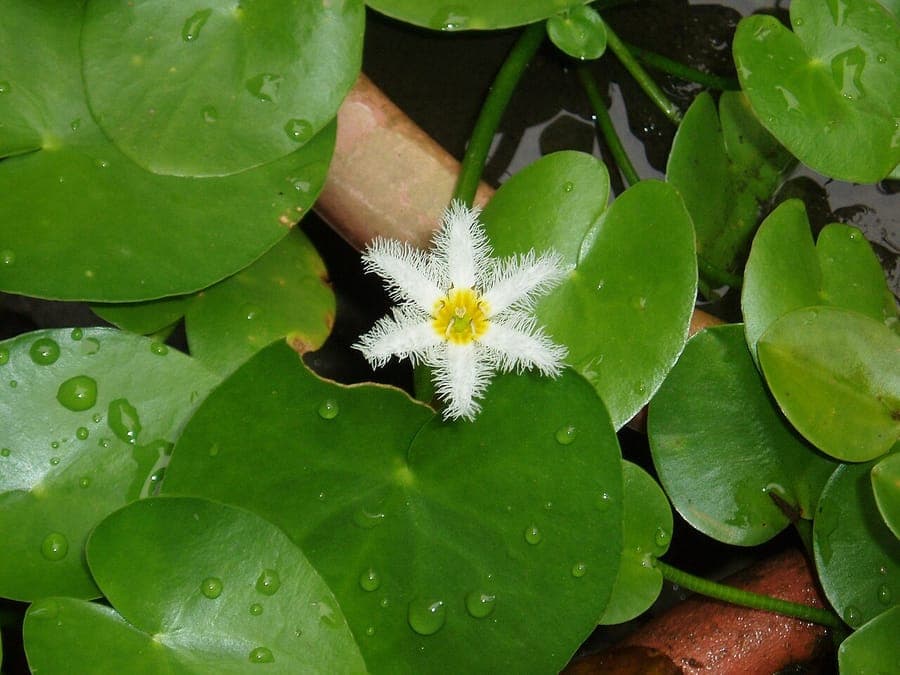
Edward Jaser / CC BY-SA 3.0, via Wikimedia Commons
Water-snowflake: complete guide
Nymphoides indica
Want to see Water-snowflake: complete guide in your garden?
1 minute, no credit card
Nymphoides indica, known as water-snowflake, robust marshwort, or banana-plant, is a fascinating floating aquatic plant from the Menyanthaceae family. This plant is native to tropical and subtropical Asia, with distribution from India and Assam through Australia and the Pacific. In its natural environment, it inhabits still freshwater and sometimes lightly brackish water, such as lakes, ponds, and backwaters where it thrives in warm, sunny climates.
Nymphoides indica is renowned for its yellow star-shaped flowers appearing above water surfaces, as well as its underground runners forming distinct spreading colonies. The plant grows as a floating species with submerged stems and suspended leaves, making it ideal for ponds, aquaria, and aquatic biotopes from temperate to warm environments. This is particularly valuable because it requires less warmth than many other tropical floating plants.
Appearance and bloom
Nymphoides indica grows as a submerged herb with submerged stems and floating leaves. The leaves are round to elliptical, typically 5-15 centimeters in diameter, with smooth edges. Each leaf has a characteristic darker line pattern with lighter green-red or purple tinting underneath, especially when young. Basal leaves are often purple or red-tinged.
Flowers are the most striking feature. This plant produces ten to twenty yellow flowers per flowering spot, each approximately 1-2 centimeters wide, with five petals. The flowers have characteristic wavy or frilly-edged petals and appear just above or on the water surface on stiff, short stalks. Blooming occurs throughout summer and autumn, typically opening in morning with afternoon closure.
Beneath floating leaves, submerged stem segments develop runners - horizontal stems with young plantlets at their ends. This reproduction system is highly efficient and can lead to rapid population growth.
Ideal location
Nymphoides indica grows best in warm, sunny aquatic environments. Minimum 4-5 hours direct sunlight daily is beneficial for blooming; however, the plant can sustain itself in partial shade. In very shaded conditions, it produces few flowers though leaf growth continues.
The plant appreciates still water and can sustain itself in slow-flowing water, though rapid current can lead to uprooting or root damage. Water quality must be clean and oxygen-rich, though Nymphoides indica is far more tolerant than many other aquatic plants regarding water contamination.
Water temperature between 16-28°C is ideal, though plant tolerates down to 15°C. Below 10°C, growth slows considerably; below 5°C may cause critical damage.
Growing medium
Nymphoides indica grows in aquatic growing medium. For pot cultivation in aquaria, use light, well-draining soil or sand. No nutrient supplementation usually needed in aquaria since fish food provides sufficient nutrients. For pond cultivation, soft water-lily pot soil can be used, though often direct introduction into pond silt is acceptable.
The plant draws many nutrients directly from water, so separate feeding is unnecessary in well-fed aquaria or ponds.
Free design
Want to see Water-snowflake: complete guide in your garden? Make a free design now.
Watering
Without formal "watering," Nymphoides indica requires pure water. In closed aquaria, regular water changes must be performed (weekly 20-25 percent) for water quality. In ponds, natural decomposition and fish production generate sufficient nutrients.
Check pH (5.0-7.5 ideal) and avoid extremely acidic water. Water chemistry must remain stable; rapid water changes can cause plant stress.
Highly acidic water probably leads to root decline and reduced blooming; pure water is better.
Pruning
Nymphoides indica requires minimal pruning. Remove damaged or rotting leaves carefully. Excessive growth can be controlled by removing runner stems covering too much surface area (usually more than 50-70 percent of water surface should float for adequate gas exchange).
If plant material accumulates, it can be gently removed from water to redirect growth energy upward toward flowering.
Damaged flowers can be removed, though this is unnecessary.
Maintenance calendar
January-February: Minimal watering in temperate zones. Monitor for possible scale insects (in indoor aquaria). Prepare for growth.
March-April: Increase light and watering as temperatures rise. Begin light feeding if aquarium feeding is insufficient. Expect first flowers in April.
May-September: Peak growth and flowering period. Regular water changes. Possible runner removal for propagation. Monitor for algal bloom (plant help control).
October-November: Continue growth regimen. Gradual reduction of temperature and light. Remove dead material.
December: Minimal care in temperate zones or aquaria. Protect outdoor ponds from freezing.
Winter hardiness
Nymphoides indica is cold-sensitive. Water temperatures below 10°C cause growth stalling; below 5°C may cause critical damage. In temperate climates where water freezes, special protection or movement indoors is necessary for survival.
In tropical zones (USDA 10-11), plant can remain outdoors. In zones 8-9, plant must be protected or overwintered indoors.
Companion plants
Nymphoides indica combines beautifully with other aquatic floating plants:
- Salvinia and other floating plants: similar light preference
- Azolla (mosquito fern): fast-growing for background
- Nymphaea (water-lily): different level interest for diverse composition
- Potamogeton (pondweed): submerged foliage for fish-safe aquatic ecosystem
- Anubias (rooted plant): texture contrast
Avoid overcrowding floating plants that block light from submerged plants.
Conclusion
Nymphoides indica is a beautiful, low-maintenance floating plant for warm aquaria and ponds. With its yellow flowers, rapid growth, and tolerance for varied water conditions, it adds tremendous value to aquatic systems. The plant is beneficial because it can significantly reduce algal growth by shading light.
Try this plant in warm aquaria (minimum 16°C) or outdoor ponds in tropical zones. Many suppliers carry this plant as aquarium stock. In Dutch aquarium retailers, this is usually sourced.
Design your complete aquatic system with diverse growth forms on gardenworld.app. Discover more plant guides on gardenworld.app for other aquatic species that work well in floating-plant systems.
Want to see Water-snowflake: complete guide in your garden? Make a free design now.
Upload a photo, pick a style, and get a photorealistic design with plant list in under a minute.
No credit card required


Similar plants
Acer pycnanthum: complete guide
Acer pycnanthum
Acer pycnanthum, the Japanese swamp maple, is a fast-growing tree with early red flowers and brilliant autumn color, ideal for damp garden settings.
Freeman maple: complete guide
Acer × freemanii
Everything about the Freeman maple (Acer x freemanii): a fast-growing shade tree with spectacular autumn colour for large gardens.
Silver vine: complete guide
Actinidia polygama
Discover silver vine (Actinidia polygama): a hardy climbing plant with silvery foliage, loved by gardeners and cats alike.