
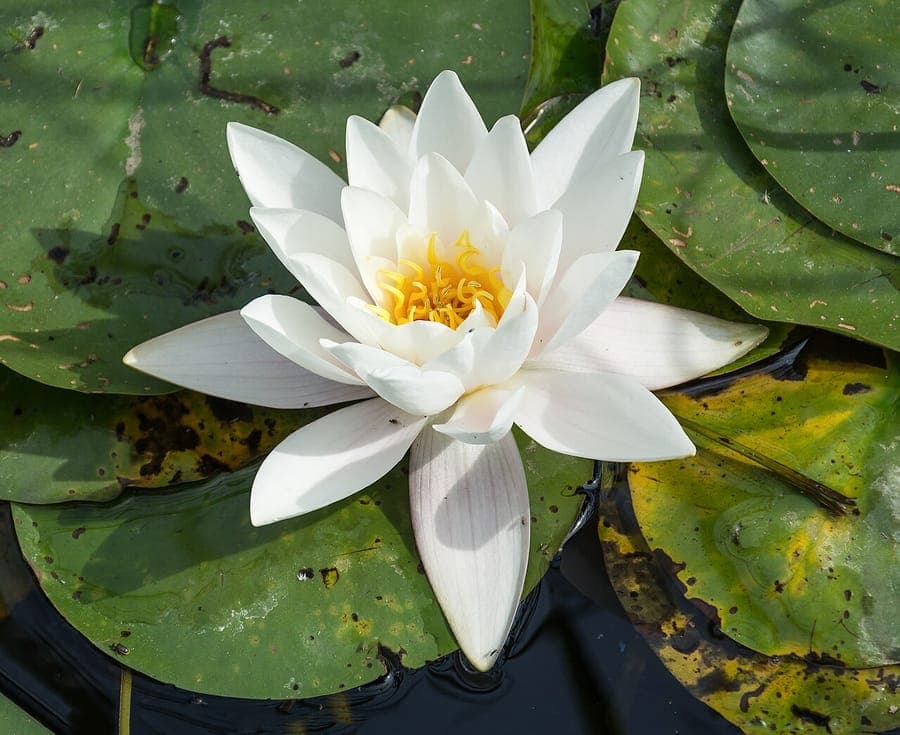
Jacek Halicki / CC BY-SA 4.0, via Wikimedia Commons
White water-lily: complete guide
Nymphaea alba
Want to see White water-lily: complete guide in your garden?
1 minute, no credit card
Overview
Nymphaea alba, commonly known as the white water-lily, is a staple in naturalistic and formal pond designs across temperate regions. Native to slow-moving rivers, lakes, and ponds in Europe, this aquatic perennial forms a lush carpet of floating foliage crowned with pristine white blooms. It belongs to the Nymphaeaceae family and thrives in still or gently moving freshwater environments. In the garden, it's valued not only for its beauty but also for providing shade and cover for fish and invertebrates.
This plant is herbaceous and spreads via thick rhizomes anchored in the pond bottom. It's fully winter-hardy down to USDA zone 5, making it suitable for most of the UK, northern Europe, and much of North America. With proper care, a single rhizome can grow into a dominant presence in your pond within two to three seasons. On gardenworld.app, you can design a custom pond layout that integrates water-lilies with depth zones and companion planting.
Appearance & bloom cycle
The leaves, or lily pads, are round, waxy, and bright green, reaching 20–30 cm in diameter. They float on the surface, creating dense coverage that helps suppress algae by limiting sunlight. The flowers are the highlight-pure white, 10–15 cm wide, with a cluster of golden stamens at the center. They open mid-morning on sunny days and close by dusk, lasting about four days each.
Bloom season runs from June through September, peaking in July and August. Each plant can produce multiple blooms simultaneously when conditions are optimal. After pollination, the flower sinks below the water to develop seeds. Old leaves turn yellow and should be removed to prevent decay and maintain water quality.
Ideal location
White water-lilies need full sun to bloom well-aim for 6 to 8 hours daily (light level 8 on a 10-point scale). A shady pond will result in sparse flowering and leggy growth. The planting depth is critical: place the rhizome in water 40 to 80 cm deep. Shallow water heats up too quickly and can damage the plant; too deep, and it won't reach the surface with vigor.
Avoid positioning near overhanging trees or dense shrubs that drop leaves or cast shade. A central location in your pond works best, allowing the lily pads to spread outward evenly. Use planting baskets to contain the rhizome and prevent invasive spread. On gardenworld.app, you can simulate how different pond depths affect plant performance and bloom density.
Soil requirements
Use heavy, nutrient-rich loam or clay-based soil-never regular potting mix, which floats and leaches nutrients. A mix of 3 parts loam to 1 part well-rotted compost works well. The ideal pH is neutral to slightly alkaline: 7.0 to 7.5. Acidic soils can lead to nutrient deficiencies, especially in iron.
Plant the rhizome in a wide, slotted basket (at least 25 cm in diameter), position it at a 45-degree angle with the growing tip facing outward, and cover the soil with a thin layer of gravel to prevent fish from disturbing it. Avoid chemical fertilizers in the first growing season.
Free design
Want to see White water-lily: complete guide in your garden? Make a free design now.
Watering
Once established, Nymphaea alba requires no active watering-it's submerged year-round. The key is stable water levels and quality. Fluctuating water levels can stress the plant, especially during early growth. Keep the pond free of excessive runoff, which can introduce pollutants and algae-promoting nutrients.
Use rainwater when topping up, and avoid chlorinated tap water unless dechlorinated. A balanced ecosystem with oxygenating plants like Hornwort or Anacharis helps maintain clarity and reduces maintenance. Still water is best-strong fountains or waterfalls near the lily can damage emerging leaves.
Pruning
Pruning is mostly about removing dead or dying foliage and spent flowers. Use clean, sharp scissors to cut stems back to the base of the rhizome. Do this monthly during the growing season to keep the pond tidy and prevent organic buildup. Overcrowded pads reduce airflow and light, leading to poor flowering.
In late summer or early autumn, trim back excess growth to about 15 cm above the rhizome. This helps the plant prepare for dormancy. Don't remove all pads at once-leave a few to continue photosynthesizing into fall.
Maintenance calendar
- March–April: Plant or reposition rhizomes. Divide if clumped. Use fresh aquatic soil.
- May: Monitor for new shoots. No feeding needed yet.
- June–August: Peak bloom. Remove faded flowers weekly. Apply aquatic plant fertilizer tablets if growth slows (1–2 per basket monthly).
- September: Begin cutting back yellowing leaves. Limit surface coverage to 60%.
- October–November: Let remaining foliage die back naturally. Ensure water depth exceeds 50 cm for winter.
Winter hardiness
Nymphaea alba is hardy to USDA zone 5 (–29°C). In zones 5–9, the rhizome can overwinter underwater as long as it's planted below the frost line-minimum 50 cm depth. In shallow ponds, consider lifting the basket and storing it in a frost-free container of water (e.g., in a garage).
Don't panic if foliage turns black in winter-this is normal dieback. The plant survives on stored energy in the rhizome and will resprout in spring when water temperatures rise above 10°C.
Companion plants
Pair white water-lilies with marginal plants like Iris laevigata, Caltha palustris, or Pontederia cordata for visual contrast. Underwater, include oxygenators such as Elodea nuttallii or Vallisneria spiralis to improve water quality. Small floating plants like Hydrocharis morsus-ranae (frogbit) can fill gaps without competing aggressively.
Avoid invasive species like Azolla or duckweed in large quantities, as they can smother lilies. Maintain a balance: aim for 40–60% surface coverage by floating plants to allow light penetration.
Closing
The white water-lily brings elegance and ecological balance to any pond. It's low-maintenance once established and rewards patience with years of summer blooms. Purchase rhizomes in spring from reputable garden centres or online suppliers-look for firm, healthy pieces with visible growing buds.
In the UK and US, check major garden centres for pond plant sections. In Europe, retailers like OBI or Truffaut often stock native water-lilies. Always inspect plants for pests like aphids or snails before adding them to your pond.
For help designing your planting scheme, visit gardenworld.app. Their interactive tools let you map out depth zones, sunlight exposure, and compatible species so your water-lily thrives for years.
Want to see White water-lily: complete guide in your garden? Make a free design now.
Upload a photo, pick a style, and get a photorealistic design with plant list in under a minute.
No credit card required


Similar plants
Rocky Mountain pond-lily: complete guide
Nuphar polysepala
Everything about Rocky Mountain pond-lily (Nuphar polysepala): pond placement, soil, water care, pruning and winter hardiness tips.
Dotleaf Waterlily: complete guide
Nymphaea ampla
Nymphaea ampla, known as Dotleaf Waterlily, is a tropical aquatic plant from the Americas. Learn how to cultivate and maintain this beautiful water lily in your pond.
Roundleaf Waterlily: complete guide
Nymphaea conardii
Nymphaea conardii is a unique tropical waterlily with distinctive round leaves from Central and South America. Discover care tips for this specialized aquatic plant.