
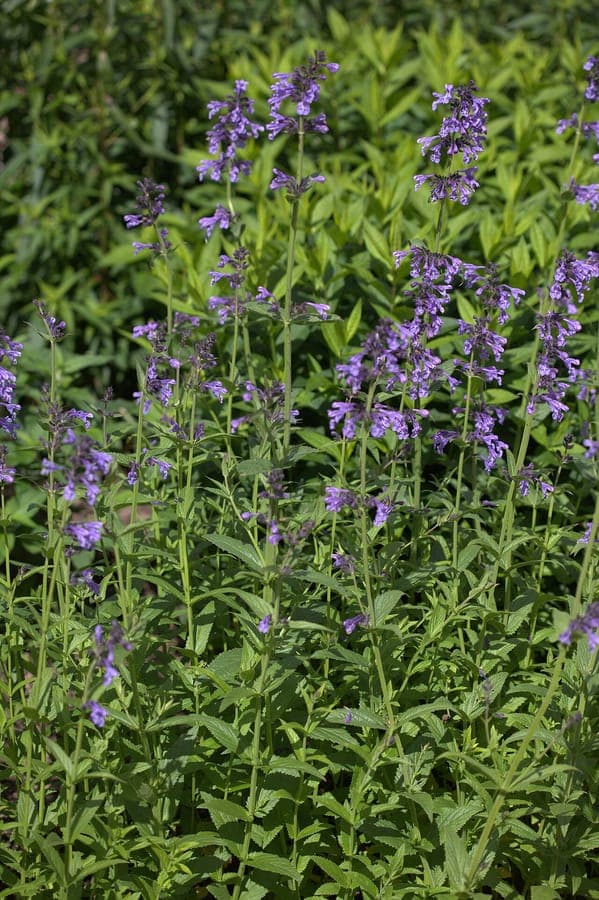
Averater / CC BY-SA 3.0, via Wikimedia Commons
Siberian catmint: complete guide
Nepeta sibirica
Want to see Siberian catmint: complete guide in your garden?
1 minute, no credit card
Overview
Nepeta sibirica, commonly known as Siberian catmint or large dragon-flower, is a cold-hardy herbaceous plant native to the dry mountain regions of Siberia, Kazakhstan, Mongolia, and parts of China. This robust plant grows increasingly popular in temperate gardens for its elegant lilac blooms and compact growth habit. The plant forms dense, mounding clumps approximately 60 to 90 centimeters tall.
Nepeta sibirica is known for attractive lilac-blue flowers densely arranged in elongated flower spikes. The plant grows more compact and stronger than its relatives. This is a very cold-hardy plant, winter-hardy to at least -20 degrees Celsius. The plant attracts numerous bees and other pollinators.
Appearance and bloom
Nepeta sibirica has a very pleasant appearance with fine, linear to lance-shaped leaves that are greyish-green and distinctly hairy. The leaves are small, approximately 1 to 3 centimeters long, and grow densely along the stems. The stems are upright, thin, and numerous, resulting in a full, mounding silhouette.
The flowers are small, approximately 1 centimeter long, lilac to blue in color with darker lips. They grow densely in spiral arrangements along long, slender flower spikes. These spikes can reach 20 to 30 centimeters long. Flowering begins in June and lasts through September. The blooms have a subtle, pleasant herbaceous fragrance.
Ideal location
Nepeta sibirica thrives best in very sunny locations with at least 6 to 8 hours direct sunlight daily. More sun means stronger, more compact growth. In partial shade, the plant grows somewhat taller and less compact. The plant tolerates windy locations well.
This plant is unsuitable for heavily shaded locations. A southeast or south-facing position is ideal. The plant also grows well on hilltops.
Soil
Nepeta sibirica makes no particularly stringent soil demands and thrives on sandy, slightly loamy, and equally well on lean soils. The plant prefers well-draining soil and tolerates no waterlogging. Heavy clay must be improved with sand or compost.
Soil pH may be neutral to slightly acidic, ideal 6.0 to 7.5. External fertilization is typically unnecessary. Light fertilizer at planting helps, but is not necessary. Good drainage matters much more than soil fertility.
Free design
Want to see Siberian catmint: complete guide in your garden? Make a free design now.
Watering
Nepeta sibirica is extremely drought-tolerant after establishment. In the first season, water regularly until roots establish well (approximately 4 to 6 weeks), then water only during very dry periods. Once mature, this is a very drought-tolerant plant.
Even in warm, dry summers this plant can grow without supplemental water. Too much water is more harmful than too little. This makes it ideal for dry gardens.
Pruning
Nepeta sibirica requires minimal pruning, though deadheading can extend flowering. After the first bloom wave, the plant can be cut back to approximately 15 centimeters, stimulating a second flowering flush. In spring, all dead stems can be removed close to ground level.
For severely overgrown plants, complete early spring cutback to 10 centimeters above ground stimulates more compact regrowth. This must be done carefully.
Maintenance calendar
March-April: Prune dead stems. May-June: Growth begins. July-August: Peak blooming. September-October: Late flowers. November-February: Rest.
Winter hardiness
Nepeta sibirica is very frost-hardy and completely winter-hardy to USDA zone 4 (approximately -30 degrees Celsius). The plant survives winters throughout Europe without protection. Extremely frost-resistant.
After above-ground parts die back, the plant regrows from roots each spring. Very wet winters are more problematic; therefore, good drainage matters more.
Companion plants
Nepeta sibirica combines excellently with other drought-tolerant, sun-loving plants such as lavender, sage, and rosemary. The lilac flowers look beautiful associated with yellow plants. Plant with ornamental grasses for textural contrast.
The plant also combines well with silver-foliaged plants. In larger gardens, groups of several Nepeta sibirica plants are very effective. Avoid very moisture-loving neighbours.
Conclusion
Nepeta sibirica is a valuable herb for any garden with sunny, dry locations. Its frost-hardiness and drought-tolerance make it very undemanding. Find it at garden centres throughout Europe. For professional garden design advice, consult gardenworld.app.
Want to see Siberian catmint: complete guide in your garden? Make a free design now.
Upload a photo, pick a style, and get a photorealistic design with plant list in under a minute.
No credit card required


Similar plants
Apple mint (Mentha x villosa): complete guide
Mentha x villosa
Meet apple mint (Mentha x villosa): a fruity-scented kitchen herb with woolly leaves, perfect for tea and mojitos.
Salvia peyronii: complete guide
Salvia peyronii
Discover Salvia peyronii, a rare Lebanese mountain sage. Growing tips, hardiness, and companion planting for a Mediterranean gravel garden.
Bigleaf mint (Mentha x rotundifolia): complete guide
Mentha x rotundifolia
Discover bigleaf mint: cultivation, care tips, and garden uses. Learn how to grow this aromatic herb with soft, hairy leaves.