
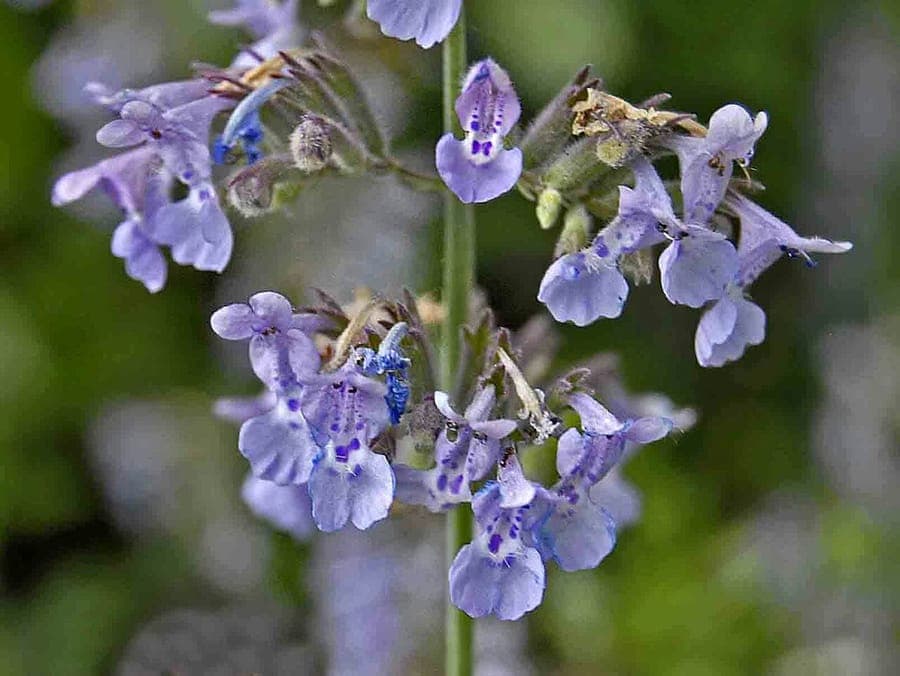
Hectonichus / CC BY-SA 3.0, via Wikimedia Commons
Lesser catmint: complete guide
Nepeta nepetella
Want to see Lesser catmint: complete guide in your garden?
1 minute, no credit card
Overview
Lesser catmint, or Nepeta nepetella, is a resilient and understated perennial that brings texture and charm to gardens without demanding much in return. Native to southern Europe and North Africa - including regions of Spain, Italy, Morocco, and southern France - this hardy plant thrives in rocky, well-drained soils and hot, dry conditions. Unlike its more famous relative Nepeta racemosa, this species doesn't typically attract cats, but it's a magnet for bees, butterflies, and other pollinators. It blooms in mid to late summer, producing delicate white flowers on slender, arching stems. Perfect for naturalistic planting schemes, rock gardens, and drought-resistant borders.
Appearance & bloom cycle
Lesser catmint grows to a height of 30–45 cm, with a spread of about 40 cm. The foliage is lance-shaped, gray-green, and softly hairy, giving it a silvery appearance that contrasts beautifully with darker green plants. From July to August, small white, tubular flowers appear in loose clusters along the upper stems. The bloom is subtle but persistent, lasting up to six weeks under ideal conditions. After flowering, the plant retains its tidy form, making it a reliable structural element in the garden through autumn.
Ideal location
Plant in full sun for best results - a minimum of 6 hours of direct sunlight daily. While it can tolerate light shade, flowering will be reduced, and stems may become leggy. This plant excels in dry, sunny borders, gravel gardens, or along stone walls where excess moisture drains quickly. Its natural habitat includes rocky slopes and open scrubland, so mimic those conditions when siting in your garden. On gardenworld.app, you can design a sun-drenched planting plan that highlights drought-tolerant species like Nepeta nepetella.
Soil requirements
Well-drained soil is essential. Sandy, gravelly, or loamy soils work well, but avoid heavy clay unless amended with grit or perlite. The ideal pH range is between 6.0 and 7.5. Do not enrich the soil with compost or manure - too many nutrients lead to weak growth and flopping stems. If your soil is poor, that's actually beneficial. This plant prefers lean conditions and will thrive where other perennials struggle.
Watering
Once established, Lesser catmint is highly drought-tolerant. Water regularly during the first growing season to help roots develop, but after that, supplemental irrigation is rarely needed. Overwatering is a common mistake and can lead to root rot. In average UK or US summer conditions, rainfall is usually sufficient. During extreme heat waves, give a deep soak every 10–14 days - about 5 litres per plant - but allow the soil to dry out completely between waterings.
Free design
Want to see Lesser catmint: complete guide in your garden? Make a free design now.
Pruning
Deadhead or cut back by one-third after the main bloom in August to encourage fresh foliage and sometimes a second, lighter flush of flowers. Avoid cutting into old, woody growth. In early spring, remove any dead or damaged stems to make way for new growth. Use clean, sharp shears and cut just above a leaf node. This light maintenance keeps the plant looking tidy and prevents self-seeding in some cases.
Maintenance calendar
- Jan: No action required.
- Feb: Check for winter damage; remove any collapsed stems.
- Mar: Cut back old growth; prepare soil if dividing.
- Apr: Monitor for slugs; keep area weed-free.
- May: Avoid overwatering; watch for leggy growth in shade.
- Jun: Reduce watering; support weak stems if needed.
- Jul: Peak bloom; avoid wetting foliage.
- Aug: Cut back after flowering; propagate if desired.
- Sep: Allow seed heads to remain for wildlife.
- Oct: Leave standing for winter texture.
- Nov: No care needed unless in containers.
- Dec: Protect container plants in zone 6 or colder.
Winter hardiness
Lesser catmint is hardy in USDA zones 6 to 9 (-23°C to -1°C). In most of the UK and much of the US, it overwinters reliably with no protection. Young plants may benefit from a light mulch of dry leaves in harsh winters. Avoid mulching too close to the crown, as this can trap moisture. Container-grown plants are more vulnerable and should be moved to a sheltered spot or wrapped in hessian during freezing spells.
Companion plants
Pair with other sun-loving, drought-tolerant perennials such as Echinacea, Salvia nemorosa, Sedum 'Herbstfreude', or Stachys byzantina. The soft gray foliage contrasts well with purple or blue blooms. Lavender and Russian sage make excellent companions both in form and cultural needs. Avoid moisture-loving plants like hostas or astilbes, which require opposite conditions.
Closing
Lesser catmint is a no-fuss, long-lived perennial that adds subtle beauty and ecological value to the garden. It's perfect for low-maintenance borders, green roofs, or gravel gardens. Use it as a soft edging plant or to fill gaps between stones. For inspiration on how to include it in your planting scheme, visit gardenworld.app and explore curated designs. You can find healthy plants at local garden centres in late spring or early autumn, especially at trusted retailers like garden centres across the UK and US.
Want to see Lesser catmint: complete guide in your garden? Make a free design now.
Upload a photo, pick a style, and get a photorealistic design with plant list in under a minute.
No credit card required


Similar plants
Apple mint (Mentha x villosa): complete guide
Mentha x villosa
Meet apple mint (Mentha x villosa): a fruity-scented kitchen herb with woolly leaves, perfect for tea and mojitos.
Salvia peyronii: complete guide
Salvia peyronii
Discover Salvia peyronii, a rare Lebanese mountain sage. Growing tips, hardiness, and companion planting for a Mediterranean gravel garden.
Bigleaf mint (Mentha x rotundifolia): complete guide
Mentha x rotundifolia
Discover bigleaf mint: cultivation, care tips, and garden uses. Learn how to grow this aromatic herb with soft, hairy leaves.