
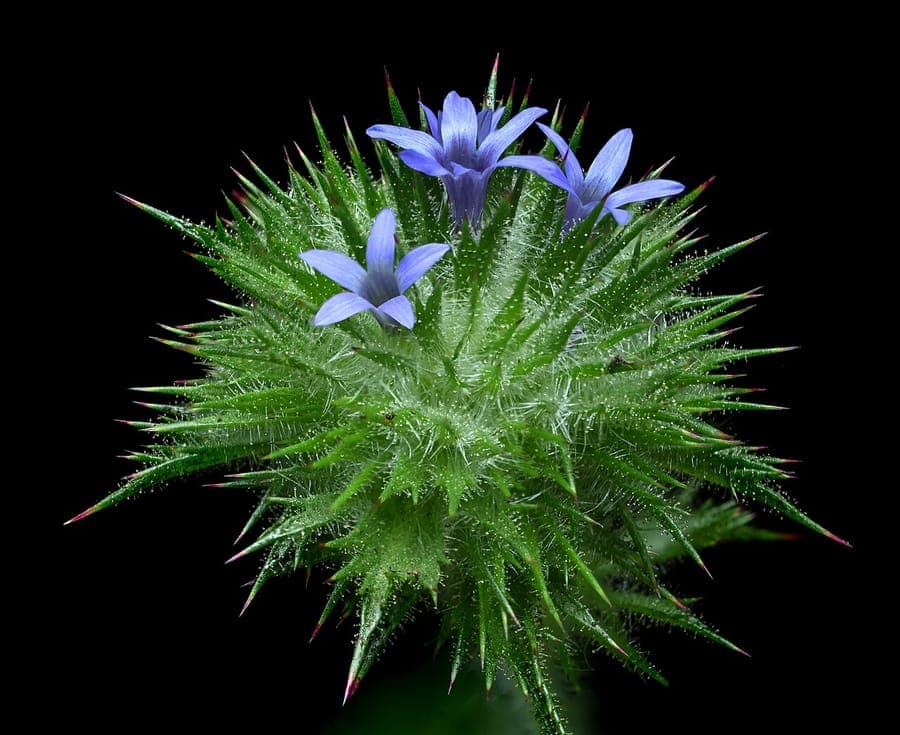
Alan Rockefeller / CC BY 4.0, via Wikimedia Commons
Skunkweed: complete guide
Navarretia squarrosa
Want to see Skunkweed: complete guide in your garden?
1 minute, no credit card
Overview
Navarretia squarrosa, commonly known as California stinkweed, skunkweed, or skunkbush, is a remarkable annual herb belonging to the family Polemoniaceae. Native to the Pacific Coast of North America, the plant grows naturally from British Columbia in Canada south through Washington, Oregon, and California, with an additional inland population in Montana. The species was also introduced to Tasmania in the nineteenth century. Its vivid common names reflect the pungent, musky odour released when the foliage is bruised or handled - a scent often compared to that of a skunk.
Navarretia is a genus of approximately 30 species, nearly all native to western North America. The genus was named in honour of Francisco Navarrete, a Spanish physician and naturalist. The species epithet 'squarrosa' refers to the stiff, spreading, and recurved bracts that are so characteristic of this plant. Despite its uninviting common names, Navarretia squarrosa is a botanically fascinating plant with highly specialised ecological adaptations to dry, open habitats. On gardenworld.app, you can find inspiration for incorporating botanically interesting native plants into your garden design.
Appearance and bloom cycle
Navarretia squarrosa is a low-growing annual that typically reaches 5 to 25 cm in height. It forms a dense, heavily branched structure with a compact, cushion-like habit. The stems are glandular-hairy - these sticky hairs trap small insects and debris and are responsible for the plant's distinctive smell. The leaves are pinnately lobed with stiff, sharp-tipped segments, giving the whole plant a spiny appearance.
The flowers are small but attractive: funnel-shaped with five lobes, purple to blue-purple in colour, occasionally white. They are nestled among the spiny bracts and bloom from May through August depending on elevation and local climate. The flowers attract bees and other pollinators despite - or perhaps because of - the plant's pungent scent. After pollination, small capsule fruits develop, each containing several seeds.
The distinctive odour comes from volatile terpenes produced in the glandular hairs on stems and leaves. While humans generally find the smell unpleasant, it may function as a specific pollinator attractant - an example of the specialised pollination syndromes that have evolved in many plant families. This makes the plant a fascinating subject for anyone interested in plant-insect interactions.
Ideal location
Navarretia squarrosa is a pioneer of open, unshaded habitats. It grows naturally on dry grasslands, roadsides, disturbed ground, rocky slopes, and areas with seasonal moisture fluctuations. The plant thrives in full sun and shows no tolerance for shade.
In garden settings - where the plant is rarely intentionally cultivated due to its odour - Navarretia squarrosa may appear as a self-sown addition in a wildflower meadow or a dry rock garden. It is a valuable component of native California plant collections and educational botanical gardens. Its adaptation to summer drought and its low resource requirements make it increasingly relevant as gardens in western Europe adapt to drier summers.
Soil
This species is undemanding with regard to soil quality. In its native habitat, Navarretia squarrosa grows on poor, well-draining substrates ranging from sandy to lightly loamy, and sometimes on clay-based soils that are wet in the rainy season but completely dry by summer. Heavy, persistently moist, or nutrient-rich garden soils are unsuitable - the plant has evolved for lean, dry conditions.
A neutral to mildly alkaline pH suits the plant well, though it tolerates a broad pH range. Nutrient-poor sandy soils or gravelly ground are in fact the most suitable growing media. No mulching or fertilising is required or beneficial - rich soil amendments would encourage excessive leafy growth at the expense of flowering. In containers, use a lean, very well-draining compost mixed with coarse grit or horticultural sand.
Watering
Californian stinkweed is strongly drought-tolerant and requires little to no supplementary water in the second half of the growing season. In its native California range, the plant completes its entire life cycle on natural rainfall - germinating in the cool, wet season and completing seed set before the summer drought arrives. The entire growth rhythm is calibrated to this seasonal wet-dry cycle.
In European gardens with a normally wet spring followed by a warm, dry summer, supplementary irrigation is rarely needed. A single watering during a prolonged dry spell in early spring - the germination phase - can help establish seedlings. Mature plants tolerate weeks without rainfall without difficulty. Overwatering is genuinely harmful and quickly leads to root rot in the sharply draining soils the plant requires.
Free design
Want to see Skunkweed: complete guide in your garden? Make a free design now.
Pruning
As an annual species, Navarretia squarrosa requires no pruning. The plant grows, flowers, sets seed, and dies within a single growing season. The only management decision for gardeners is whether to encourage self-seeding - by leaving plants to complete their full cycle - or to limit spread by removing plants before seed ripens.
In a wildflower meadow or naturalistic planting, this species can establish itself annually without any further effort once introduced. If the odour is objectionable near seating areas or frequently used paths, it is better to remove plants as they finish flowering. Wear gloves when handling to avoid prolonged contact with the glandular hairs.
Maintenance calendar
January - March: Seeds germinate with the first warm rains or when soil temperature rises above 10 degrees Celsius. In mild areas this may begin in late February.
April - May: Young seedlings grow rapidly on open, sunny ground. Seedlings are recognisable by their finely divided, sharp-tipped leaves.
May - August: Flowering period. Small purple blooms appear among the spiny bracts, followed by seed set. This is the most visually striking stage.
September - October: After seed ripening, plants die back. Seeds fall to the ground or are lightly dispersed by wind and passing animals.
November - December: Seeds overwinter in the soil and are ready to germinate in the following season. No further action required.
Winter hardiness
Navarretia squarrosa is an annual species that overwinters as seed in the soil. The parent plant dies at the end of the growing season. Seeds are frost-tolerant and survive temperate winters without difficulty. In mild maritime climates such as those found in the Netherlands, Belgium, and the UK - USDA zone 8 or above - seeds may germinate very early in the year during mild spells.
The species behaves as a winter annual or a facultative annual depending on local climate. In western European gardens, gardeners can treat it as a self-seeding annual that, once established, perpetuates itself each year without further intervention. No winter protection is ever needed, as the plant survives as dormant seed through cold periods.
Companion plants
Due to its distinctive odour and spiny habit, Navarretia squarrosa is not a typical border plant. It is best suited to a botanical or educational context alongside other native Californian or western North American plants. In a dry, sunny corner with other pioneer plants and drought-adapted species, it can make an interesting contribution.
Natural botanical companions include other Polemoniaceae family members such as Phlox and Gilia, which offer similar small, colourful flowers without the strong odour. California poppy (Eschscholzia californica) shares the same dry, sunny habitats and complements the spiny texture of Navarretia with its soft, feathery foliage. Western penstemons (Penstemon species) are also well-suited to this drought-tolerant plant community. On gardenworld.app, you can explore what a dry, sunny Mediterranean-style garden planted with botanically interesting species looks like in practice.
For a naturalistic wildflower meadow that requires minimal irrigation, combinations with Phacelia, Clarkia, and other western annual wildflowers are ecologically appropriate. Place Navarretia squarrosa away from seating areas and main pathways to keep the smell at a comfortable distance.
Closing
Navarretia squarrosa is not a conventional garden plant, but a botanically fascinating annual with a rich ecological history. Its spiny habit, glandular hairs, and pungent scent are all evolutionary adaptations to the harsh, dry conditions of the western North American coast. For the curious gardener or botanical enthusiast, this plant offers a unique window into the ecology of California's dry grasslands and disturbed habitats.
Its drought tolerance, minimal soil requirements, and annual self-seeding habit make it a low-maintenance curiosity for a dry, sunny garden corner. If you are drawn to plants with a story to tell and an ecological purpose to serve, consider giving Navarretia squarrosa a small patch to call its own.
Want to see Skunkweed: complete guide in your garden? Make a free design now.
Upload a photo, pick a style, and get a photorealistic design with plant list in under a minute.
10,000+ gardens designed already
No credit card required


Similar plants
Phlox alyssifolia: complete guide to Alyssum-leaf Phlox
Phlox alyssifolia
Alyssum-leaf phlox is a compact alpine pink bloomer from North America. Discover care, location and all growing requirements.
Phlox richardsonii: complete guide to Richardson's Phlox
Phlox richardsonii
Richardson's phlox is an arctic bloomer exceptionally robust. Learn cultivation in extreme conditions and complete care guide.
Polemonium foliosissimum: complete guide
Polemonium foliosissimum
Polemonium foliosissimum is a vigorous Rocky Mountain perennial with blue-purple summer flowers that attract pollinators and thrive in borders.