
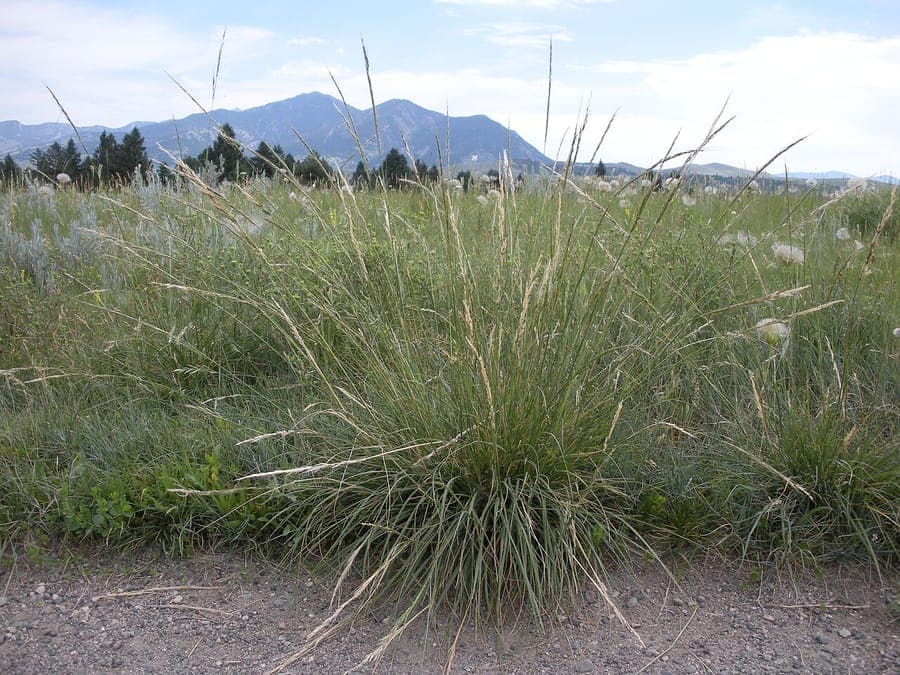
Matt Lavin / CC BY-SA 2.0, via Wikimedia Commons
Green needlegrass: complete guide
Nassella viridula
Want to see Green needlegrass: complete guide in your garden?
1 minute, no credit card
Overview
Nassella viridula, commonly known as green needlegrass, feather bunchgrass, or green tussockgrass, is one of the most adaptable and attractive prairie grasses native to the western and central regions of North America. The plant was previously classified under the genus Stipa - where it went by the name Stipa viridula - and was transferred to Nassella following modern phylogenetic revisions of the grass family Poaceae. The species epithet viridula means 'somewhat green', referring to the fresh, vivid colour of the foliage and flower spikes.
Native to an enormous range stretching from the Yukon and Canadian prairies southward through Montana, Wyoming, Colorado, New Mexico, and Arizona, and eastward through the Great Plains into Minnesota, Iowa, Illinois, and Kansas, this grass demonstrates a remarkable climatic tolerance. It spans USDA hardiness zones 3 through 7, meaning it thrives across climates where winter temperatures can plunge to -40 degrees Celsius, as well as in the hot, dry summers of the central American grasslands.
For European and British gardeners, Nassella viridula offers an exciting opportunity to bring North American prairie character into ornamental borders and naturalistic plantings. At gardenworld.app you can explore full garden design concepts that show how bunchgrasses like this one transform a flat or uninspiring front garden into a dynamic, seasonal composition.
Appearance and bloom cycle
Nassella viridula grows in dense, upright tufts of narrow, arching leaf blades that maintain a fresh green colour through most of the growing season. The leaf texture is medium - neither coarse nor thread-fine - and the blades have a gentle downward curve at their tips that creates a fountain-like appearance for the clump as a whole. The overall plant is notably tidy and well-defined, without the aggressive spreading habit of some rhizomatous grasses.
Flowering begins in late spring to early summer, typically May through July in its native range, with slender culms rising 60 to 90 cm above the basal tuft. The panicles are initially greenish-yellow and gradually transition to straw-gold as summer progresses. Each floret carries a straight, needle-like awn measuring 3 to 6 cm in length - the distinctive feature that gives the plant its common name. These awns catch the light beautifully, making the plant shimmer in morning and evening sun.
At full maturity, established clumps reach 60 to 90 cm in height including the flowering culms, with a basal spread of 30 to 50 cm. The dried seed heads and culms remain structurally attractive through autumn and winter, providing textural interest in the dormant garden and an important food source for finches, sparrows, and other seed-eating birds.
Ideal location
Full sun is non-negotiable for Nassella viridula. In its native habitat it grows on open prairie, dry hillsides, and river banks where it receives uninterrupted sunlight. A minimum of six hours of direct sun per day should be considered the baseline; eight to ten hours produces the most compact, floriferous plants.
In partial shade the plant becomes lax and open, the culms elongate and tend to flop, and flowering is significantly reduced. Deep shade is simply incompatible with long-term plant health. When choosing a planting location, prioritise south- and west-facing aspects for maximum performance.
Green needlegrass is also well suited to exposed and windy positions. Its native prairie habitat is frequently subjected to strong winds, and the flexible culms are well adapted to bending without breaking. This makes it an excellent choice for rooftop gardens, coastal gardens, and open front gardens where many plants struggle with wind exposure.
Soil
Nassella viridula succeeds across a broad range of soil types, reflecting the diversity of substrates it encounters across its enormous native range. It tolerates a soil pH from 6.6 to 8.4, meaning it performs well on both slightly acidic and distinctly alkaline, calcareous substrates. In the wild it colonises loamy prairie soils, rocky hillsides with thin topsoil, and gravelly stream margins.
The single most important soil requirement is good drainage. Waterlogged or consistently wet soils cause root problems that are difficult to reverse. On heavier clay soils, improve drainage before planting by working in sharp grit and well-rotted compost to a depth of at least 30 cm. Raised beds or slopes are naturally suitable.
Fertility requirements are minimal. On overly rich soils the plant produces lush, floppy growth that is less decorative and more prone to collapse. On lean, well-drained soils it stays compact, blooms prolifically, and lives for many years without any supplemental feeding. This low-input character makes it a natural fit for prairie and meadow-style plantings.
Free design
Want to see Green needlegrass: complete guide in your garden? Make a free design now.
Watering
Once established - typically after the first growing season - Nassella viridula is a genuinely drought-tolerant plant. Its extensive, deep root system allows it to access soil moisture well below the surface during prolonged dry spells. In its native range it survives the intense summer droughts of the Great Plains without supplemental irrigation.
During the first year after planting, regular watering is important to help the plant establish its root system. Water deeply but infrequently: allow the soil to dry partially between waterings so that roots are encouraged to grow downward in search of moisture. Shallow, frequent watering promotes surface rooting, which leaves the plant vulnerable to drought.
In the British and European garden context, established plants typically need no supplemental watering except during extended summer dry spells. When irrigation is necessary, a thorough soaking once a week is preferable to light daily watering. Always allow the soil surface to dry between waterings. Overwatering is a more common cause of plant failure than drought, particularly on heavier soils.
Pruning
Annual rejuvenation of Nassella viridula is straightforward. The best time is late winter or very early spring, before new growth begins to emerge from the base - typically February to early March in the UK and northern Europe. Cut the entire clump back to approximately 10 to 15 cm above ground level. Use sharp hedging shears for young plants or a small pruning saw for larger, more established clumps.
Do not cut back in autumn. The dried culms and seed heads are genuinely ornamental through the winter months and provide food and shelter for wildlife. Leave them standing until frost is reliably past and new growth is about to begin. This late-winter timing minimises the risk of young shoots being damaged by late frosts.
Avoid pulling or tearing the dead foliage by hand, as this can damage the growing points at the base of the clump. A clean cut with sharp tools is always preferable. If the clump becomes very large and congested over many years, lift and divide it in early spring to reinvigorate growth.
Maintenance calendar
January - February: Leave the clump standing for winter interest and bird feeding. Check that the planting site is not waterlogged.
March: Cut back the clump to 10-15 cm. Remove all old material. Apply a thin top-dressing of well-rotted compost around the base if desired.
April - May: New growth emerges. Water if conditions are dry. Check for any unwanted self-seeding around the plant.
June - July: Flowering period. Enjoy the shimmer of the awns in sunlight. Deadhead selectively if self-seeding is not wanted.
August - September: Late summer drought period. Water if necessary during extended dry spells. Seed heads turn straw-gold.
October - November: Plant enters dormancy. No action required.
December: Full dormancy. The clump provides structural interest and a seed source for garden birds through the winter months.
Winter hardiness
Nassella viridula is exceptionally cold-tolerant. Rated to USDA zone 3, it withstands minimum winter temperatures of approximately -40 degrees Celsius - well below anything experienced in the British Isles or western Europe. Cold is simply not a limiting factor for this plant in the European garden context.
The more significant winter risk is excessive moisture. Persistently wet soil around the roots, especially combined with freeze-thaw cycles, can cause problems on clay-heavy soils. On free-draining sites this is not an issue. Where drainage is less than perfect, raising the planting position slightly or incorporating extra grit will mitigate the risk.
A light mulch of 5 cm of leaf mould or composted bark applied around the base of the clump in autumn will insulate the root zone and improve soil structure. Remove this mulch in late winter before new growth begins to prevent young shoots from rotting under the covering. At gardenworld.app you can get tailored advice on preparing your specific garden conditions for plants like this one.
Companion plants
Nassella viridula pairs beautifully with a wide range of drought-tolerant perennials and prairie natives. Classic combinations include purple coneflower (Echinacea purpurea), black-eyed Susan (Rudbeckia fulgida), ornamental sage (Salvia nemorosa), hyssop (Agastache), and Russian sage (Perovskia atriplicifolia). The fine-textured bunchgrass provides an excellent foil to the bolder flowers and broader foliage of these companions.
In larger prairie-style borders, combine with Verbena bonariensis, Echinacea pallida, Allium sphaerocephalon, and other Nassella or Stipa species for a naturalistic, layered effect. Low-growing sedums and stonecrops at the front of the border complete the drought-tolerant planting scheme.
Avoid pairing with moisture-loving plants or species that require rich, fertile soil. The differing cultural needs will result in one partner outcompeting the other over time, compromising the long-term balance of the planting.
Closing
Nassella viridula is a plant for gardeners who value authenticity, ecological sensitivity, and beauty that requires minimal intervention once established. It suits modern naturalistic borders, drought-resilient front gardens, and prairie-style schemes that connect the cultivated garden with the wider landscape.
Look for it at specialist herbaceous nurseries and garden centres. It may also be sold under the older name Stipa viridula. Whether you are creating a wildlife-friendly meadow garden or a sleek contemporary border, green needlegrass brings four seasons of interest - from the fresh green tufts of spring, through the shimmering golden awns of summer, to the sculptural seed heads of winter. Use gardenworld.app to visualise your planting plan and find the perfect position for this versatile prairie grass in your garden design.
Want to see Green needlegrass: complete guide in your garden? Make a free design now.
Upload a photo, pick a style, and get a photorealistic design with plant list in under a minute.
10,000+ gardens designed already
No credit card required


Similar plants
Two-ranked alpine bluegrass: complete guide
Oreochloa disticha
Everything about Oreochloa disticha, the two-ranked alpine bluegrass from the European mountains. Location, acidic soil, care, and companion plants.
Argentine needlegrass: complete guide
Nassella tenuissima
Nassella tenuissima, the finest ornamental grass. Elegant, silvery threadlike awns that dance in the slightest breeze. Drought hardy.
Stipa gigantea: complete guide
Stipa gigantea
Giant feather-grass is a striking ornamental grass with feathery seed heads and golden shimmer. Learn how to grow this monumental grass successfully in your garden design.