
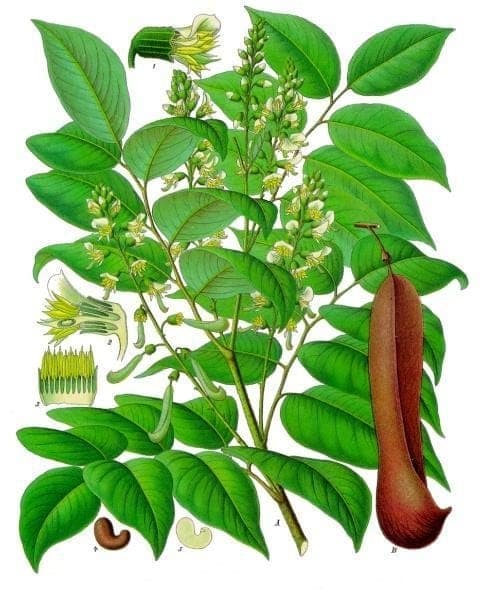
Franz Eugen Köhler, Köhler's Medizinal-Pflanzen / Public domain, via Wikimedia Commons
Balsam of Peru: complete guide
Myroxylon balsamum
Want to see Balsam of Peru: complete guide in your garden?
1 minute, no credit card
Myroxylon balsamum, commonly known as Balsam of Peru, balsam tree, or Tolu balsam, is an impressive tropical tree from the legume family (Fabaceae). This tree is renowned for the aromatic resins and essential oils extractable from its bark and heartwood - substances employed for centuries in traditional medicine, perfumery, cosmetics, and incense production worldwide. Myroxylon balsamum achieves 20-25 meters in its native habitat, though cultivated specimens remain considerably more compact.
The tree is indigenous to Central and South America, ranging from Mexico through Peru and Ecuador. In natural settings, it inhabits tropical rainforests and evergreen woodlands where warm, humid conditions prevail. This tree holds both botanical and economic significance - traditional extraction methods for balsam resin trace back centuries.
Appearance and bloom
Myroxylon balsamum is a deciduous tree bearing impressive, pinnately compound leaves. Each leaf comprises 7-9 small leaflets attached to a central petiole. The leaflets are dark green, lance-shaped, and finely textured, providing substantial canopy coverage. Bark on young branches is greenish-brown and smooth; older branches assume gray-brown coloration with shallow fissuring.
Flowers appear in small clusters and are white to cream-colored with delicate, graceful form typical of legume flowers. Blooming occurs late spring through early summer, lasting several weeks. The scent is subtle and pleasant - noticeable but not overpowering.
Following bloom, elongated brown pods develop, each containing a single seed. These pods are botanically interesting and useful for seed propagation.
Ideal location
Myroxylon balsamum performs best in warm, sunny positions with minimum 6 hours daily direct sunlight. Though the tree originates from rainforest understory where partial shade occurs, cultivated material requires substantial light for healthy growth and full leaf development.
The tree appreciates protection from strong winds, especially when young. Mature specimens tolerate stronger breezes, but young plants suffer damage from severe wind.
In tropical regions (USDA zones 10b-11), outdoor cultivation is feasible. In temperate climates, greenhouse or conservatory cultivation is necessary. The plant demands warmth - minimum temperatures around 15°C, ideally 18-25°C.
Soil
This tree requires well-draining, nutrient-rich soil. An excellent growing medium combines two parts garden soil, one part coarse sand for drainage, and one part decomposed organic matter (compost or leaf mold). pH should be neutral to slightly acidic (pH 6.0-7.0).
For container cultivation, select large containers (minimum 40-50 liters) with excellent drainage holes. Since this tree is deep-rooting, adequate pot depth is essential. Regular compost additions encourage robust growth.
Free design
Want to see Balsam of Peru: complete guide in your garden? Make a free design now.
Watering
Myroxylon balsamum prefers consistent moisture levels. During the growing season, maintain moist (not waterlogged) soil. Check regularly by inserting your finger 5 centimeters into the soil.
During winter or in cool conditions, substantially reduce watering. The tree tolerates dry periods of a few weeks but suffers from prolonged drought.
High humidity favors growth, especially for young plants. Regular misting promotes health. Avoid waterlogging or allowing water to pool at contact points.
Pruning
Myroxylon balsamum can be carefully pruned to maintain form and encourage dense growth. Pruning is best undertaken in late spring, after flowering. Remove weak, crossing, or damaged branches.
Selective pruning also stimulates leaf development. The tree responds well to pruning and regrows vigorously when healthy.
Remove yellowed or damaged leaves regularly. For substantial damage, prune carefully back to a healthy node.
Maintenance calendar
January-February: Minimal watering in temperate zones. Inspect for pests in greenhouses. Prepare for growth season.
March-April: Begin monthly feeding. Increase watering as temperatures rise. Possible pruning for form.
May-July: Bi-weekly feeding with balanced fertilizer. Peak growth and flowering period. Maintain consistent moisture.
August-September: Continue care. Possible first fruit development. Monitor for pests.
October-November: Gradually reduce watering. Cease feeding. Transition toward dormancy.
December: Minimal care in temperate climates. Protect if temperatures drop below 15°C.
Winter hardiness
Myroxylon balsamum is frost-sensitive and cannot tolerate freezing. Temperatures below 15°C slow growth; below 10°C cause serious problems. In temperate climates, winter storage in a greenhouse is essential.
Prolonged exposure to temperatures below 12°C causes leaf drop and growth stunting. Always protect from frost - this tree suits USDA zones 10b-11.
Companion plants
Myroxylon balsamum grows well alongside other tropical trees and plants:
- Other Fabaceae (legumes): Erythrina, Albizia
- Tropical deciduous trees: Ficus, Melia
- Vines: Ipomoea, Passiflora
- Understory plants: Philodendron, Anthurium
- Grasses: Bamboo for screening
Pair best with plants requiring similar warm-humid conditions.
Conclusion
Myroxylon balsamum is a fascinating tree for those interested in ethnobotany, traditional medicine, and exotic tropical plants. Though frost-sensitive, it thrives under proper conditions. Sourcing remains challenging, but tropical plant nurseries may occasionally have seeds or young plants. With patience and attention, this tree rewards growers with fascinating foliage and aromatic properties.
Design your complete garden with tropical elements on gardenworld.app and discover more plant guides for exotic species suited to your situation. Use gardenworld.app for inspiration creating the warm-humid microclimate this remarkable tree deserves.
Want to see Balsam of Peru: complete guide in your garden? Make a free design now.
Upload a photo, pick a style, and get a photorealistic design with plant list in under a minute.
No credit card required


Similar plants
Tall Silky Lupine: complete guide
Lupinus elatus
Tall silky lupine is a fast-growing Californian perennial with silvery foliage and blue-purple flower spikes, ideal for a prairie-style garden.
Garfield Lupine: complete guide
Lupinus garfieldensis
The Garfield lupine is a rare, fast-growing American perennial for alkaline, dry grassland gardens, with striking blue flower spikes.
Lupinus elegans: complete guide
Lupinus elegans
Lupinus elegans, the elegant lupine, is a spectacular blooming plant from Mexico with blue flower spikes. Care, cultivation and garden use.