
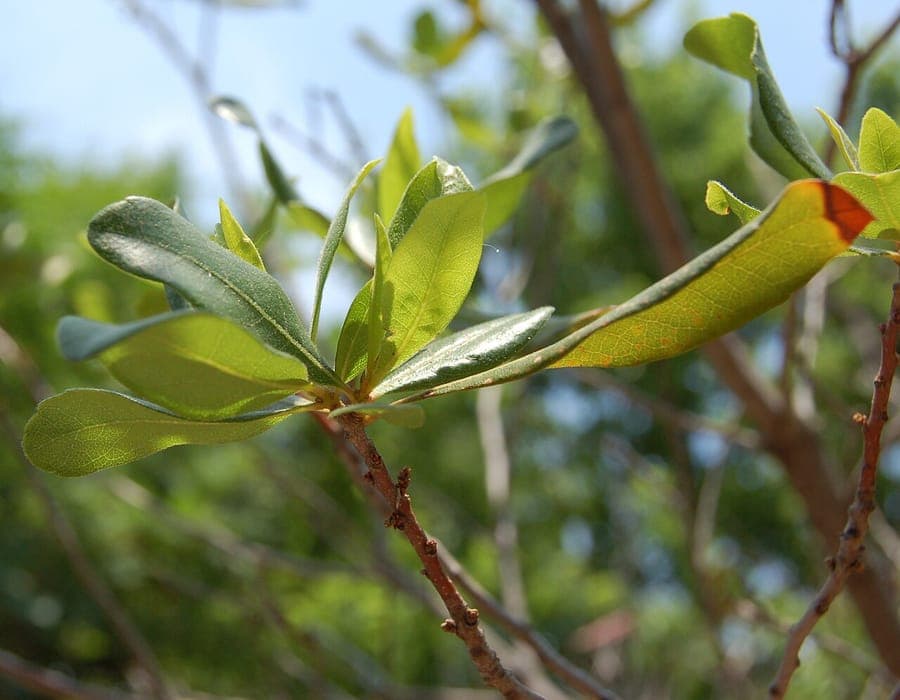
Photo by Derek Ramsey (Ram-Man) / CC BY-SA 2.5, via Wikimedia Commons
Myrica pensylvanica: complete guide
Myrica pensylvanica
Want to see Myrica pensylvanica: complete guide in your garden?
1 minute, no credit card
Overview
Myrica pensylvanica, better known as Northern Bayberry or Northern Waxmyrtle, is a robust deciduous to semi-evergreen shrub native to eastern North America. This plant ranges from Canada to the southeastern United States, demonstrating remarkable adaptability to diverse growing conditions. It is highly valued by bird lovers and landscape designers for its food-producing talents - the edible blue berries attract numerous bird species.
While Northern Bayberry lacks exotic beauty, it is a dependable performer in coastal landscapes, dry zones, and difficult soil areas. This is your plant if you seek something sturdy that gives more than it takes.
Appearance and Bloom
The shrub typically reaches 1-2 meters tall and can grow equally wide, depending on variety and conditions. The foliage is lance-shaped, small, and highly aromatic - rub a leaf and you immediately smell a pleasant, spicy fragrance. The leaves are glossy green with a subtle gray-white waxy coating.
The flowering is not visually spectacular - small, inconspicuous catkin-like flowers appear in early spring before leaves fully emerge. Female plants, however, produce beautiful blue berries coated in white wax (historically used for candlemaking). These berries persist well into winter, providing food for warblers, quail, and numerous other bird species.
Ideal Location
Set Northern Bayberry in full sun - at least six hours of direct sunlight. The plant also tolerates partial shade, especially in warm climates. In windy coastal regions, it thrives better than many shrubs, making it ideal for seaside gardens.
The plant is extremely tolerant of sandy, wet, or very dry sites - exactly what you need for problematic spots in your garden.
Soil
Myrica pensylvanica is remarkably indifferent to soil type. It grows on sand, clay, stony soil, and everything in between. It tolerates acidic, neutral, and very alkaline soils. This is a plant that excels on waste and marginal lands where many shrubs would fail.
The plant hosts nitrogen-fixing bacteria in root nodules, meaning it can harvest its own nitrogen from the air - it even gradually improves soil quality.
Free design
Want to see Myrica pensylvanica: complete guide in your garden? Make a free design now.
Watering
Once established, this is a drought-tolerant plant. Ensure young plants receive regular water during their first growing season, especially in warm climates. Mature plants need little supplemental water except during extreme drought.
In coastal areas where it grows (often moister), it performs equally well. This is truly a "plant and forget" species.
Pruning and Maintenance
Myrica pensylvanica requires minimal pruning. Remove only dead wood and branches in the way. The plant can be shortened if it becomes too large, but it doesn't respond well to heavy pruning.
Reshaping is unnecessary - this is a plant you set and leave alone. No formal maintenance schedule required.
Maintenance Calendar
Spring: Support growth of young plants with regular water. Flower production begins.
Summer: Enjoy waxy coating illustration on fruits. Water as needed.
Autumn: Migrating birds land to eat berries. Leaves subtly change color before falling (in northern climates).
Winter: Leafless or semi-evergreen. Berries persist long, feeding birds through winter.
Winter Hardiness
This is an extremely cold-hardy plant, suitable for zones 2-6 (to -40°C). In southern regions (zones 7-8) it may be semi-evergreen. This is your plant if you live in North America and want something absolutely certain to be frost-hardy.
Companion Plants
Plant alongside other bird-feeding plants: elderberry, dogwood, hollies. For coastal landscapes, combine with sea grasses and other salt-tolerant vegetation. In dry areas, group with beebee and sneezeweed.
Closing Thoughts
Myrica pensylvanica is for gardeners who value substance over fuss. This is a plant you can leave alone and it still flourishes. For bird lovers, it's a must. For those with sandy or dry soil, it's a godsend. Find it at garden centers in North America, or ask native seed suppliers in your region. For more inspiration on native plants, check gardenworld.app.
Plant Northern Bayberry - a piece of unshakeable northern charm.
Want to see Myrica pensylvanica: complete guide in your garden? Make a free design now.
Upload a photo, pick a style, and get a photorealistic design with plant list in under a minute.
No credit card required


Similar plants
Acer pycnanthum: complete guide
Acer pycnanthum
Acer pycnanthum, the Japanese swamp maple, is a fast-growing tree with early red flowers and brilliant autumn color, ideal for damp garden settings.
Freeman maple: complete guide
Acer × freemanii
Everything about the Freeman maple (Acer x freemanii): a fast-growing shade tree with spectacular autumn colour for large gardens.
Silver vine: complete guide
Actinidia polygama
Discover silver vine (Actinidia polygama): a hardy climbing plant with silvery foliage, loved by gardeners and cats alike.