
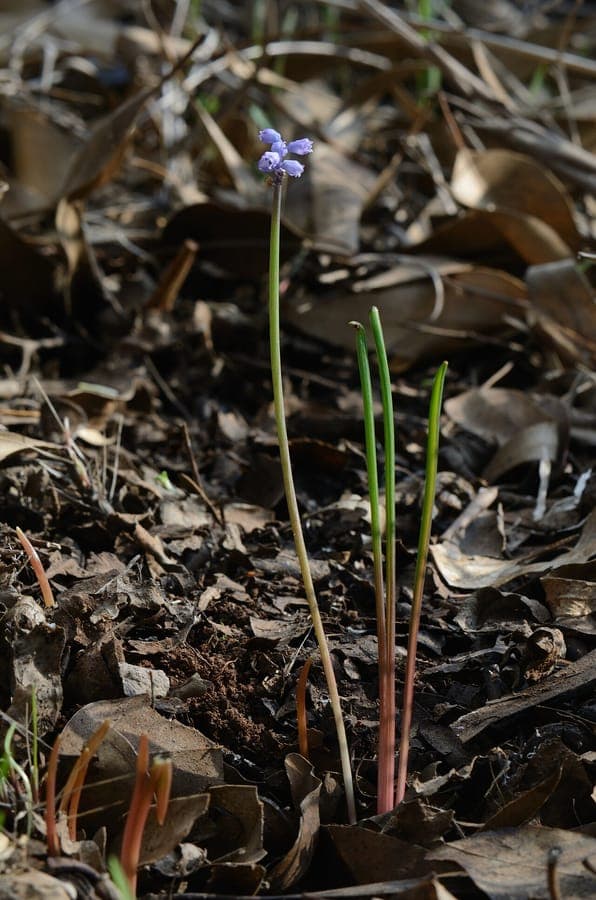
Gideon Pisanty (Gidip) / CC BY 3.0, via Wikimedia Commons
Muscari parviflorum: complete guide
Muscari parviflorum
Want to see Muscari parviflorum: complete guide in your garden?
1 minute, no credit card
Overview
Muscari parviflorum, commonly known as small grape hyacinth or small muscari, is an elegant spring bulb native to the Mediterranean region. This compact plant is renowned for its delicate small blue flowers arranged in tight, grape-like clusters. Standing just 15-25 centimetres tall, Muscari parviflorum provides reliable spring color with minimal effort, blooming from March through May.
Originally found across Spain, Italy, North Africa and the Levant, this species has earned a place in gardens worldwide. Known for its hardiness, easy maintenance and prolific self-seeding, Muscari parviflorum offers gardenworld.app users a foolproof way to add spring colour without demanding care.
Appearance and Bloom
Small grape hyacinth is instantly recognizable by its compact flower clusters. Each bulb produces 10-20 tiny, tubular flowers in soft blue, packed so densely they resemble miniature grapes. The flowers measure just 3-4 millimetres across, creating an intricate, delicate display.
Foliage emerges as narrow, grass-like green leaves from the base, creating a tidy mound beneath the flower stems. Flower stalks reach 20-25 centimetres at maturity. After blooming, leaves gradually fade as the bulb stores energy underground for next season.
Bloom timing spans March to May, depending on local climate and spring warmth. In mild winters, flowers may appear as early as late February.
Ideal Location
Muscari parviflorum performs best in full sun to part shade, requiring at least four to six hours of direct sunlight daily for optimal flowering and vigor. While it tolerates shade, blooming becomes sparse in full shade.
This plant excels in open borders, along pathways, in rock gardens, and in containers on patios or balconies. Its compact stature makes it perfect for small spaces and for gardeners seeking intense seasonal colour without space demands.
Soil
Small grape hyacinth requires well-drained, moderately fertile soil. Heavy clay must be amended with sand, gravel and organic matter to improve drainage, as bulbs suffer in waterlogged conditions.
A soil pH of 6.0 to 7.5 is ideal. Enrich poor soils with garden compost or potting mix before planting. Ensure excess water drains quickly, as standing water causes bulb rot and fungal disease.
Free design
Want to see Muscari parviflorum: complete guide in your garden? Make a free design now.
Watering
After autumn planting, water regularly until soil settles around bulbs. Once established, Muscari parviflorum is remarkably drought-tolerant. Supplemental water is only necessary during extreme dry spells.
During active spring growth, water weekly if rainfall is scarce. As flowers fade and the plant begins withdrawing into dormancy, reduce watering gradually. In summer, withhold water entirely; the bulb rests underground.
Pruning
Muscari parviflorum requires virtually no pruning. Remove spent flower stems to prevent unwanted self-seeding (unless naturalization is desired). Allow foliage to persist through June so bulbs absorb nutrients for next season.
If you wish to remove senescent (dying) leaves early, do so gently without damaging underlying bulbs. Many grape hyacinth varieties naturally self-seed and multiply via offset bulblets.
Maintenance Calendar
March-May: Flowering; check regularly for weeds and pests. June: Foliage begins to fade. July-October: Soil remains quiet and dry; no watering needed. October-November: Plant bulbs for next spring. December-February: Bulbs chill underground, preparing for growth.
Winter Hardiness
Muscari parviflorum is extremely hardy throughout the Netherlands and Belgium, tolerating temperatures as low as -15 degrees Celsius. This makes it ideal for permanent garden planting, returning reliably each spring without protection.
In very cold alpine regions or during extreme frost events, mulching around plants can prevent frost heave, though this is rarely necessary in lowland areas.
Companion Plants
Small grape hyacinth pairs beautifully with other spring bloomers. Snowdrops and witch hazel provide color contrast. Tulips and daffodils offer height and complementary hues.
In rock gardens, combine with small alpine plants, sedums and other dwarf spring bulbs for a layered spring display. In containers, pair with small grasses and evergreen herbs for seasonal impact.
Closing
Muscari parviflorum is an effortless choice for gardeners wanting reliable spring blue without fuss. Easy to grow, long-lived and exceptionally hardy, this small grape hyacinth deserves a place in every front garden. On gardenworld.app, this plant becomes part of spring-focused designs, adding colour and texture to outdoor spaces.
Plant Muscari parviflorum bulbs in October/November for spectacular spring bloom. Quality bulbs are available at major garden centres. Complete your front garden with this Mediterranean treasure.
Want to see Muscari parviflorum: complete guide in your garden? Make a free design now.
Upload a photo, pick a style, and get a photorealistic design with plant list in under a minute.
No credit card required


Similar plants
Narrow-leaved dracaena: complete guide
Dracaena angustifolia
Everything about Dracaena angustifolia - the narrow-leaved dracaena: location, care, overwintering and use as a houseplant or patio plant.
Chaparral yucca: complete guide to Hesperoyucca whipplei
Hesperoyucca whipplei
Hesperoyucca whipplei (Our Lord's candle) is a dramatic rosette-forming plant from California that produces a towering flower spike, ideal for dry and gravel gardens.
False lily-of-the-valley: complete guide
Maianthemum dilatatum
Everything about Maianthemum dilatatum, the false lily-of-the-valley. Care, shade location, propagation and garden combinations for this popular shade ground cover.