
Hans Hillewaert / CC BY-SA 3.0, via Wikimedia Commons
Grape-hyacinth: complete guide
Muscari neglectum
Want to see Grape-hyacinth: complete guide in your garden?
1 minute, no credit card
Overview
Muscari neglectum, commonly known as grape-hyacinth, is a resilient little bulb that brightens up early spring gardens across the UK and North America. Native to southern Europe and western Asia, it's now naturalized in many temperate regions, thriving in lawns, under trees, and along borders. At just 10–15 cm tall, it's unassuming but packs a punch with its dense, grape-like clusters of deep blue flowers.
Despite its modest height, grape-hyacinth makes a bold visual impact when planted in drifts. It's one of the easiest bulbs to naturalize, returning year after year with minimal effort. On gardenworld.app, you can design a garden layout that highlights these bulbs under deciduous trees or woven through a wildflower meadow for a soft, natural look.
Appearance & bloom cycle
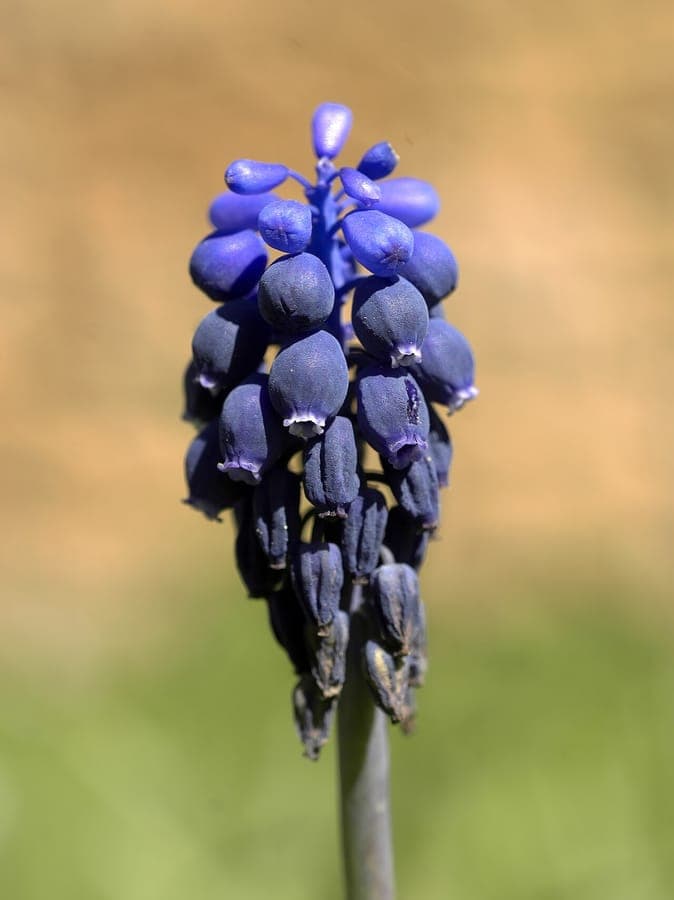
Grape-hyacinth blooms from mid-March to early April, depending on your climate zone (USDA 4–8). The flowers form tight cylindrical spikes, typically 2–3 cm long, with the uppermost florets often paler-almost white or pale blue-creating a two-tone effect against the darker lower blooms. This contrast adds depth and interest to borders.
The foliage is narrow, strap-like, and grey-green, reaching about 15 cm in length. It emerges with the flowers and dies back completely by early summer. The plant spreads gently via offsets and seed, forming larger colonies over time-ideal for creating a self-sustaining spring display.
Ideal location
Choose a spot with full to partial sun (light level 7/10) for best results. Grape-hyacinth performs well in open lawns, rock gardens, and under shrubs with light canopy cover. It's particularly effective when planted beneath early-flowering trees like dogwood or serviceberry, where it gets full sun before the leaves fully emerge.
For a naturalized effect, plant bulbs in groups of 15–25, spaced 5–8 cm apart and 8–10 cm deep. Avoid heavily shaded areas or dense ground cover that might inhibit growth. On gardenworld.app, you can preview how these plantings will look across seasons, ensuring your design stays vibrant from spring into summer.
Soil requirements
This plant prefers well-drained, moderately fertile soil with a neutral to slightly alkaline pH (7.0–7.5). Heavy clay or waterlogged soils can cause bulb rot, so improve drainage by adding grit or compost before planting. Avoid overly rich soils, which encourage leaf growth at the expense of flowering.
In sandy soils, mix in organic matter to help retain moisture during dry springs. The key is consistent moisture during growth, followed by dry conditions in summer dormancy.
Free design
Want to see Grape-hyacinth: complete guide in your garden? Make a free design now.
Watering
After planting in autumn, watering is usually unnecessary unless conditions are exceptionally dry. During active growth in spring, keep the soil lightly moist but never soggy. If rainfall is below average, water once a week during bud formation and flowering.
Once blooming ends, reduce watering gradually to help the bulbs enter dormancy. Overwatering in summer can lead to rot, especially in poorly drained soils.
Pruning
No pruning is required. The key is to leave the foliage intact for at least six weeks after blooming to allow the leaves to photosynthesize and feed the bulb for next year's flowers. Never cut or tie the leaves-let them yellow and wither naturally.
If you need to lift and divide bulbs, do so after the foliage has fully died back, usually by late May. Store in a cool, dry place until replanting in October.
Maintenance calendar
- January: Check for frost heave; protect with a light mulch if needed.
- February: Monitor for early emergence.
- March: Flowers appear. Water lightly during dry spells.
- April: Blooming ends. Begin reducing water.
- May: Foliage yellows. Do not remove yet.
- June–September: Dormant period. No care required.
- October: Plant new bulbs at 8–10 cm depth, 5–8 cm apart.
- November–December: Leave undisturbed; ensure soil drains well.
Winter hardiness
Grape-hyacinth is fully winter-hardy in USDA zones 4–8. It tolerates temperatures down to -30°C with no protection. However, in areas with heavy winter rains and poor drainage, bulbs may rot. A light mulch of leaf litter or straw can help in wet climates.
The plant naturalizes easily, especially in grassy areas where mowing is delayed until after foliage dies back. Avoid planting in areas prone to waterlogging.
Companion plants
Pair grape-hyacinth with other spring bulbs like crocus, snowdrops, or checkered lilies (Fritillaria meleagris) for a layered effect. It also works well with low-growing perennials such as creeping phlox or ajuga.
In mixed borders, combine with early tulips or daffodils for a vibrant display. Avoid aggressive ground covers like ivy or vinca, which can outcompete the bulbs. For rock gardens, try pairing with sedums or dwarf alliums.
Closing
Grape-hyacinth is a low-maintenance, high-reward bulb that brings reliable color to the early garden. Its compact size and naturalizing habit make it ideal for small spaces, pathways, and underplanting. Plant in autumn for spring rewards-look for firm, healthy bulbs at garden centres like those in your local area. With proper care, these little blue clusters will return bigger and brighter each year. Whether you're designing a cottage garden or a modern minimalist space, Muscari neglectum earns its place. Explore planting schemes on gardenworld.app to see how this humble bulb can elevate your entire spring palette.
Want to see Grape-hyacinth: complete guide in your garden? Make a free design now.
Upload a photo, pick a style, and get a photorealistic design with plant list in under a minute.
No credit card required


Similar plants
Narrow-leaved dracaena: complete guide
Dracaena angustifolia
Everything about Dracaena angustifolia - the narrow-leaved dracaena: location, care, overwintering and use as a houseplant or patio plant.
Chaparral yucca: complete guide to Hesperoyucca whipplei
Hesperoyucca whipplei
Hesperoyucca whipplei (Our Lord's candle) is a dramatic rosette-forming plant from California that produces a towering flower spike, ideal for dry and gravel gardens.
False lily-of-the-valley: complete guide
Maianthemum dilatatum
Everything about Maianthemum dilatatum, the false lily-of-the-valley. Care, shade location, propagation and garden combinations for this popular shade ground cover.