
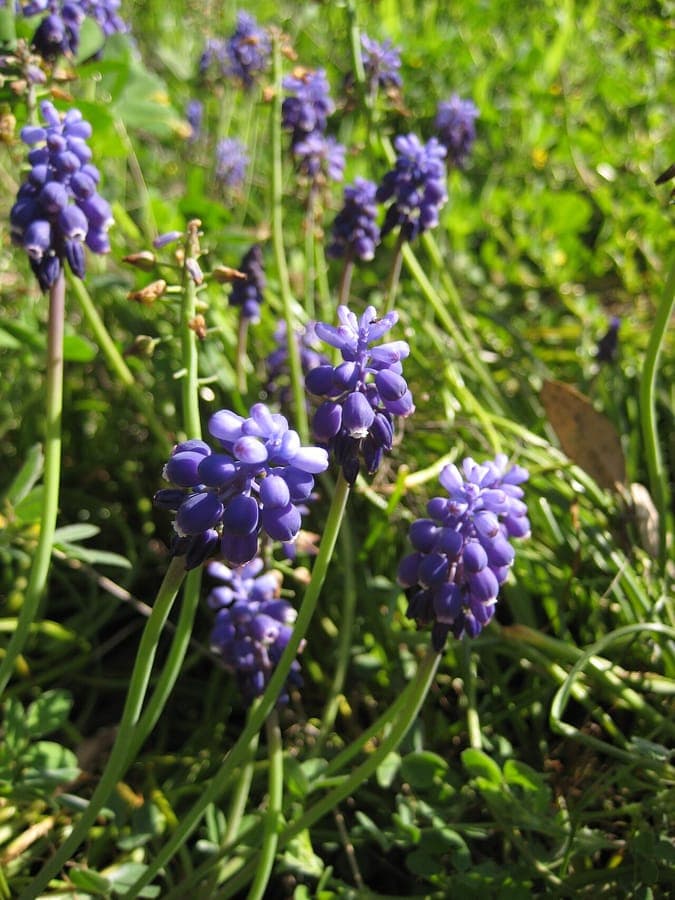
Liveon001 ©Travis Witt / CC BY-SA 3.0, via Wikimedia Commons
Grape-hyacinth: complete guide
Muscari botryoides
Want to see Grape-hyacinth: complete guide in your garden?
1 minute, no credit card
Overview
Muscari botryoides, commonly known as Grape-hyacinth, is a small but spirited spring bulb that brings rich blue color to gardens from March through May. Native to regions across Southern and Central Europe-from Austria and Greece to Italy and Bulgaria-this herbaceous perennial belongs to the Asparagaceae family. It thrives in open woodlands, rocky slopes, and grassy hillsides, which tells you everything you need to know about its preferred growing conditions: well-drained soil and partial shade.
What makes Grape-hyacinth a favorite among gardeners is its reliability and modest charm. It naturalizes easily, forming soft drifts under shrubs, along pathways, or in lawns mown late in the season. Once planted, it returns year after year with minimal care. You plant it once, and it does the rest. On gardenworld.app, you can design a garden layout that highlights these little blue gems alongside taller spring bloomers.
Appearance & bloom cycle
Grape-hyacinth grows 10 to 15 cm tall, making it ideal for the front of borders or as an underplanting for tulips and daffodils. Its flowers are deep blue, almost indigo, arranged in dense, grape-like clusters of tiny, urn-shaped blooms. The foliage is narrow, linear, and bright green, emerging at the same time as the flower stalks.
Bloom time ranges from March to May, depending on your climate and exposure. In mild winters, you might see shoots as early as late February. After flowering, the leaves remain for about six weeks to replenish the bulb's energy stores. Do not cut them down prematurely-wait until they yellow and wither naturally.
Ideal location
Choose a spot with light to partial shade. Full sun is acceptable in cooler northern zones, but in warmer areas, afternoon shade prevents the soil from drying out too quickly. Grape-hyacinths do best under deciduous trees or shrubs, where they receive early sun before the canopy fills in.
They also work well in rock gardens, raised beds, or containers, provided the pot has drainage holes. Avoid waterlogged areas-these bulbs hate wet feet. For naturalistic planting, toss the bulbs and plant them where they land. It creates a more organic look. Use gardenworld.app to map out your bulb density and spacing before you start planting.
Soil requirements
Well-drained soil is non-negotiable. Heavy clay can be improved with grit, sand, or compost. A pH between 6.0 and 7.5 is ideal. Grape-hyacinths tolerate slightly acidic to neutral soils but struggle in highly alkaline conditions.
Plant bulbs 5 to 8 cm deep, spaced 5 to 7 cm apart. In poor soil, they actually bloom better-rich soil encourages leaf growth at the expense of flowers. Let the soil do the work; these are tough plants that adapt well once established.
Free design
Want to see Grape-hyacinth: complete guide in your garden? Make a free design now.
Watering
Water thoroughly once after planting. After that, they're largely drought-tolerant. In average UK or Pacific Northwest climates, rainfall is sufficient. During prolonged dry spells in early spring-especially if flower buds are forming-give them a light soak.
In containers, check the top 2 cm of soil. If it's dry, water in the morning or evening to reduce evaporation. Never leave pots sitting in water-this invites rot. In winter, reduce watering significantly, especially in cold, damp climates.
Pruning
No pruning is needed. Remove spent flower stalks if they become unsightly, but leave the foliage intact. Cutting the leaves too early starves the bulb and reduces flowering the following year. Wait until they turn yellow or brown before snipping them off at soil level.
Maintenance calendar
- September–October: Plant new bulbs
- March–May: Bloom period; monitor for weeds
- June: Let foliage die back naturally
- July–August: Dormant phase; no action required
- Every 3–4 years: Divide and replant if overcrowded
Lift and divide bulbs only when clumps become too dense, usually every few years. Do this after the leaves have fully withered, typically in late June. Replant immediately or store in a cool, dry place until autumn.
Winter hardiness
Muscari botryoides is hardy in USDA zones 4 to 8. It withstands freezing temperatures without protection. In zone 4, a light mulch of straw or leaves can help insulate the bulbs during prolonged cold snaps with little snow cover. In pots, move containers to a sheltered spot or against a wall to reduce freeze-thaw cycles.
Companion plants
Pair Grape-hyacinth with other early spring bulbs like Crocus, Scilla, or Narcissus 'Tête-à-tête'. It looks stunning beneath late-flowering tulips, where the blue contrasts beautifully with red, yellow, or white. For a woodland effect, combine with Anemone blanda or Erythronium.
Avoid aggressive ground covers like ivy or mint, which can choke out the bulbs. Instead, use low, slow growers like Ajuga or barren strawberry (Waldsteinia). Their textures complement the upright spikes of Muscari without competing for space.
Closing
Grape-hyacinth is a no-fuss, high-reward plant that adds early color and structure to any garden. It's perfect for beginners and seasoned gardeners alike. Once established, it spreads gently, creating natural-looking drifts that come back stronger each year. Buy bulbs in autumn from local garden centres and plant them right away. With minimal effort, you'll enjoy a burst of blue every spring. Keep track of your plantings using gardenworld.app so you never forget where you planted your bulbs.
Want to see Grape-hyacinth: complete guide in your garden? Make a free design now.
Upload a photo, pick a style, and get a photorealistic design with plant list in under a minute.
No credit card required


Similar plants
Narrow-leaved dracaena: complete guide
Dracaena angustifolia
Everything about Dracaena angustifolia - the narrow-leaved dracaena: location, care, overwintering and use as a houseplant or patio plant.
Chaparral yucca: complete guide to Hesperoyucca whipplei
Hesperoyucca whipplei
Hesperoyucca whipplei (Our Lord's candle) is a dramatic rosette-forming plant from California that produces a towering flower spike, ideal for dry and gravel gardens.
False lily-of-the-valley: complete guide
Maianthemum dilatatum
Everything about Maianthemum dilatatum, the false lily-of-the-valley. Care, shade location, propagation and garden combinations for this popular shade ground cover.