
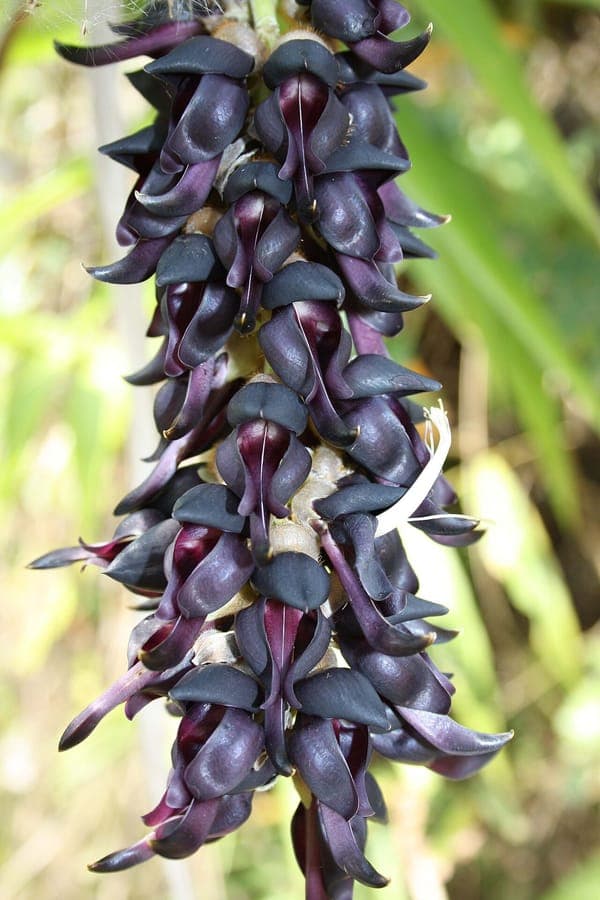
Agong1 / CC BY-SA 3.0, via Wikimedia Commons
Mucuna pruriens: complete guide to velvet bean, cowitch vine
Mucuna pruriens
Want to see Mucuna pruriens: complete guide to velvet bean, cowitch vine in your garden?
1 minute, no credit card
Overview
Mucuna pruriens, commonly known as velvet bean, cowitch, or itchy bean, is a vigorous tropical climbing vine native to Africa and Asia. This plant is notable for its spectacular purple flowers, unusual fuzzy seed pods, and diverse applications. It is both ornamental and functional crop with medicinal and nutritional value.
Mucuna pruriens is cultivated in many tropical regions for nutrition, soil improvement, and medicinal purposes. The seeds contain L-dopa, a substance with health benefits.
Appearance and bloom
Mucuna pruriens grows as a vigorous climbing vine with long, strong twining stems. The plant can reach 5-10 meters or more when supported. The leaves are large, green, and compound with three leaflets.
The flowers are the highlight of this plant. They appear in long, hanging racemes of spectacular purple, violet, or sometimes pink flowers. Each flower is approximately 1.5-2 cm long and highly showy. Blooming occurs from summer through fall.
After flowering, long pods develop that are completely covered with very fine, fuzzy hairs. These hairs can cause skin irritation. The seeds are large, approximately 3 cm, and dark brown in color.
Ideal location
Mucuna pruriens grows best in full sun to partial shade. The plant thrives in warm climates and cannot be grown in areas with regular frost. In temperate climates, it can only be cultivated seasonally in containers.
The plant requires strong support, such as a trellis, pergola, or sturdy wire. It can be trained on other large plants as support.
Warmth and humidity are very important for good growth.
Soil
Mucuna pruriens grows best in fertile, organically rich soil. The plant accepts a broad pH range of 5.5-8.0. Add compost and organic material to the planting hole.
Good drainage is important, though the plant is fairly moisture-loving. In containers, use premium potting mix with extra organic matter.
The plant tolerates poor soils and can even improve them through nitrogen fixation.
Free design
Want to see Mucuna pruriens: complete guide to velvet bean, cowitch vine in your garden? Make a free design now.
Watering
Mucuna pruriens is moisture-loving and requires regular watering during the growing season. Water so the soil remains moist. In containers, water more frequently.
Consistent moisture is important, especially when flowering begins. Soggy roots can cause rot, so good drainage is essential.
Water more frequently during dry periods.
Pruning
Mucuna pruriens can be pruned aggressively to control growth. Cut back in spring to encourage more compact growth.
Remove dead or diseased wood. Pruning after flowering may encourage next-season growth.
The plant responds well to pruning and will regrow with multiple branches.
Maintenance calendar
May-June: Plant beginning, set up supports. July-August: Growth, regular watering. September-October: Flowering, maintain moisture. November-March: Winter rest, minimal watering.
Winter hardiness
Mucuna pruriens is not winter-hardy and dies back at temperatures below 10 C. In cold climates, it can only be grown as an annual or in containers that can be brought indoors.
In tropical and subtropical regions (zone 10+), it can grow permanently outdoors. In zone 9, it can grow in protected locations.
Companion plants
Mucuna pruriens works well with other tropical climbers for support. Combine with Passiflora, Thunbergia, or Clitoria ternatea for color contrast.
In gardens, plant alongside other food crops like Sesamum or Aleurites.
For ornamental purposes, combine with flowering perennials like Dahlia or Gladiolus.
Closing remarks
Mucuna pruriens is a fascinating climbing vine with many benefits. With warm conditions, good drainage, and regular watering, this plant thrives and flowers abundantly. The spectacular purple blooms and unique pods make it both ornamental and functional.
This plant can be obtained as seed or starter plants in tropical regions. For more information, visit gardenworld.app.
Want to see Mucuna pruriens: complete guide to velvet bean, cowitch vine in your garden? Make a free design now.
Upload a photo, pick a style, and get a photorealistic design with plant list in under a minute.
No credit card required


Similar plants
Tall Silky Lupine: complete guide
Lupinus elatus
Tall silky lupine is a fast-growing Californian perennial with silvery foliage and blue-purple flower spikes, ideal for a prairie-style garden.
Garfield Lupine: complete guide
Lupinus garfieldensis
The Garfield lupine is a rare, fast-growing American perennial for alkaline, dry grassland gardens, with striking blue flower spikes.
Lupinus elegans: complete guide
Lupinus elegans
Lupinus elegans, the elegant lupine, is a spectacular blooming plant from Mexico with blue flower spikes. Care, cultivation and garden use.