
Khalid Mahmood / CC BY-SA 3.0, via Wikimedia Commons
Morus macroura: complete guide
Morus macroura
Want to see Morus macroura: complete guide in your garden?
1 minute, no credit card
Overview
Morus macroura, known as Himalayan mulberry or long mulberry, is a fascinating fruit tree from the Himalayas and South China. This fast-growing tree belongs to the Moraceae family and is known for its long, juicy fruits and robust growth. For gardeners with ample space, this is a valuable addition.
This tree is native to mountainous areas from the Himalayas to Java and Sumatra. The tree grows rapidly and eventually becomes a medium to large specimen. This is a tree with practical fruit production and attractive appearance.
Appearance and Bloom
Morus macroura grows into a medium-sized tree with an open, spreading crown and dark green foliage. The leaves are heart-shaped, rough textured and dark green. The tree has a full, healthy appearance.
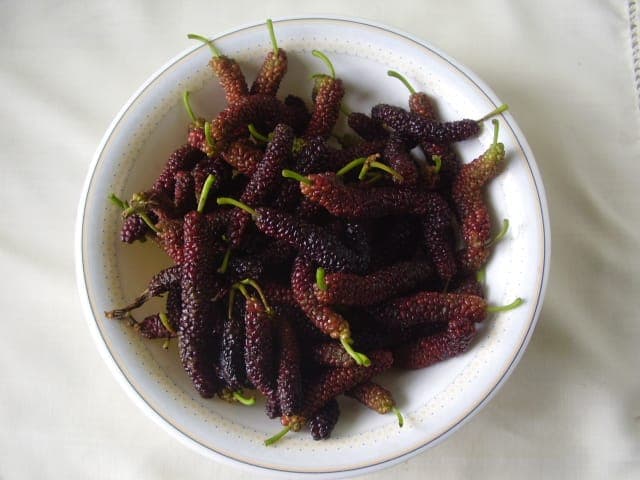
The flowers are discrete catkins that appear in spring. The fruits are the most distinctive feature - very long, deep red to black, juicy mulberries. The fruits grow to 5-8 cm long and are exceptionally juicy and sweet. This is a highly productive species.
Ideal Location
This tree thrives best in full sun. A minimum of six hours of direct sunlight daily is essential for optimal growth and fruit production. In very warm climates, some afternoon shade may be welcome.
Choose a location with some wind protection, though the tree is reasonably wind-resistant. Provide ample space - this tree can reach 10-15 meters or more. Plan ahead for mature size. Avoid locations directly near structures where falling fruit could be problematic.
Soil
Morus macroura is flexible about soil type and grows in various soils. The tree accepts acidic to alkaline pH. Well-draining soil is beneficial, though the tree is rather moisture-loving.
The tree thrives even in moderate, even somewhat nutrient-poor soils. Add organic matter where available - compost helps water retention. pH 6.0-8.5 is acceptable. This is not a fussy tree about soil quality.
Watering
During youth (first year), water regularly for root development. Once established, the tree is reasonably drought-tolerant, though moister soil stimulates more fruit production.
In dry regions or drought years, water in deep periods. Young trees benefit from more consistent moisture. Once mature, the tree can handle longer dry spells. Drip irrigation is useful in arid regions.
Free design
Want to see Morus macroura: complete guide in your garden? Make a free design now.
Pruning
This tree is vigorous and pruning-tolerant. Youth-shaping is useful to create a well-formed specimen. Remove conflicting branches and cross-branches for an open crown.
Older trees need minimal pruning. Remove only dead, damaged, or diseased branches. Heavy pruning inhibits growth but the plant recovers quickly. Early morning or late autumn best for pruning.
Maintenance Calendar
Early Spring (March-April): Check tree health. Add organic matter. Begin regular watering as growth starts.
Spring (April-May): Growth period. Monitor growth. Support young trees with stakes if necessary.
Summer (June-August): Full growth. Fruits ripen. Monitor moisture. First red, then black - harvest when black.
Autumn (September-October): Harvest period. Fruits abundant. Apply fertilizer for nutrition.
Winter (November-February): Tree is dormant. Minimal maintenance. Prune as needed.
Winter Hardiness
Morus macroura is winter hardy to approximately -10 to -15 degrees Celsius, depending on provenance. Himalayan origin is hardier than lowland forms. This tree is suitable for temperate and subtropical climates.
In very cold regions (below -20 degrees), protection may be useful for young trees. Established trees survive hard winters. Protect against extreme north winds.
Companion Plants
Morus macroura combines well with other fruit trees and useful plants:
Mango: Tropical partner, similar sun requirements.
Walnut: Temperate partner, complementary season.
Chestnut: Mountain region compatible, similar fruit value.
Strawberry Tree: Mediterranean appearance, different season.
Blackcurrant: Low-growing, underplanting, different season.
Closing Thoughts
Morus macroura offers gardeners a spectacular fruit tree with long, delicious fruits and robust growth. The tree grows rapidly and becomes productive quickly. For gardeners with ample space and in suitable climate, this is a valuable addition.
The fruits are very tasty fresh, ideal for fresh consumption or jam-making. The tree supports bees and pollinators that produce female flowers. This is a tree both useful and decorative. Available from specialized tree nurseries or online. Plant via gardenworld.app for fruit tree design and landscape inspiration.
Want to see Morus macroura: complete guide in your garden? Make a free design now.
Upload a photo, pick a style, and get a photorealistic design with plant list in under a minute.
No credit card required


Similar plants
Brosimum guianense: complete guide
Brosimum guianense
Guiana snakewood: exotic tree from South America with valuable timber. Cultivation and care for warm-climate gardens.
Maclura tinctoria: complete guide
Maclura tinctoria
Learn how to grow Maclura tinctoria or Cubanwood. This beautiful tree offers shade, food and dye possibilities in your garden.
Morus celtidifolia: complete guide
Morus celtidifolia
Discover Texas mulberry, a fruit-bearing tree from Central America with distinctive foliage and sweet berries. Learn care requirements, growing tips, and ideal conditions for this warm-climate species.