
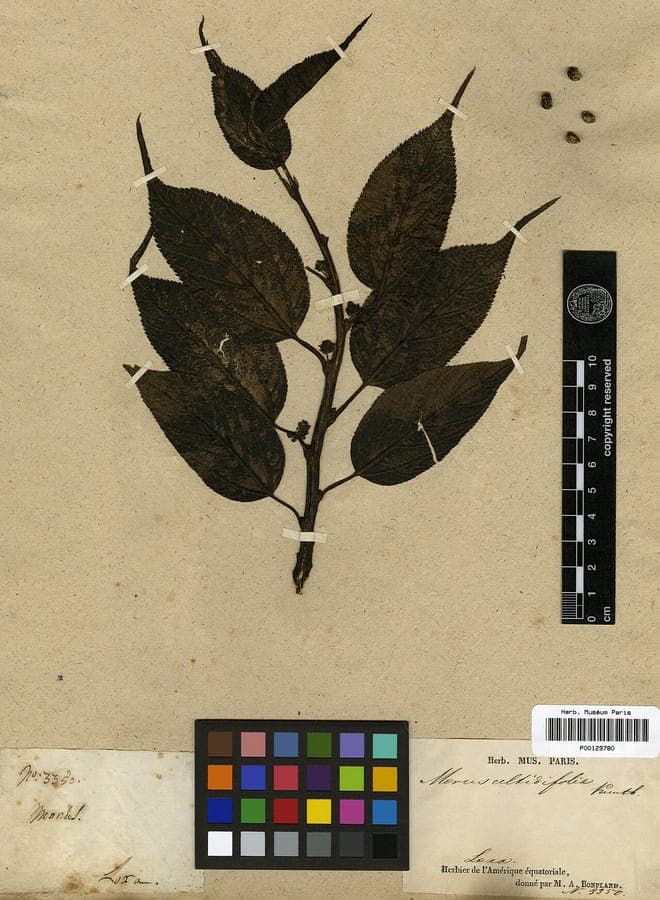
Aimé Bonpland - Museum national d'histoire naturelle (MNHN), Paris / CC BY-SA 1.0, via Wikimedia Commons
Morus celtidifolia: complete guide
Morus celtidifolia
Want to see Morus celtidifolia: complete guide in your garden?
1 minute, no credit card
Overview
Morus celtidifolia, commonly known as Texas mulberry, is a fascinating fruit-bearing tree native to Central America, Mexico, and the Andes. Prized for its delicious fruit that ripens from red to black and its distinctive, attractive foliage, this tree thrives in warm climates where both food production and ornamental value are desired. The Texas mulberry is a relation of the common white mulberry (Morus alba) but distinguishes itself through its tropical origins and preference for warm temperatures.
Appearance and bloom
The Texas mulberry is a medium to large tree reaching 8 to 15 meters tall depending on growing conditions. Leaves are oval to lanceolate with interesting venation patterns. The crown is compact and broad, providing substantial shade. Rather than showy flowers, the tree produces inconspicuous blooms followed by fruit. Berries begin green, mature through red, and become black when ripe. They measure approximately 2-3 centimeters in length and offer a pleasant, slightly sweet flavor.
Ideal location
This tree thrives in full sun with at least six hours of direct sunlight daily. In warm, Mediterranean climates, Morus celtidifolia tolerates light afternoon shade. The tree suits protected locations, such as against south-facing walls or sheltered garden corners. Avoid windy exposures as branches can be fragile. The tree prefers a sheltered, warm microclimate where it can flourish year-round.
Soil
Morus celtidifolia is not fussy regarding soil type, as long as drainage is excellent. Ideal is a light sandy or loamy-sandy soil rich in organic matter. pH may range between 6.0 and 7.5. Heavy clay soils should be amended with sand, humus, and small stones to improve aeration. Ensure water does not stagnate after heavy rains; waterlogging causes root rot. Plant on a slightly elevated area to prevent moisture accumulation.
Watering
During the first growing year, water regularly, especially during dry periods. Once established, the tree is relatively drought-tolerant. During the growing season (May through September), water when the top 5 centimeters of soil are dry. In winter dormancy, drastically reduce watering; minimal moisture is needed. During extended dry spells (more than three weeks without rain), provide light watering. Ensure water drains quickly; the tree cannot tolerate marshy conditions.
Free design
Want to see Morus celtidifolia: complete guide in your garden? Make a free design now.
Pruning
Morus celtidifolia can be shaped to create an attractive form. Pruning is best conducted in late winter (January-February) before new growth emerges. Remove crossing branches, dead wood, and hindering limbs. Keep the canopy open for light penetration. To maximize fruiting, focus on maintaining horizontal branches where fruit production is concentrated. Avoid heavy pruning after May, as this can compromise flowering and fruit set.
Maintenance calendar
January-February: Pruning and shaping; remove dead wood. March: Growing season begins; water regularly. April-May: Prepare for flowering; monitor actively. June-September: Fruiting period; water during drought. October-November: Prepare for dormancy; reduce watering. December: Dormancy period; minimal maintenance. Inspect twice yearly for pests and diseases.
Winter hardiness
Morus celtidifolia is frost-sensitive. This tree does not tolerate temperatures below -8°C. In temperate climates (minimum temperatures above -5°C), the tree can overwinter in protected sites. In colder regions, cultivate as a container plant brought indoors before winter. Severe frost will likely kill the tree. In cold climates, plant in a very sheltered courtyard or grow as a container specimen.
Companion plants
Morus celtidifolia pairs well with other warm-loving Mediterranean plants such as Citrus, Olea (olive), or various Prunus species. At the tree's base, warm-loving groundcovers thrive, such as Rosmarinus or Lavandula. Avoid dense undergrowth, which creates competition and moisture retention issues. The tree casts heavy shade, so avoid planting shade-intolerant species beneath it.
Closing remarks
Morus celtidifolia provides years of food and shade when planted in suitable climates and well-maintained. The tree requires patience; first fruit appears only after 2-3 years. Once mature, the tree is highly reliable and productive. Berries are delicious eaten fresh or processed into jam. Young trees are available through specialist nurseries, particularly in warm regions. Discover more warm-climate fruit trees on gardenworld.app and expand your edible landscape with unique, exotic varieties.
Want to see Morus celtidifolia: complete guide in your garden? Make a free design now.
Upload a photo, pick a style, and get a photorealistic design with plant list in under a minute.
No credit card required


Similar plants
Morus macroura: complete guide
Morus macroura
Himalayan mulberry with long fruits. Fast-growing, edible berries, winter hardy. Suitable for large gardens and landscapes.
Brosimum guianense: complete guide
Brosimum guianense
Guiana snakewood: exotic tree from South America with valuable timber. Cultivation and care for warm-climate gardens.
Maclura tinctoria: complete guide
Maclura tinctoria
Learn how to grow Maclura tinctoria or Cubanwood. This beautiful tree offers shade, food and dye possibilities in your garden.