
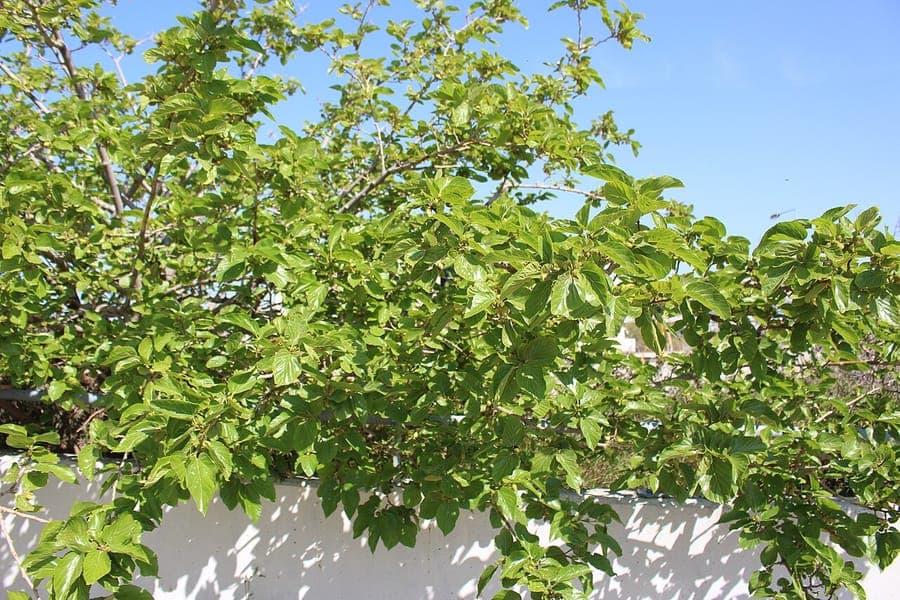
Emőke Dénes / CC BY-SA 4.0, via Wikimedia Commons
Russian mulberry: complete guide
Morus alba
Want to see Russian mulberry: complete guide in your garden?
1 minute, no credit card
Overview
Morus alba, commonly known as Russian mulberry, is a hardy, fast-growing tree that thrives in temperate climates. Native to central China, it's now widely cultivated across Europe and North America for its edible fruit, shade, and adaptability. In the UK and Northern Europe, it's a popular choice for large gardens, wildlife spaces, and even urban yards. Gardeners appreciate its resilience and low care needs, making it a practical addition to many landscapes. On gardenworld.app you can create a custom garden layout that integrates Morus alba seamlessly into your space.
This species grows as a tree or can be trained as a large shrub, depending on pruning. Mature specimens typically reach 8–12 metres in height with a spread of 6–8 metres. It grows quickly-up to 60 cm per year under good conditions-and develops a broad, rounded crown. As a deciduous tree, it loses its leaves in autumn but flushes with fresh green growth by late spring.
Appearance & bloom cycle
The Russian mulberry has shiny, deep green leaves that are simple and oval-shaped on mature wood, though juvenile growth may show lobed or toothed margins. In April and May, it produces small, green, catkin-like flowers that hang in clusters. These wind-pollinated blooms are inconspicuous but essential for fruit set.
Fruit development follows shortly after, with berries ripening from June to July. Despite the name 'white mulberry', the fruit can range from white to pink, purple, or nearly black when fully ripe. The taste is sweet with a subtle tang, less intense than Morus nigra. The berries are excellent for eating fresh, in jams, or as a topping for desserts.
Ideal location
Choose a spot with full sun-at least level 7 on a 1–10 light scale-for best growth and fruiting. While the tree tolerates partial shade, fruit yield drops significantly. Allow at least 4 metres of clearance from buildings, fences, or other trees to avoid root competition and structural damage.
Due to its vigorous root system, avoid planting near drains, septic tanks, or building foundations. In compact gardens, consider root barriers or raised beds to manage spread. On gardenworld.app, you can simulate how a mulberry tree will fit in your garden design before planting.
Soil requirements
Morus alba is adaptable to many soil types, as long as drainage is adequate. It prefers a pH between 5.0 and 7.0-slightly acidic to neutral. It grows well in loam, sandy soil, and even chalky ground, provided it retains some moisture during dry spells. Heavy clay soils should be amended with grit or compost to improve drainage.
A light application of compost or balanced fertiliser in early spring is sufficient. Avoid high-nitrogen feeds, which promote leafy growth at the expense of fruit.
Free design
Want to see Russian mulberry: complete guide in your garden? Make a free design now.
Watering
Young trees need consistent watering during their first two growing seasons-about 10–15 litres per week during dry periods. Once established, Russian mulberry is highly drought-tolerant. Mature trees rarely need supplemental water, except during prolonged droughts lasting over three weeks.
Water deeply at the base to encourage deep root development. Avoid frequent shallow watering, which encourages weak surface roots.
Pruning
Pruning isn't strictly necessary, but it helps maintain shape and improve air circulation. Prune in late winter or early spring before bud break. Remove dead, damaged, or crossing branches, and thin out crowded areas in the crown.
For shrub form, allow multiple stems and cut back top growth annually. For tree form, select a single leader and remove lower branches up to 1.5 metres. Be aware that pruning in spring may cause sap bleeding, but this doesn't harm the tree.
Maintenance calendar
- January: Inspect for winter damage, plan pruning.
- February: Remove dead wood, prune as needed.
- March: Apply compost around the base.
- April: Monitor flowering, protect from late frosts if needed.
- May: Watch for aphids or fungal issues in wet weather.
- June: Begin harvesting ripe berries.
- July: Finish harvest, net if birds are a problem.
- August: No routine care, unless extreme drought.
- September: Leave fallen leaves as natural mulch.
- October: Clear leaves if fungal disease is present.
- November: No action required.
- December: Tree is dormant.
Winter hardiness
Morus alba is hardy in USDA zones 6–9. In the UK (zone 8), it survives most winters without protection. Young trees benefit from a mulch layer of straw or leaf litter around the base for the first 2–3 winters. Temperatures below -18°C may damage buds, but the tree usually recovers well in spring.
Companion plants
Plant drought-tolerant perennials beneath the canopy, such as lavender, catmint, or yarrow. Avoid aggressive groundcovers like ivy that can climb and girdle the trunk. Fruit trees like apple or pear make good companions if spaced properly.
Closing
The Russian mulberry is a reliable, productive tree that offers shade, fruit, and visual interest with minimal upkeep. It's a smart choice for gardeners seeking a tough, edible landscape feature. Available at major garden centres across the UK and Europe. Explore design ideas on gardenworld.app to see how it fits your outdoor space.
Want to see Russian mulberry: complete guide in your garden? Make a free design now.
Upload a photo, pick a style, and get a photorealistic design with plant list in under a minute.
No credit card required


Similar plants
Morus macroura: complete guide
Morus macroura
Himalayan mulberry with long fruits. Fast-growing, edible berries, winter hardy. Suitable for large gardens and landscapes.
Brosimum guianense: complete guide
Brosimum guianense
Guiana snakewood: exotic tree from South America with valuable timber. Cultivation and care for warm-climate gardens.
Maclura tinctoria: complete guide
Maclura tinctoria
Learn how to grow Maclura tinctoria or Cubanwood. This beautiful tree offers shade, food and dye possibilities in your garden.