
Samuel Curtis and William Jackson Hooker / Public domain, via Wikimedia Commons
Calabash-nutmeg: complete guide
Monodora myristica
Want to see Calabash-nutmeg: complete guide in your garden?
1 minute, no credit card
Overview
Monodora myristica, commonly known as calabash-nutmeg, African nutmeg, or false nutmeg, is a fascinating tropical tree native to West and Central Africa. Growing naturally in rainforests of countries like Nigeria, Cameroon, Congo, and Ghana, it is prized for both its aromatic seeds and medicinal properties. The tree can reach 15 to 25 meters in its native habitat, though container-grown specimens remain much more compact.
The plant is known for striking, distinctively-shaped flowers and fragrant, egg-shaped seed capsules containing aromatic seeds. Unlike true nutmeg (Myristica fragrans), this belongs to an entirely different plant genus. The fruit and seed profile differ noticeably from conventional nutmeg, with a more complex flavor and aroma. While tropical, cultivation in southern Europe and other subtropical regions is possible for specialized growers.
Appearance and bloom
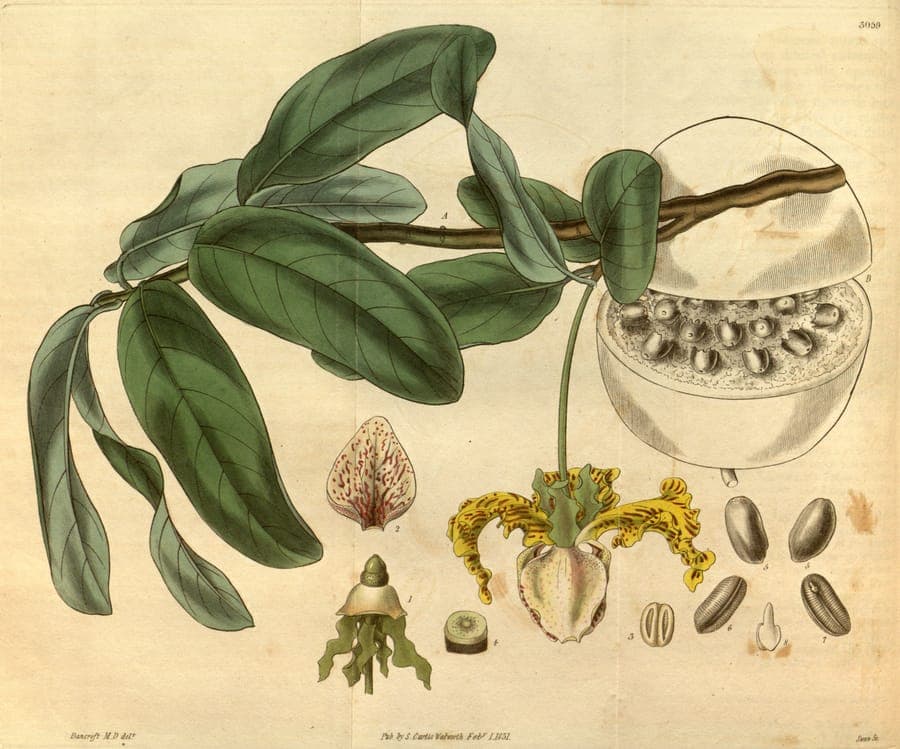
The calabash-nutmeg tree has a striking and characteristic appearance. The leaves are large, elliptic to lance-shaped, approximately 15 to 30 centimeters long, dark green, leathery, and glossy. They grow alternately along branches with prominent veining.
The flowers are particularly interesting: they possess a unique, somewhat irregular form with thick, yellowish-reddish petals opening at different levels. Flowers grow solitary or in small clusters, directly from branches or even the trunk (cauliflory), typical of tropical rainforest trees. The blooms emit a subtle, pleasant fragrance. The fruit is large, ovoid to globular, approximately 8 to 12 centimeters in diameter, yellowish-green to brownish, with thick skin and multiple seeds surrounded by arillus.
Ideal location
The calabash-nutmeg requires warm, subtropical to tropical climate for successful growth. The plant thrives in temperatures between 20 and 30 degrees Celsius, with minimum winter temperatures not below 10 to 15 degrees Celsius. In temperate climates, this is suited only to protected greenhouse conditions or very warm regions outdoors.
The tree prefers partial shade in extremely hot climates, though it grows equally well in full sun provided moisture is adequate. In containers, this frost-sensitive tree can be moved indoors during winter in temperate regions. Provide protection from strong winds and moisture-loss stress.
Soil
The calabash-nutmeg grows best in nutrient-rich, well-draining soil with high organic matter content, as found in natural tropical environments. Heavier soil types work if well-draining. The plant prefers slightly acidic to neutral soil, ideal pH 6.0 to 7.0. Adding abundant compost or leaf matter improves soil structure and water retention.
Use nutrient-rich potting compost for container cultivation with good amendments. Regular slow-release fertilizer application supports growth and fruiting. Ensure adequate nutrition, particularly potassium, magnesium, and trace elements.
Free design
Want to see Calabash-nutmeg: complete guide in your garden? Make a free design now.
Watering
The calabash-nutmeg is highly water-demanding and thrives in tropical moisture conditions. Regular watering is essential, especially during growth periods and frost-free seasons. Never allow soil to dry completely between watering, but avoid waterlogging. Daily watering may be necessary in very hot periods. During winter dormancy, watering can be reduced.
In container cultivation, regular misting of foliage is beneficial to promote higher humidity around the plant, mimicking tropical conditions. Drought causes leaf drop and growth decline.
Pruning
The calabash-nutmeg requires relatively little pruning in early years. For container plants, frost-prevention pruning and shape training may be done to maintain compact form. The tree naturally grows as a central stem with lateral branches. Old or damaged branches may be removed.
To stimulate fruiting, excessively long, thin branches can be lightly shortened, though this is not absolutely necessary. For severely overgrown container specimens, hard pruning in early spring helps rebalance growth.
Maintenance calendar
May-June: Warm season and growing period; frequent watering, regular feeding. July-August-September: Peak growth season; vigorous growth, moisture feeding; possible blooming and early fruiting. October-November-December: Frost season; reduced watering and feeding; move indoors in temperate climates. January-February-March: Dormancy; minimal watering and feeding, prepare for new season. April-May: Growth restarts; restore feeding, increase watering.
Winter hardiness
The calabash-nutmeg is not frost-hardy in temperate climates and dies at temperatures below 0 degrees Celsius. Even light frost (below 10 degrees) causes leaf drop and growth stoppage. This tree should preferably overwinter in protected environments or greenhouse structures in temperate regions. In southern France, Spain, Portugal, and Italy it can grow under protection but still faces frost risk.
Southern Spain, southern Portugal, southern Italy, and southern Greece offer better opportunities for outdoor cultivation. Users in temperate climates should plan container cultivation with winter housing.
Companion plants
In tropical gardens, calabash-nutmeg can be associated with other warm-loving plants like bananas, citrus, avocado, mango, and coconut palms. In container settings (for temperate climates), it can be positioned near other tropical container-growing plants such as bromeliads, orchids, and other heat-loving specimens.
The tree also provides attractive shade for somewhat shadier tropical plants. In its native habitat, it naturally grows in rainforest tree associations with abundant understory foliage and high humidity levels.
Conclusion
The calabash-nutmeg is an exotic and interesting plant for gardeners in warm to subtropical regions, or for tropical plant enthusiasts in temperate climates willing to undertake container cultivation with winter housing. The aromatic seeds have traditional and culinary applications, though the tree is primarily appreciated for its distinctive appearance and tropical character. For professional guidance integrating exotic plants into your garden, consult gardenworld.app.
Want to see Calabash-nutmeg: complete guide in your garden? Make a free design now.
Upload a photo, pick a style, and get a photorealistic design with plant list in under a minute.
No credit card required


Similar plants
Corkwood: complete guide
Annona glabra
Grow corkwood (Annona glabra) for tropical fruit. Pond-apple tree for wet gardens, edible fruit, soft tropical flesh.
Wild custard-apple: complete guide
Annona senegalensis
Discover Annona senegalensis - a delicious African fruit tree with creamy, sweet fruit. Read our full guide on growing, harvesting, and cultivating this exotic fruiting plant.
Pawpaw Tree: complete guide
Asimina triloba
Discover Asimina triloba, the Pawpaw or Indian-banana. A North American fruit tree with large leaves, purple flowers, and delicious yellow-green fruits. Edible fruits.