
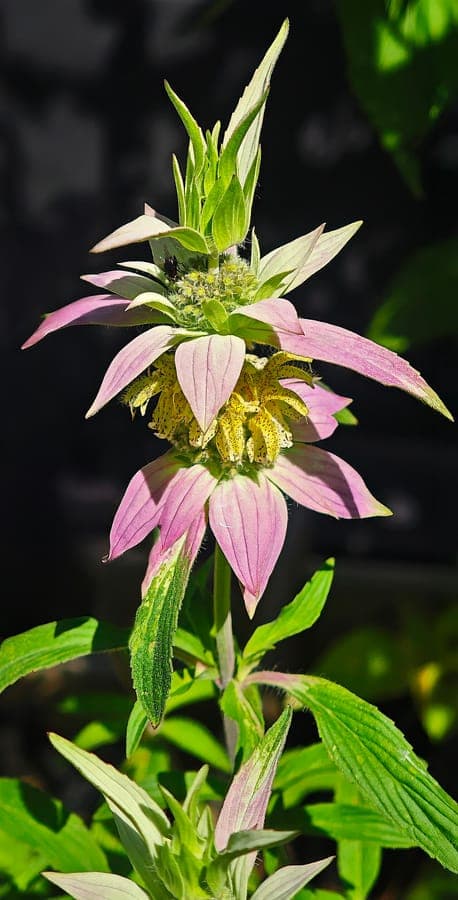
Didier Descouens / CC BY-SA 4.0, via Wikimedia Commons
Dotted Monarda: complete guide
Monarda punctata
Want to see Dotted Monarda: complete guide in your garden?
1 minute, no credit card
Overview
Monarda punctata, commonly known as dotted monarda or spotted horse-mint, is a distinctive North American native plant increasingly popular in temperate gardens. This robust perennial excels in sunny, dry locations where many ornamentals struggle. The striking spotted flowers arranged in stacked whorls around upright stems create a uniquely graphic garden presence.
The plant typically reaches 60 to 90 centimeters tall and forms dense, compact clusters. Flowering runs from June through September. The blooms are exceptionally attractive to butterflies, bees, and other pollinators, making it an excellent choice for wildlife-supporting gardens. Originally from the open, dry grasslands of North America, it thrives equally well in temperate climates and is completely winter-hardy to at least -15 degrees Celsius.
Appearance and bloom
Dotted monarda is immediately recognizable thanks to its highly distinctive flowering structure. The small flowers, typically white, purple, or red with dark speckles, form vertical rings stacked along the stem. This creates an architectural appearance that commands attention. The leaves are linear to lance-shaped, approximately 3 to 5 centimeters long, dark green, and lightly downy.
The stems are upright, strong, and less branched than other monarda species, making them suitable for cut flower arrangements. The flowering period extends from early June through mid-September, depending on climate and weather conditions.
Ideal location
Monarda punctata thrives in full sun, requiring at least 6 to 8 hours of direct sunlight daily. More sun means stronger flowering and more compact growth. In shaded locations, the plant becomes lanky with fewer flowers. It requires no special protection and grows well in open, windy terrain.
Avoid planting in heavily shaded corners or beneath large trees. A southeast-facing position is ideal, particularly because the plant dislikes moisture-logged soil. In very warm regions, it tolerates light afternoon shade from nearby low shrubs without significant growth compromise.
Soil
Dotted monarda is not particularly demanding about soil composition, but good drainage is absolutely crucial. The plant thrives in sandy, slightly loamy soils and tolerates even very lean soil. It is essential that the soil drains well. Heavy clay must be improved with sand or compost before planting.
Soil pH should be neutral to slightly acidic, ideally between 6.0 and 7.5. Fertilization is usually unnecessary; the plant actually performs better in less nutrient-rich soil. Light slow-release fertilizer at planting helps, but is not essential. Good drainage matters far more than soil fertility.
Free design
Want to see Dotted Monarda: complete guide in your garden? Make a free design now.
Watering
After planting, water regularly until the plant establishes roots (approximately 4 to 6 weeks), then water only during dry periods. Once established, this is an extremely drought-tolerant plant requiring minimal supplemental irrigation. Too much water is more harmful than too little.
During dry, hot summers, young plants may need watering once weekly. However, mature plants tolerate drought excellently, making them perfect for xeriscaping or water-conscious gardens. Always water at soil level, never overhead, to prevent fungal diseases. Early morning watering is best practice.
Pruning
Dotted monarda requires minimal pruning. After flowering, stems can be cut back to approximately 15 centimeters above ground if the plant appears tired or overgrown. This stimulates compact growth and encourages repeat blooming. In spring, any dead stem sections can be removed as growth begins.
The plant flowers prolifically without requiring deadheading, though deadheading prevents fuzzy seed heads if desired. For rejuvenating older, leggy plants, cutting back completely to 10 centimeters in spring stimulates more compact regrowth.
Maintenance calendar
March-April: Inspect for winter damage; no feeding needed. May: Growth begins; water during dry spells. June: Flowering starts; deadheading optional. July-August: Peak flowering, minimal watering needed. September-October: Late flowers; remove spent stem tops if desired. November-March: Dormancy; no maintenance required.
Winter hardiness
Monarda punctata is very frost-hardy, completely winter-hardy in temperate zones to USDA zone 5 (approximately -15 degrees Celsius). The plant survives winters in the UK and throughout most of Europe without protection. In even colder climates, a thin leaf mulch in autumn provides root protection.
After above-ground parts die back, the plant regrows from roots each spring. Wet, heavy winters are more problematic than frost alone; therefore, good drainage matters more than frost protection.
Companion plants
Dotted monarda pairs beautifully with other drought-tolerant, sun-loving plants such as Russian sage, yarrow, and lavender. Its vertical flower structure contrasts nicely with more horizontal or mounding forms. Try planting with ornamental grasses like feather reed grass for architectural contrast. In slightly moister soils, association with Phlox or Echinacea works well.
For color schemes, white and purple varieties look stunning with silver-foliaged plants like Artemisia. Red-flowering monarda looks striking paired with blue plants like catmint or delphiniums. Avoid very moisture-loving neighbours in shared soil.
Conclusion
Monarda punctata is a valuable addition to any garden with sunny, dry locations where distinctive form and colourful blooms are desired. Its frost-hardiness and drought tolerance make it undemanding. Find it at garden centres throughout the UK, and explore gardenworld.app for professional design support.
Want to see Dotted Monarda: complete guide in your garden? Make a free design now.
Upload a photo, pick a style, and get a photorealistic design with plant list in under a minute.
10,000+ gardens designed already
No credit card required


Similar plants
Apple mint (Mentha x villosa): complete guide
Mentha x villosa
Meet apple mint (Mentha x villosa): a fruity-scented kitchen herb with woolly leaves, perfect for tea and mojitos.
Salvia peyronii: complete guide
Salvia peyronii
Discover Salvia peyronii, a rare Lebanese mountain sage. Growing tips, hardiness, and companion planting for a Mediterranean gravel garden.
Bigleaf mint (Mentha x rotundifolia): complete guide
Mentha x rotundifolia
Discover bigleaf mint: cultivation, care tips, and garden uses. Learn how to grow this aromatic herb with soft, hairy leaves.