
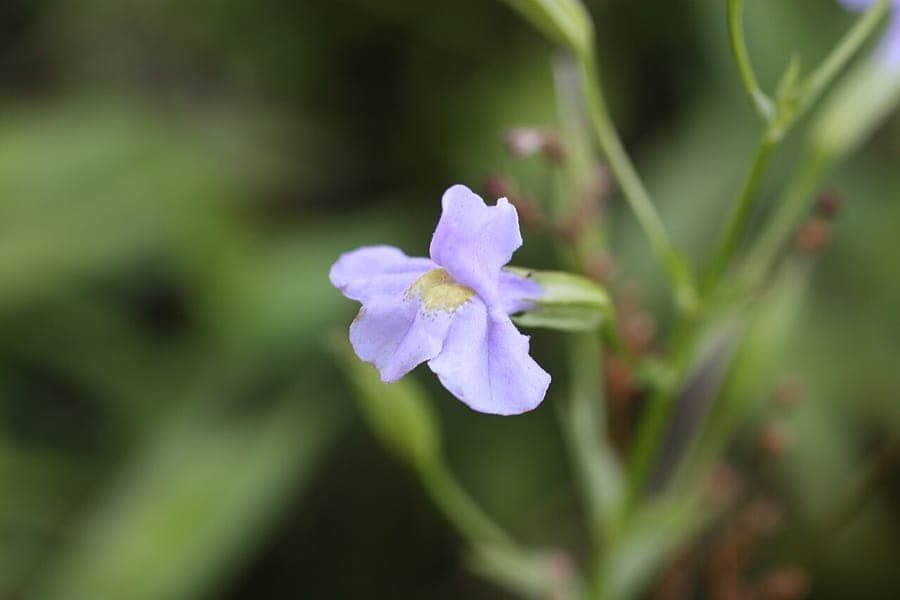
Tgnil / CC BY-SA 4.0, via Wikimedia Commons
Allegheny monkeyflower: complete guide
Mimulus ringens
Want to see Allegheny monkeyflower: complete guide in your garden?
1 minute, no credit card
Overview
Mimulus ringens, the Allegheny monkeyflower, is one of North America's most charming wetland perennials. Native from eastern Canada south through the central and eastern United States to Texas, it colonises stream margins, lakeshores, wet meadows, and roadside ditches. The species owes its common names to two features: 'square-stemmed monkeyflower' refers to its distinctly four-angled stems, while 'blue monkeyflower' describes the lavender to violet-blue flowers that bloom from June to September. Any garden with a pond, stream, or reliably wet corner will benefit enormously from this plant. At gardenworld.app you can visualise how plants like this monkeyflower can transform a water feature into a year-round focal point.
Appearance and bloom cycle
Mimulus ringens produces slender, strongly four-angled stems that typically reach 30-90 cm in height, occasionally to 120 cm in ideal conditions. The plant branches little, giving it an upright, columnar habit that works well in naturalistic plantings. Leaves are opposite and sessile - meaning they clasp the stem without stalks - one of the easiest field marks for distinguishing it from related species. They are smooth, light green, and slightly sticky.
The flowers are up to 3 cm long, two-lipped, and strikingly face-like, which explains the 'monkeyflower' name. The upper lip has two erect lobes; the lower has three spreading lobes forming the 'mouth', with a distinctive yellow patch that acts as a nectar guide for visiting pollinators. Colours range from pale blue through lavender to violet-purple. The flowering season in European gardens runs from mid-June to early September. After flowering, cylindrical seed capsules form and burst open to scatter numerous fine seeds.
Ideal location
Allegheny monkeyflower demands a permanently moist to wet position. The three main options are:
- Pond or stream margins: plant in 0-5 cm of water or directly on the bank with roots in permanently saturated soil.
- Bog garden or wet border: in heavy moisture-retentive clay or loam, or with regular irrigation.
- Partial shade: it tolerates filtered shade from shrubs or trees well; full sun is also fine as long as roots never dry out.
In deep shade flowering is reduced. Use gardenworld.app to plan the layout of your water feature or wet corner and select companion plants that share the same moisture requirements.
Soil
The ideal substrate is heavy, moisture-retentive clay or rich loam with a pH of 5.5 to 7.0. The plant also tolerates mildly alkaline conditions. It withstands brief flooding to 10-15 cm depth, making it suitable for the outer row of marginal planting around ponds, or for areas that flood in winter. When planting in an aquatic basket, use unamended pond clay mixed with a little multipurpose compost; avoid perlite or other drainage improvers that counteract the moisture retention you are trying to achieve.
Watering
For Allegheny monkeyflower, the challenge is not too much but always enough water. In a pond or stream margin the water manages itself. In a wet border away from open water, the plant needs thorough watering during dry spells - ideally every day in hot weather, in the evening. Never let the soil dry out completely; even a few dry days can significantly reduce flowering and weaken the plant. A container-grown plant benefits from standing in a saucer kept permanently topped up with water to guarantee constant moisture at root level.
Free design
Want to see Allegheny monkeyflower: complete guide in your garden? Make a free design now.
Pruning
Pruning is straightforward. After the first main flush in July, cutting the stems back by half stimulates side shoots and encourages a second, somewhat lighter flush in August and September. Remove spent flowers throughout the summer to keep the plant looking neat and to extend the blooming period. In autumn, after the first frost blackens the foliage, cut stems back to just above ground level. The rootstock overwinters reliably in moist soil without any special protection.
Maintenance calendar
- February - March: Take cuttings from overwintered parent plants in a heated space, or sow seed on a cool, bright windowsill at 15-18 degrees Celsius.
- April - May: Plant out after the last frost directly at or in the water, or in consistently moist ground.
- June - July: Peak flowering. Remove spent flowers regularly. Check for aphids and slug damage in wet periods.
- Early August: Light cut-back to encourage a second flush of flowers.
- September: Collect ripe seed if you wish to sow the following spring.
- October - November: Cut stems back to ground level after the first frost.
- December - February: Plant overwinters as a rootstock; no special protection needed in normal pond-side conditions.
Winter hardiness
Mimulus ringens is fully hardy throughout Britain and northern Europe, tolerating temperatures down to approximately -20 degrees Celsius, equivalent to USDA hardiness zone 4. The rootstock overwinters safely in moist to wet soil, even if the surface freezes. No protection is needed in a normal garden setting. Container-grown plants on exposed terraces should be insulated with hessian or sunk into the ground for the winter, as roots in above-ground containers are more vulnerable to frost than those planted in the earth.
Companion plants
Allegheny monkeyflower is an excellent partner for other marginal and bog plants that share its moisture requirements:
- Iris pseudacorus (yellow flag iris): golden-yellow flowers in May-June contrast beautifully with the later blue blooms of the monkeyflower.
- Caltha palustris (marsh marigold): blooms earlier in April-May and provides a bright yellow curtain-raiser.
- Lysimachia nummularia (creeping Jenny): low carpet that covers bare soil at the water's edge.
- Lythrum salicaria (purple loosestrife): the same wet conditions, long flowering season, and eye-catching pink-purple spikes beside the blue mimulus.
- Pontederia cordata (pickerelweed): a blue-flowered aquatic that carries the colour theme into the water.
Ferns such as Dryopteris filix-mas also work well in the shadier parts of the waterside planting. On gardenworld.app you can experiment visually with different combinations of marginal plants in your garden design before committing to a scheme.
Closing
Allegheny monkeyflower is one of the most rewarding perennials available for wet gardens, pond margins, and bog areas. Its long flowering season from June to September, excellent winter hardiness, and high value for bees, hoverflies, and butterflies make it an ideal choice for any ecologically conscious, wildlife-friendly planting. Whether you have a large stream bank or simply a small pond basket, Mimulus ringens will deliver a reliable, colourful display year after year with minimal effort.
Want to see Allegheny monkeyflower: complete guide in your garden? Make a free design now.
Upload a photo, pick a style, and get a photorealistic design with plant list in under a minute.
10,000+ gardens designed already
No credit card required


Similar plants
Field monkeyflower: complete guide
Erythranthe arvensis
Complete growing guide for Erythranthe arvensis - a cheerful yellow wildflower for pond margins, rain gardens and moist borders across western North America.
Musk monkeyflower: complete guide
Erythranthe moschata
Everything about growing musk monkeyflower in your garden: ideal site, soil, watering, pruning, and companion planting tips.
Sharp-wing monkey-flower: complete guide
Mimulus alatus
Everything about Sharp-wing monkey-flower (Mimulus alatus): location, soil, watering, pruning and care for wet and pond-side gardens.