
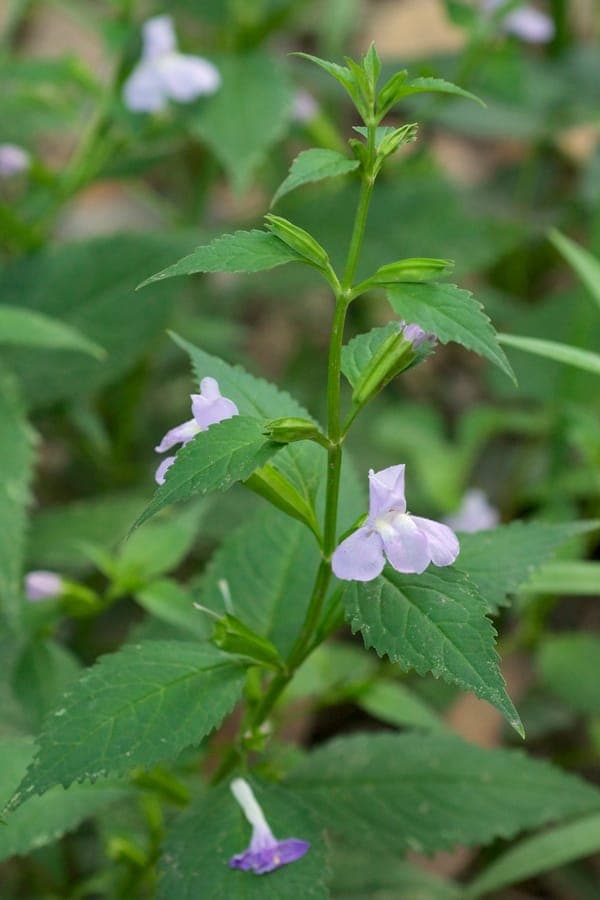
Eric in SF / CC BY-SA 3.0, via Wikimedia Commons
Sharp-wing monkey-flower: complete guide
Mimulus alatus
Want to see Sharp-wing monkey-flower: complete guide in your garden?
1 minute, no credit card
Overview
Mimulus alatus Aiton, commonly known as sharp-wing monkey-flower or winged monkey-flower, is a hardy herbaceous perennial in the family Phrymaceae. It was formally described by the Scottish botanist William Aiton in 1789 and is native to eastern and central North America, ranging from Ontario in Canada south to Florida and west to Nebraska and Texas. In the wild, it grows along stream banks, in swamps, on wet shorelines, and in moist woodland edges, where it forms part of rich plant communities with ferns, sedges, and other waterside species.
The epithet alatus (Latin for 'winged') refers to the narrow, leaf-like ridges or wings that run along the four angles of the square stems, making the plant immediately recognisable. This feature cleanly distinguishes Mimulus alatus from the closely related Mimulus ringens (square-stemmed monkey-flower), whose stems are angled but not winged. The common name 'monkey-flower' applies to the whole genus and refers to the grinning, mask-like appearance of the two-lipped flowers.
For gardeners, sharp-wing monkey-flower is a valuable addition to any moist or bog-style planting. Its vivid lilac to rose-purple flowers provide colour from June to September in habitats that often lack showy bloomers. The plant is also ecologically significant: the flowers are adapted for bumblebee pollination, with the two-lipped structure requiring the insect to assume a precise position to reach nectar, simultaneously transferring pollen.
Explore how moisture-loving perennials like Mimulus alatus can anchor a waterside planting scheme at gardenworld.app, where the design tool lets you visualise combinations before you plant.
Appearance & bloom cycle
Mimulus alatus grows as an upright, clump-forming perennial reaching 60-120 cm in height; in persistently wet conditions plants can exceed 150 cm. The stems are stout, square in cross-section, and distinctly winged: four narrow, leaf-like ridges run along the stem angles, giving the plant its name. The stems are hairless (glabrous) or only slightly hairy, and branch freely in the upper portions.
The leaves are opposite, elliptic to ovate, 5-13 cm long and 2-6 cm wide, with finely toothed margins and a prominent midrib. Leaf colour is deep green, fading to yellow in autumn before the stems die back. Leaf stalks are short (0.5-2 cm) and, interestingly, are also slightly winged where they join the stem.
Flowers emerge from June through September, peaking in July and August. Each bloom is two-lipped (zygomorphic), lilac to rose-purple in colour, often with darker purple nectar-guide markings on the lower lip. Individual flowers are 2-3 cm long and are produced in the axils of the upper leaves. After pollination by bumblebees, the plant sets small oval seed capsules 1-1.5 cm long containing numerous tiny seeds. The variety Mimulus alatus var. chandleri (Farwell) is botanically a synonym of the species itself.
Ideal location
Sharp-wing monkey-flower demands consistently moist to wet conditions and performs best in full sun to partial shade. In its native habitat it frequently grows with its roots in shallow standing water or on permanently waterlogged soil. In the garden, ideal locations include pond margins, stream banks, rain gardens, bog borders, and low-lying areas where moisture accumulates.
With adequate soil moisture, the plant also does well in a sunnier position. In partial shade under light tree canopy it thrives as long as soil moisture is maintained, though deep shade produces etiolated stems and sparse flowering. Full sun combined with reliable moisture gives the best combination of compact growth and prolific bloom.
Hardiness: USDA zones 5-9, covering virtually all of Western Europe. In most of the UK, Belgium, and the Netherlands (zones 8a-8b) the plant overwinters without any protection. Plant spacing of 40-60 cm between centres is appropriate for group plantings; established clumps spread by rhizomes and will gradually fill a generous area within two to three years, creating a dense, naturalised-looking colony.
Soil requirements
Mimulus alatus is not particular about soil composition but has an absolute preference for moist to wet, fertile conditions. The suitable pH range is 6.2-7.8; slightly acidic to neutral soil (pH 6.5-7.0) gives the most vigorous growth and richest flowering.
The plant thrives in heavy clay to loamy soils that naturally retain moisture. On sandy, fast-draining ground, generous compost incorporation is needed: mix 25-30% mature compost into the planting zone to improve moisture retention structurally. On heavy, permanently wet clay, no special soil preparation is required; on the contrary, this is where the plant shows its full potential.
Fertilisation is usually unnecessary on naturally fertile soils. On poorer ground, an annual topdressing of 5-8 cm of mature compost or a light application of slow-release fertiliser (such as Osmocote) in early spring provides adequate nutrition. Avoid nitrogen-heavy feeds during summer, which promote excessive foliage at the expense of flowering.
Watering
Watering is seldom a concern when Mimulus alatus is planted in a permanently moist streamside or pond-edge position. Natural soil moisture or periodic flooding provides all the water the plant needs.
In a conventional border or in any position without reliable natural moisture, watering must be frequent. During dry summer spells, daily watering may be necessary to prevent wilting. Never allow the soil to dry out completely: the first sign of stress is a slight drooping of the leaves, at which point the plant needs water immediately. Water generously until the soil feels moist at 20-30 cm depth.
Drip irrigation delivered at root depth is the most efficient method for plants outside the pond zone, and it significantly reduces the risk of fungal diseases associated with prolonged wet foliage. Water in the morning; evening irrigation encourages powdery mildew and similar pathogens on the leaf surface. A 5-7 cm mulch of compost or bark around the planting reduces evaporation considerably, cutting irrigation frequency in hot summers.
In autumn and winter, water requirements drop sharply as the plant dies back and growth ceases entirely.
Free design
Want to see Sharp-wing monkey-flower: complete guide in your garden? Make a free design now.
Pruning
Sharp-wing monkey-flower requires only minimal pruning. The plant dies back completely to ground level each autumn and regrows from the overwintering rootstock each spring. The primary task is therefore cutting down the dead stems in November or early December to 5-10 cm above ground level. These short stumps are left as additional protection for the root crown over winter.
During the growing season, cutting back the upper portions of stems after the first flush of flowers (around August) stimulates fresh branching and a second wave of blooms in September and October. Remove the spent flowers and the top 15-20 cm of each stem; this redirects energy into new side shoots equipped with fresh flower buds.
Manage the spread of the plant by removing rhizome runners that extend beyond the desired planting zone. On consistently moist, fertile ground, Mimulus alatus can spread aggressively via underground stems. Delimit the growth zone annually in spring or autumn with a sharp spade, or install root barrier fabric at 25-30 cm depth.
Maintenance calendar
January-February: No action required. Roots overwinter safely in the soil; the mulch layer provides protection. Check occasionally that the mulch has not been disturbed by wind or frost heave.
March: First growth signals appear. Remove any remaining dead stems from the previous season. Apply a layer of mature compost around the plant. Check the planting zone boundary and remove any far-ranging rhizome runners.
April-May: Rapid growth begins. Stems extend quickly. Maintain consistent soil moisture. The first flowers can appear in warm, sheltered positions as early as May.
June-July: Full flowering underway. Water daily or every other day during dry spells. Remove spent flowers promptly to extend the display. Check for aphid colonies; treat with insecticidal soap or neem oil if needed.
August: Peak blooming. Trim the top growth back after the first flush to encourage a second flowering. Maintain soil moisture.
September: Second bloom period. Allow individual flowers to set seed if you wish to encourage self-seeding.
October: Growth slows. Stems begin to yellow. No intervention required.
November-December: Cut stems back to ground level or to 5-10 cm stubs. Apply a 5-7 cm mulch of dry leaves or straw.
Winter hardiness
Mimulus alatus is reliably hardy across USDA zones 5-9, encompassing the Benelux, northern France, and all of Germany. The plant withstands root-zone temperatures down to approximately -25 °C (zone 5) when soil does not freeze solid throughout the root mass. In practice, the winters of the Netherlands and Belgium (zones 8a-8b, minimum -9 to -6 °C) present no challenge for this species.
The complete die-back of above-ground growth each autumn is entirely normal and not a sign of damage. The roots and rhizomes survive in the soil and produce fresh shoots each spring. On persistently frozen ground, a protective mulch layer of 5-7 cm is recommended to prevent the root crown from freezing solid.
In colder zones (5-6) where the ground freezes to more than 30 cm depth, or in pond-side positions where the water surface freezes, apply a 10 cm layer of reed or straw mulch in November. In zone 7 and above, no additional protection is required.
Companion plants
Mimulus alatus fits naturally into a wide range of companion plantings for moist and wet positions:
- Lobelia cardinalis (cardinal flower): the scarlet flower spikes in August-September create a vivid complementary contrast with the lilac Mimulus blooms; both demand the same moist, fertile conditions.
- Iris versicolor (blue flag iris): pond-margin iris with purple-blue flowers in June, whose bloom period connects naturally with the opening flowers of Mimulus alatus.
- Pontederia cordata (pickerelweed): dense marginal aquatic with blue flower spikes from July to September, forming a colourful waterside community with Mimulus.
- Caltha palustris (marsh marigold): early-season marginal with golden flowers in March-May that bridges the gap before Mimulus begins to flower.
- Carex riparia (greater pond sedge): broad, blue-green sedge that provides structural contrast in the lower layer as Mimulus grows upward.
- Lythrum salicaria (purple loosestrife): native wetland plant with rose-purple flowers that complement the colour range of Mimulus alatus beautifully.
Avoid planting sharp-wing monkey-flower next to small, delicate waterside plants that may be displaced by its expanding rhizomes. Maintain adequate spacing from creeping marginal plants such as Lysimachia nummularia.
Conclusion
Sharp-wing monkey-flower is an outstanding choice for gardeners creating a moist, colourful, and wildlife-rich waterside planting. The vivid flowers, the distinctive winged stems, and the long June-to-September blooming season make it one of the most rewarding native-style marginals available for UK, Belgian, and Dutch gardens. Its hardiness and low maintenance demands make it an equally good choice for beginners and experienced gardeners.
For more ideas about designing pond margins and wet garden areas with flowering plants like Mimulus alatus, visit gardenworld.app to explore planting combinations and visualise your garden layout.
Want to see Sharp-wing monkey-flower: complete guide in your garden? Make a free design now.
Upload a photo, pick a style, and get a photorealistic design with plant list in under a minute.
10,000+ gardens designed already
No credit card required


Similar plants
Field monkeyflower: complete guide
Erythranthe arvensis
Complete growing guide for Erythranthe arvensis - a cheerful yellow wildflower for pond margins, rain gardens and moist borders across western North America.
Allegheny monkeyflower: complete guide
Mimulus ringens
Everything about Mimulus ringens, the Allegheny monkeyflower: waterside location, soil, care, pruning and companion plants for your garden.
Musk monkeyflower: complete guide
Erythranthe moschata
Everything about growing musk monkeyflower in your garden: ideal site, soil, watering, pruning, and companion planting tips.