
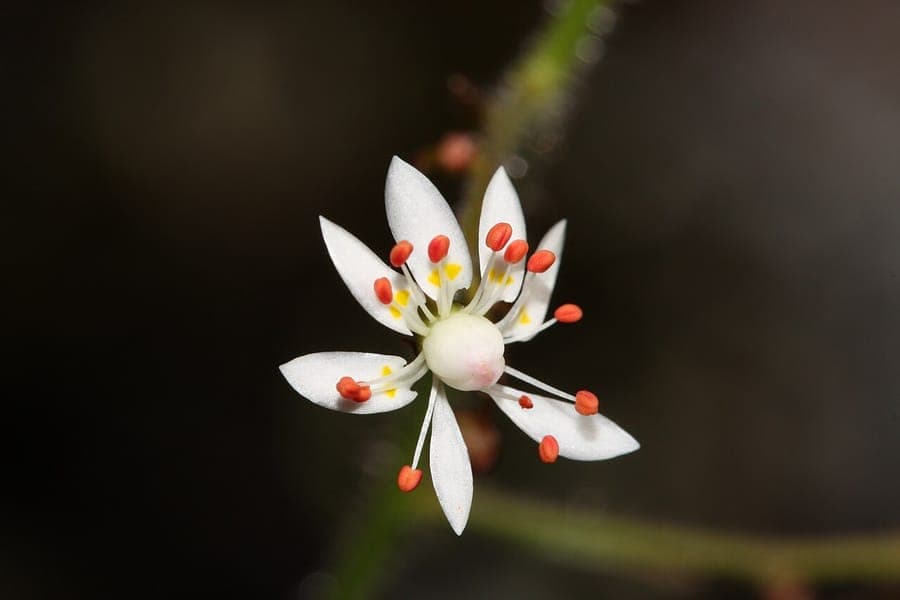
Walter Siegmund (talk) / CC BY-SA 3.0, via Wikimedia Commons
Russethair saxifrage: complete guide
Micranthes ferruginea
Want to see Russethair saxifrage: complete guide in your garden?
1 minute, no credit card
Overview
Micranthes ferruginea - known as Russethair saxifrage, Rusty saxifrage, or Alaska saxifrage - is a compact, rosette-forming perennial in the family Saxifragaceae. Previously classified as Saxifraga ferruginea, the species was reclassified into the genus Micranthes in 2007 following molecular phylogenetic research that separated a distinct lineage from the broader Saxifraga aggregate.
The plant is native to a broad arc of cool, montane and subalpine habitats stretching from Alaska through western Canada (British Columbia, Alberta) and into the northwestern United States - Washington, Oregon, Idaho, Montana, Wyoming, and California. Within this range, it typically grows on shaded rock faces, along mountain streams, in moist crevices, and on mossy slopes at elevations from near sea level (in Alaska) to well above 2,000 metres in the Rockies.
The species epithet 'ferruginea' (from Latin: rust-coloured) refers to the distinctive rust-brown glandular hairs that clothe the leaf stalks and flowering stems - a feature visible without magnification and one that immediately distinguishes the plant from close relatives. Taxonomically, the species is richly varied, with numerous synonyms and former varieties reflecting the diversity observed across its wide range.
For gardeners, Micranthes ferruginea offers an intriguing combination of elegant appearance and reliable garden performance: attractive rosettes of leathery, toothed leaves, airy plumes of small white flowers in late spring and early summer, and an unusually wide tolerance of soil pH. On gardenworld.app, rock garden designs often highlight this species as an accent element among other low alpine perennials.
Appearance & bloom cycle
Micranthes ferruginea forms low, compact rosettes 20 to 35 cm in diameter. The leaves are spatulate to obovate, 3 to 8 cm long, with coarsely toothed or lobed margins. Leaf surfaces are somewhat leathery with a slightly rough texture; the undersides and stalks bear rust-brown glandular hairs - the namesake characteristic. The leaf colour is deep, glossy green, sometimes taking on a light bronze flush in autumn.
In May and June, slender flowering stems rise 15 to 40 cm above the rosettes, also covered with rust-coloured hairs. Each stem bears a loose, much-branched panicle of numerous small white flowers. Individual flowers are 5 to 8 mm across with five white petals, ten stamens, and two carpels. Although small individually, the flowers are borne in such numbers that the overall effect is graceful and showy.
A particularly interesting feature of this species is its ability to produce small plantlets (bulbils) on the flowering stems, alongside or instead of seeds. This vegetative propagation strategy means that in suitable conditions the plant can spread naturally without seed germination - the plantlets drop and root in adjacent crevices or moist patches.
After flowering (June-July), small seed capsules develop. The rosette itself is evergreen - remaining green through winter - providing year-round foliage interest. The plant is long-lived in suitable conditions, gradually forming multi-rosette clumps over the years. Planting distance of 25 to 30 cm is recommended in group plantings.
Ideal location
Micranthes ferruginea thrives in cool, moisture-retentive positions with partial or light shade. In its native range it occupies shaded cliff faces, streamside mossy ledges, and cool north-facing slopes - habitats characterised by high air humidity, cool temperatures, and never-drying soil.
In the garden, the ideal position is on the north or east-facing side of a wall, large rock, or substantial shrub, where the plant receives morning sun but is sheltered from the hot afternoon sun. Three to four hours of direct light per day is generally sufficient for good flowering; less than two hours produces a healthy plant but with fewer flowers. Full sun, especially combined with dry soil, causes leaf scorching, wilting, and early dormancy in midsummer.
The plant is well suited to larger rock gardens, alpine troughs, moist wall crevices, waterside plantings by garden ponds or streams, and shaded woodland garden edges. It also performs well in containers (alpine pans or troughs) filled with sharply draining alpine compost, provided the position is cool and moisture is maintained. Avoid south-facing positions with high heat accumulation.
Soil requirements
Micranthes ferruginea has one of the widest recorded pH tolerances of any Saxifragaceae species: from pH 3.7 to pH 8.5. In practice, it grows best at pH 5.5 to 7.5 (slightly acidic to neutral). This extraordinary range reflects the plant's ability to adapt to both the acidic volcanic soils of Alaskan coastal ranges and the alkaline limestone substrates of the Rockies.
In terms of texture and structure, the plant requires well-drained soil with good organic matter content. It is intolerant of waterlogged conditions, particularly around the crown and rosette. A classic alpine grit mix of 50% coarse grit or horticultural gravel, 30% loam, and 20% leaf mould or well-rotted compost works excellently in rock garden planting pockets.
In border situations, standard garden soil amended with extra grit and compost is satisfactory, provided drainage is adequate. On heavy clay soils that remain wet in winter, thorough soil improvement with grit - or the construction of raised beds - is necessary. Mulching around (not on) the rosette with fine gravel or grit helps regulate moisture and prevents crown rot.
The plant has a relatively shallow root system and appreciates consistent surface moisture. Organic mulches (leaf mould, composted bark) around the rosette at a 5 cm depth are beneficial in summer but should be kept away from direct contact with the leaf rosette to prevent rotting.
Free design
Want to see Russethair saxifrage: complete guide in your garden? Make a free design now.
Watering
Consistent moisture is important throughout the growing season, but waterlogging - especially around the crown - is dangerous. The ideal soil moisture level is comparable to a well-wrung sponge: uniformly damp but never sodden. Standing water around the rosette for prolonged periods almost invariably leads to crown rot.
During dry spells from May to August, water one to two times per week, depending on soil composition and rainfall. Drip irrigation or soaker systems are ideal as they deliver water directly to the root zone without wetting the rosette. If hand-watering, direct the water to the periphery of the rosette rather than the centre, and water in the morning to allow any splashing to dry before evening.
In autumn and winter, natural rainfall is normally sufficient in temperate northern European climates. The main danger during winter is a sustained combination of frost and waterlogging - this is far more damaging than frost alone. Ensuring excellent drainage at the planting site is the most effective protection.
A fine gravel or grit mulch around the rosette (but not covering the leaves) helps buffer soil moisture fluctuations and provides some thermal protection in winter.
Pruning
Pruning requirements for Micranthes ferruginea are minimal. The main seasonal task is removing spent flowering stems after the bloom period ends in June-July. Cut the stems as close to the rosette base as possible using clean, sharp scissors or secateurs, to maintain a tidy appearance and prevent the dead stems from harbouring fungal pathogens in wet conditions.
Remove dead, yellowed, or damaged leaves from the rosette as they appear throughout the growing season. This is particularly important in damp weather when dead plant material can host botrytis (grey mould). Use a fine-pointed scissors or tweezers to extract dead leaves cleanly from the tight rosette without pulling and damaging live tissue.
If bulbils form on the flowering stems, these can be detached and placed on a tray of moist alpine grit and compost mix in a cool, bright position for vegetative propagation. Rooting typically takes three to six weeks. Small plants can be potted individually once a few roots are visible.
In spring (March-April), inspect the rosette for winter damage. Remove only clearly dead leaves; allow borderline tissue to recover before removing it.
Maintenance calendar
January-February: Dormant period. Check that winter mulch (grit) is still in place. No irrigation needed in normal northern European winter rainfall conditions.
March: Growth resumes. Remove winter protection carefully. Inspect rosette for frost damage. Remove any dead leaves from the rosette.
April: Leaf growth picks up pace. Apply a thin layer of well-rotted compost around (not on) the rosette if needed. Overcrowded clumps can be divided now.
May: Flowering begins. Water regularly during dry spells. Apply a grit mulch if not already in place. Watch for slugs, which can damage young leaves.
June-July: Peak bloom. Water consistently. Remove spent flowering stems promptly after blooming ends. Collect bulbils for propagation if desired.
August: Late summer status. Reduce watering slightly. Remove dead leaves. Bulbils can still be collected and propagated.
September-October: Growth slows. Apply fine grit or gravel mulch around the rosette for winter protection.
November-December: Overwintering phase. Minimal maintenance. Ensure the site does not stay waterlogged during wet weather.
Winter hardiness
Micranthes ferruginea is reliably cold-hardy, in keeping with its native range spanning Alaska and the high mountain ranges of the Pacific Northwest and Rockies. The plant overwinters without difficulty at temperatures down to -20 to -25 degrees Celsius in well-drained soil, corresponding to USDA hardiness zones 4 to 7. In the UK, Netherlands, Belgium, and Germany - generally zones 7 to 8 - the plant is fully hardy without protection.
The critical caveat is drainage: in poorly drained soils, the combination of frost and standing water causes crown rot, which is the primary cause of winter losses. In excellently draining rock garden or grit bed conditions, the plant is extremely robust. In heavier border soils, ensuring drainage is improved and providing a grit collar around the crown are the most effective protective measures.
In regions with reliable winter snow cover, the plant is very well protected; snow acts as an excellent insulator. In areas with hard frost but no snow (common in continental Europe), a thin layer of fine grit or pine needles around the crown provides useful insurance.
Companion plants
Micranthes ferruginea combines beautifully with other low-growing alpine and rock garden plants. The white flower plumes and dark rosettes associate well with plants of contrasting colour and form. Recommended combinations include:
- Saxifraga paniculata, Saxifraga cotyledon, and Saxifraga callosa: related saxifrages with similar cultural requirements and complementary white or cream flower sprays.
- Primula species: low-growing primroses in yellow, purple, pink, or white that bloom at the same time or slightly before Micranthes, creating a lively spring scene.
- Dryas octopetala (mountain avens): a mat-forming alpine subshrub with white flowers that thrives in similar cool, rocky conditions.
- Campanula cochleariifolia (fairies' thimbles): small blue or white bell-flowers that thread through rock garden plantings beautifully and contrast with the white Micranthes plumes.
- Phlox subulata (moss phlox): dense mats of pink, white, or lavender spring flowers complement Micranthes ferruginea well in larger rock garden plantings.
In moist shade borders, low Astilbe varieties, small hostas, and miniature ferns such as Asplenium trichomanes (maidenhair spleenwort) make good companions.
Conclusion
Micranthes ferruginea is a plant for the discerning gardener who values both botanical interest and reliable garden performance. Its distinctive rust-coloured hairs, graceful white flower plumes, exceptional pH tolerance, and robust cold hardiness make it a standout choice for rock gardens, waterside plantings, and shaded borders. While still relatively uncommon in British and European garden centres, it is worth seeking out from specialist alpine nurseries.
For those planning a rock garden or shade border that incorporates alpines like Micranthes ferruginea, gardenworld.app offers tailored garden design tools to help create beautiful, coherent plantings. More plant profiles, cultural tips, and design inspiration are available at gardenworld.app.
Want to see Russethair saxifrage: complete guide in your garden? Make a free design now.
Upload a photo, pick a style, and get a photorealistic design with plant list in under a minute.
10,000+ gardens designed already
No credit card required


Similar plants
Korean astilbe: complete guide
Astilbe grandis
Discover Korean astilbe (Astilbe grandis): a tall shade plant with elegant flower plumes for pond edges and borders.
Heuchera pilosissima: complete guide to seaside alumroot
Heuchera pilosissima
Seaside alumroot (Heuchera pilosissima), an elegant North American dwarf perennial with hairy red-tinged foliage and red flower spikes.
Starry saxifrage: complete guide
Micranthes stellaris
Full guide to Micranthes stellaris, the starry saxifrage: location, soil, blooming and garden use. A tough alpine plant for moist, shady rock faces and pond margins.