
Unknown authorUnknown author / Public domain, via Wikimedia Commons
Mountain bluebells: complete guide
Mertensia ciliata
Want to see Mountain bluebells: complete guide in your garden?
1 minute, no credit card
Overview
Mertensia ciliata, commonly known as Mountain bluebells or Tall fringe bluebells, is a striking perennial native to the western United States, ranging from Arizona and California north to Montana, Wyoming, South Dakota and Colorado. A member of the Boraginaceae family - the same family as borage, lungwort and forget-me-nots - this plant thrives along mountain streams, in moist ravines, and on shaded mountain meadows at elevations of 1,500 to 3,500 metres.
The species name 'ciliata' refers to the fine fringe of hairs (cilia) along the leaf margins, a characteristic that botanists use to distinguish it from other Mertensia species. In cultivation, however, this botanical detail is largely invisible to the gardener, who is far more captivated by the plant's spectacular sky-blue flowers that gracefully droop from arching stems.
In recent decades, Mertensia ciliata has grown in popularity among gardeners seeking bold, long-flowering perennials for shade or part-shade positions. Unlike many shade plants that rely primarily on foliage interest, this species delivers a prolonged floral display from May through August, making it a genuinely useful plant in the mixed border.
At gardenworld.app, many garden designs showcase Mertensia ciliata as a key accent plant in moisture-retentive shade borders and naturalistic rock garden settings - a testament to its design versatility.
Appearance & bloom cycle
Mertensia ciliata is a herbaceous perennial that emerges in early spring from a thick rhizome. The stems are upright initially, becoming slightly arching as they grow, and reach a height of 60 to 100 cm in good conditions. Some robust cultivars in rich, moist soils have been recorded exceeding 120 cm. The spread of a mature clump is typically 40 to 60 cm, making a planting distance of 45 cm appropriate for borders.
The leaves are lance-shaped to elliptical, 5 to 12 cm long, with a soft blue-green to grey-green colouration caused by a fine waxy coating. The leaf surfaces have a slightly rough texture and the margins are fringed with short, stiff hairs - the defining feature of the species. Lower leaves are long-stalked; upper leaves become progressively shorter-stalked and eventually almost stalkless, clasping the stem.
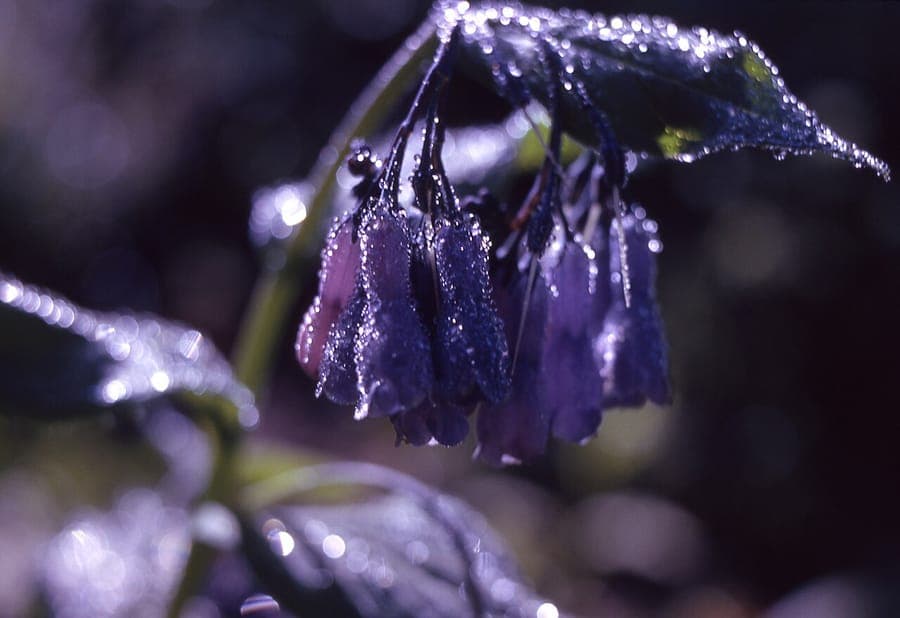
The flowers are tubular, 12 to 18 mm long, with five flared petals at the mouth. They are borne in scorpioid cymes - a coiled flower cluster that unfurls as the buds open, characteristic of the Boraginaceae. Buds open pink to reddish-purple, then rapidly change to a brilliant sky blue as they mature - a striking colour transformation caused by pH changes in the flower's cell sap. The contrast between the coral-pink buds and the open blue flowers on the same inflorescence is one of the most charming features of this plant.
Bloom time runs from late May to August, peaking in June and July. Deadheading spent flower clusters can extend the blooming period. After flowering, small, angular nutlets develop and provide seed for naturalisation in suitable woodland or streamside settings.
Ideal location
Mertensia ciliata is at its best in a position that replicates its native mountain streamside habitat: cool, moist, and lightly shaded. The ideal spot receives morning sun (three to four hours) and is sheltered from hot afternoon sun, particularly in gardens south of latitude 52°N. In cooler northern gardens, the plant tolerates more sun as long as moisture is consistent.
The east-facing side of a wall, fence, or large shrub is excellent. Positions on the north or northwest side of buildings work well too, provided they are not excessively deep shade. Full sun positions - particularly in combination with dry soils - lead to wilting, scorched leaf margins, and premature dormancy in midsummer.
Mertensia ciliata is ideal for waterside planting along ponds, streams, or bog gardens where soil remains consistently moist. It also works beautifully in woodland garden borders alongside hostas, ferns, and astilbes. In rock gardens, plant it in larger pockets or on slopes with moisture-retentive, humus-rich soil in the cooler, shaded parts of the feature.
Soil requirements
The preferred soil for Mertensia ciliata is humus-rich, moisture-retentive but well-drained, with a pH between 6.2 and 7.2 (slightly acid to neutral). In its native habitat, the plant grows in deep alluvial soils enriched by organic matter from mountain forests - soils that hold moisture well but never become waterlogged.
When preparing a planting site, incorporate 8 to 10 cm of well-rotted compost or leaf mould into the top 30 cm of soil. On heavy clay soils, add coarse grit or horticultural sharp sand to improve drainage and prevent waterlogging in winter. On sandy soils, generous organic matter additions are essential to improve moisture retention and nutrient-holding capacity.
Avoid extremely rich, nitrogen-heavy soils, which will produce lush but floppy foliage at the expense of flowering. A balanced general fertiliser applied once in spring - such as a 5-5-5 or 7-7-7 formulation - is sufficient for good performance. Excessive feeding is counterproductive and can make the plant more susceptible to pest damage.
Free design
Want to see Mountain bluebells: complete guide in your garden? Make a free design now.
Watering
Consistent moisture is the single most important cultural requirement for Mertensia ciliata. In its natural mountain habitat, the plant benefits from snowmelt, frequent summer thunderstorms, and proximity to streams - conditions that maintain evenly moist soil throughout the growing season. In the garden, replicating this means ensuring the soil never completely dries out during the period from emergence in spring to dormancy in late summer.
In practice, watering once or twice per week during dry spells is sufficient for most garden situations, provided the soil has adequate organic matter content to retain moisture between waterings. The goal is to keep the top 15 cm of soil consistently moist but not waterlogged. Drip irrigation or soaker hoses are the most effective method as they deliver water directly to the root zone without wetting the foliage, thereby reducing the risk of fungal diseases.
A 5 to 8 cm layer of organic mulch - leaf mould, composted bark, or wood chip - applied around the base of each plant significantly reduces evaporative water loss and maintains soil temperature, both of which benefit this mountain native. Mulch should be kept 5 cm away from the stem base to prevent crown rot.
In autumn, as the plant enters dormancy, watering frequency can be gradually reduced. The rhizome requires minimal moisture during winter dormancy, though the soil should not be allowed to dry out completely.
Pruning
Mertensia ciliata requires minimal pruning, but a small amount of seasonal tidying improves both the appearance and the health of the planting. In spring, once new shoots are 5 to 10 cm tall (usually March to April), remove the dead stems from the previous year by snapping or cutting them off at ground level. Take care not to damage the fragile new shoots, which may be emerging alongside the old stems.
During the flowering period, partial removal of spent flower clusters can help extend the display and reduce self-seeding if naturalisation is not desired. If you wish to collect seed for propagation, allow flower clusters to remain until the nutlets turn brown and detach easily - typically in August.
In autumn, after the first frosts have blackened the foliage, cut the plant back to ground level and apply a fresh layer of mulch. In milder climates this can be delayed until late winter with no ill effects; the dead stems provide some insulation for the crown and can look attractive when coated in frost.
Maintenance calendar
February-March: Remove winter mulch partially once hard frosts are past. Check the crown for signs of damage. New shoots typically appear in late March.
April: Clear away old stems carefully. Apply 3 to 5 cm of well-rotted compost around the plant. Top-dress with a balanced slow-release fertiliser.
May: Flowering begins. Ensure consistent watering. Apply or refresh the mulch layer if needed. Watch for aphid colonies on young stems.
June-July: Peak flowering. Water twice weekly in dry weather. Remove spent flower clusters to extend the display and reduce seeding.
August: Flowering ends. Allow seed to ripen if naturalisation is desired, or remove flower heads to redirect energy to the rhizome.
September: Plant begins to die back. Divide overcrowded clumps if needed. Cut back old stems and apply winter mulch (5 to 8 cm).
October-November: Winter mulch in place. No further work needed.
December-January: Dormancy. No care required beyond ensuring the site is not waterlogged.
Winter hardiness
Mertensia ciliata is exceptionally cold-hardy, reflecting its origins in the mountain West where winter temperatures regularly fall to -25 to -30 degrees Celsius. The species is rated for USDA hardiness zones 3 to 7, meaning it overwinters without protection in nearly all of northern and central Europe, including the UK, Netherlands, Belgium, Germany, and Scandinavia.
In zones 8 and above (southern France, coastal Mediterranean areas), the plant can struggle with prolonged summer heat. In these climates, deep shade, consistent moisture, and a cool north-facing position give the best results. A heavy mulch during summer helps keep the root zone cool.
The rhizome is the overwintering organ. It is dense and well-insulated naturally, but in regions with hard frost and no consistent snow cover, a protective mulch of 5 to 8 cm leaf mould or pine needles provides useful insurance. Snow itself is an excellent natural insulator for the crown.
Companion plants
Mertensia ciliata looks spectacular when planted with other moisture-loving shade perennials. The sky-blue flowers associate particularly well with white, cream, and soft yellow tones, and with plants of contrasting leaf form. Recommended combinations include:
- Astilbe 'Fanal' (deep red) and Astilbe 'Brautschleier' (white): the feathery plumes complement the pendant Mertensia bells beautifully, and both plants have identical moisture and light requirements.
- Hosta 'Halcyon' (blue-grey) and Hosta 'Sum and Substance' (chartreuse): bold hosta foliage provides strong contrast and serves as a living mulch, helping to keep the soil cool and moist.
- Rodgersia pinnata: large, deeply lobed leaves make a dramatic backdrop for the more delicate Mertensia flowers.
- Matteuccia struthiopteris (ostrich fern): the tall, shuttlecock-shaped fronds of this fern echo the vertical habit of Mertensia and thrive in the same moist, shaded conditions.
- Aquilegia (columbine): blooms slightly before Mertensia, ensuring continuous flowering in the border from April through July.
For rock garden combinations, consider planting Mertensia ciliata with Phlox subulata, low Geranium species, and moisture-tolerant sedges (Carex).
Conclusion
Mertensia ciliata is one of those rare perennials that delivers exceptional garden value with relatively modest demands - provided its basic requirements for cool, moist, shaded conditions are met. The transformation from coral-pink buds to sky-blue bells is a seasonal event worth planning a border around, and the long flowering season from May through August fills a gap that many shade garden plants cannot cover.
For gardeners interested in designing a planting scheme that incorporates Mertensia ciliata alongside other shade-loving perennials, gardenworld.app offers personalised garden design tools to help bring the vision to life. Discover more inspiration, plant profiles, and design ideas at gardenworld.app.
Want to see Mountain bluebells: complete guide in your garden? Make a free design now.
Upload a photo, pick a style, and get a photorealistic design with plant list in under a minute.
10,000+ gardens designed already
No credit card required


Similar plants
Western waterleaf: complete guide
Hydrophyllum occidentale
Full growing guide for western waterleaf (Hydrophyllum occidentale): shade tolerance, soil needs, watering, winter hardiness and naturalistic garden use.
Limestone phacelia (Phacelia affinis): complete guide
Phacelia affinis
Full guide to Phacelia affinis, the limestone phacelia: sowing tips, purple-blue bee flowers, drought tolerance and uses in dry or wildlife gardens.
Pyrenean viper's bugloss: complete guide
Echium asperrimum
Echium asperrimum is a striking biennial from the western Mediterranean with rough bristly stems and vivid blue flowers. A magnet for bees and a bold border plant.