
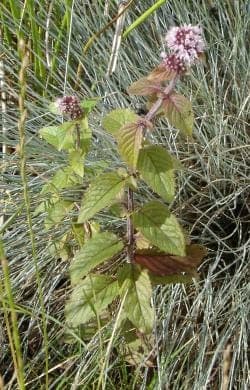
Burschik at English Wikipedia / CC BY-SA 3.0, via Wikimedia Commons
Water mint: complete guide
Mentha aquatica
Want to see Water mint: complete guide in your garden?
1 minute, no credit card
Overview
Water mint (Mentha aquatica) is a juicy, aromatic herb that naturally thrives along stream banks, ditches, and marshy areas. In the garden, it's a tough choice for damp corners where few other plants dare to grow. It belongs to the Lamiaceae family-same as thyme and sage-and stands out with its strong minty scent and clusters of purple to white flowers. Native across much of Europe, including the UK, it's often spotted along riverbanks and wet meadows.
What many gardeners don't realise is that water mint spreads aggressively through underground runners. Without control, it can take over a damp border in just one season. But with the right approach, it's a valuable addition-not just for scent, but for pollinators too. On gardenworld.app, you can design a planting scheme that includes root barriers to keep water mint in check while still enjoying its benefits.
Appearance & bloom cycle
Water mint grows 30 to 80 cm tall and forms dense clumps. Stems are square-typical of the mint family-and covered in fine hairs. Leaves are oval to lance-shaped, 2 to 5 cm long, dark green, and slightly toothed. When crushed, they release a strong mint aroma, less sharp than peppermint but full-bodied and mildly sweet.
From July to September, round flower heads appear, usually purple to pale pink, sometimes white. Each cluster holds dozens of tiny blooms that attract honeybees, bumblebees, and hoverflies. The flowering period lasts about 8 weeks, depending on moisture and temperature. Plants bloom best in partial shade, where flower buds don't dry out too quickly.
Ideal location
Water mint thrives in light shade to partial shade (light level 5/10). While it can handle morning sun, full sun causes it to bolt, become woody, and flower poorly. The best spot is along a pond edge, in a bog garden, or in any area where rainwater naturally collects.
Note: this isn't a true aquatic plant-it doesn't grow submerged, but in constantly moist, almost waterlogged soil. In gardens with rain barrels or water retention zones, water mint fits perfectly. On gardenworld.app, you can generate a planting plan that pairs water mint with other moisture-loving perennials like marsh marigold or meadowsweet.
Soil requirements
The soil should be moist, humus-rich, and well-draining. Use a mix of garden soil, compost, and sand in a 2:1:1 ratio. pH should be between 5.5 and 6.5-slightly acidic to neutral. Add some peat or leaf mould to improve moisture retention. Avoid dry, sandy, or chalky soils.
Water mint isn't heavy feeder, but responds well to a spring application of compost or organic fertiliser (100 g/m²). Too much nitrogen leads to floppy growth and reduced scent.
Free design
Want to see Water mint: complete guide in your garden? Make a free design now.
Watering
During establishment, especially near a pond or bog garden, consistent watering is key-water deeply for the first 4 weeks. Provide 5 to 7 litres per plant per week during dry spells. In wet seasons or damp locations, no extra watering is needed. The soil should never dry out, but avoid standing water.
Pruning
In May, cut back the tips by 5 to 10 cm to encourage bushiness and better flowering. After blooming in September, trim the plant down to 15 cm above ground to prevent rot and conserve energy. Use the cuttings for tea or as a flavouring in salads.
Tip: remove spent flower heads if you want to limit self-seeding. The real issue, though, is root spread. Use a root barrier at least 50 cm deep to contain it.
Maintenance calendar
- Jan: no action
- Feb: check for damaged stems
- Mar: clear old foliage; light feeding
- Apr: check soil moisture; plant new divisions
- May: pinch back tips; monitor for mint rust
- Jun: watch for drought stress
- Jul–Sep: flowering period; pollinator activity peaks
- Oct: cut back after bloom; add compost layer
- Nov: leave stems for overwintering insects
- Dec: no maintenance
Winter hardiness
Water mint is hardy to USDA zone 5 (down to -20°C). The top growth dies back in winter, but roots survive under leaf litter or straw. In harsh winters, a light mulch helps, but it's usually not necessary. In containers, protect pots by moving them against a wall or wrapping in bubble wrap.
Companion plants
Pair water mint with other moisture lovers like yellow flag iris, Joe-Pye weed, or marsh marigold. Avoid drought-tolerant plants like lavender or thyme. Near an insect hotel, it works well with catmint and yarrow.
Caution: don't plant too close to culinary herbs-the scent can transfer during drying or cooking. Use a physical barrier or keep at least 40 cm between plants.
Closing
Water mint isn't just another mint-it's a bold, wildlife-boosting herb with presence. It demands space control, but rewards with weeks of bloom and a buzzing ecosystem. For gardeners with soggy corners, it's a must-grow. Pick up water mint at garden centres like Wyevale or Dobbies, typically available April to September. Just remember: contain the roots. With smart planning, it becomes a standout in any naturalistic garden.
Want to see Water mint: complete guide in your garden? Make a free design now.
Upload a photo, pick a style, and get a photorealistic design with plant list in under a minute.
No credit card required


Similar plants
Apple mint (Mentha x villosa): complete guide
Mentha x villosa
Meet apple mint (Mentha x villosa): a fruity-scented kitchen herb with woolly leaves, perfect for tea and mojitos.
Salvia peyronii: complete guide
Salvia peyronii
Discover Salvia peyronii, a rare Lebanese mountain sage. Growing tips, hardiness, and companion planting for a Mediterranean gravel garden.
Bigleaf mint (Mentha x rotundifolia): complete guide
Mentha x rotundifolia
Discover bigleaf mint: cultivation, care tips, and garden uses. Learn how to grow this aromatic herb with soft, hairy leaves.