
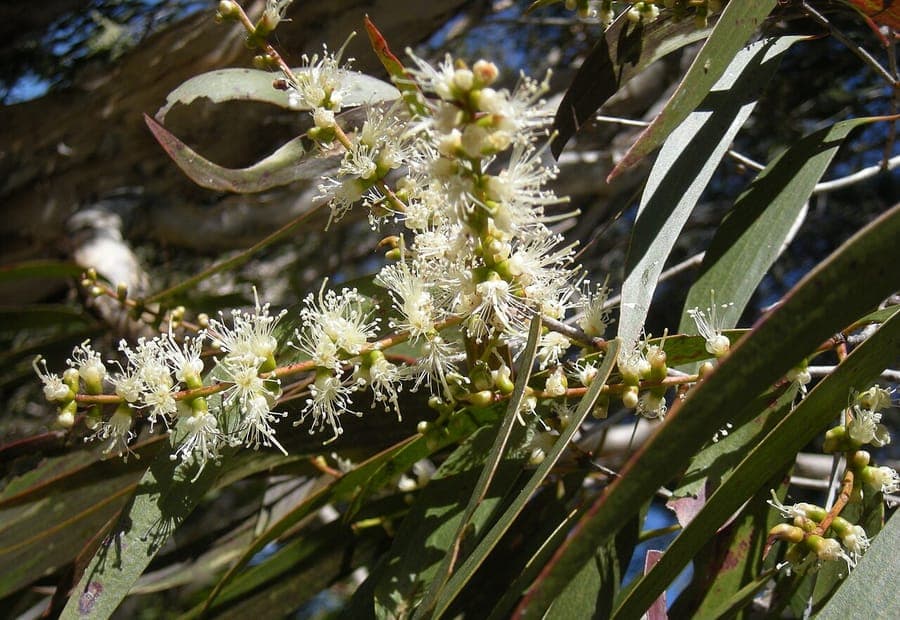
Ethel Aardvark / CC BY 3.0, via Wikimedia Commons
Melaleuca leucadendra: complete guide
Melaleuca leucadendra
Want to see Melaleuca leucadendra: complete guide in your garden?
1 minute, no credit card
Overview
Melaleuca leucadendra, also known as Cajaput tree, Paperbark, or Kajeputträd, is a spectacular tropical tree native to regions from Indonesia to Australia. This tree belongs to the Myrtaceae family, the same group as eucalypts, myrtles, and tea trees. The plant is famous for its unique, papery bark that peels in layers, revealing a beautiful white-grey or yellow finish.
Melaleuca leucadendra is a multifunctional tree offering decorative, ecological, and practical value. The tree thrives in tropical and subtropical climates and can even flourish in wet conditions.
Appearance & Bloom
Melaleuca leucadendra grows into a large tree, often 15-25 meters tall, with a spreading, open crown. The tree has a characteristic appearance thanks to its unique bark structure. The bark peels in papery layers revealing white, grey, or yellow-brown tones, making it visually interesting year-round.
The leaves are elongated, narrow, and green, with a pleasant smell when crushed. They are typical of Melaleuca species.
The bloom is subtle yet charming. The flowers are small, yellow-white cylindrical flowers presenting themselves in dense, loose spikes. They typically appear during warm months. After flowering, small, hard seed capsules form that persist on the tree for years, supporting bird activity.
Ideal Location
Melaleuca leucadendra does best in full sun. A minimum of 6-8 hours of direct sunlight daily is needed for optimal growth. The tree can tolerate some partial shade, but grows less densely and blooms less in shady environments.
The tree is reasonably flexible with wind exposure and grows well in open, windy locations. However, it is sensitive to heavy frost.
The tree is particularly useful for wet terrain where other trees don't thrive. It can grow in swampy conditions.
Soil
Melaleuca leucadendra is remarkably flexible with soil type. It grows in sand, clay, salt, and even laterite. The tree is highly tolerant of alkaline soils and can even grow in marginally fertile earth.
The ideal pH is neutral to slightly acidic (6.0-7.5), but greater variation is tolerated. This is truly a tree that adapts to virtually any soil condition.
Ensure good drainage in well-drained situations, though the tree can also tolerate waterlogged sites.
Free design
Want to see Melaleuca leucadendra: complete guide in your garden? Make a free design now.
Watering
Melaleuca leucadendra is extremely drought tolerant once established. This is not a tree requiring regular water. Water regularly during the first year after planting to encourage strong root development.
Once established, this tree needs almost no watering in normal rainfall. During extremely dry periods, supplemental water can be helpful, but it's generally not a water-hungry tree.
If planted in wet sites, the tree will flourish without extra watering.
Pruning
Melaleuca leucadendra requires minimal pruning. Allow the tree to develop its natural form. You can do some shaping in young years to direct growth, but this is optional.
The tree naturally forms an attractive shape. You only need to remove dead or diseased branches.
Avoid aggressive pruning as this can stress the tree.
Maintenance Calendar
Spring: Begin feeding as new growth starts (in tropical climates there may be two growing seasons). Summer: Regular watering during establishment. Check for pests. Fall: Minimal care in temperate seasons. Check for diseases. Winter: Minimal care. In frost-prone regions, protect from frost.
Winter Hardiness
Melaleuca leucadendra is frost sensitive. In subtropical and temperate climates with frost risk, the tree must be protected. Young trees are particularly vulnerable.
In warm tropical and subtropical regions without frost, the tree thrives outdoors year-round.
In frost-prone areas, grow it in a pot so it can overwinter indoors.
Companion Plants
Melaleuca leucadendra grows well with other tropical and subtropical species. It's excellent in bird-friendly gardens because of the seed capsules that provide bird food.
The tree is also suitable for ecological gardens and wetland restoration projects.
Conclusion
Melaleuca leucadendra is an excellent choice for warm climates, particularly for gardeners with wet soils or wishing to support ecological bird habitat. The paperbark alone makes this a visually spectacular tree. With minimal care, this becomes a valuable addition. Check gardenworld.app for help with your garden plan!
Want to see Melaleuca leucadendra: complete guide in your garden? Make a free design now.
Upload a photo, pick a style, and get a photorealistic design with plant list in under a minute.
No credit card required


Similar plants
Flooded gum (Eucalyptus grandis): complete guide
Eucalyptus grandis
Everything about the flooded gum: fast growth, impressive stature and silvery bark. How to plant and care for this eucalyptus in your garden.
Yellow gum (Eucalyptus leucoxylon): complete guide
Eucalyptus leucoxylon
Everything about the yellow gum: showy flowers in winter, compact form and drought tolerance. How to grow and care for this eucalyptus in your garden.
Sydney blue gum (Eucalyptus saligna): complete guide
Eucalyptus saligna
Everything about the Sydney blue gum: extraordinary growth rate, beautiful grey-blue bark and impressive stature. How to plant and care for this eucalyptus.