
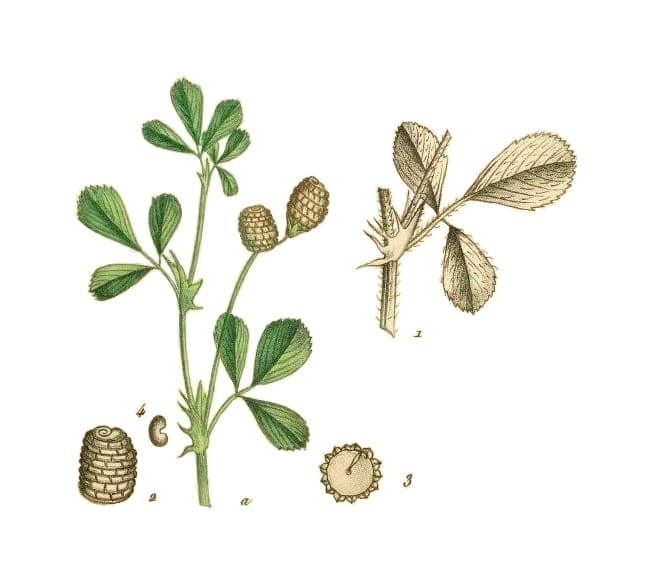
Medicago_species_4-La_flore_et_la_pomone_francaises_(clean).jpg: *Medicago_species_4-La_flore_et_la_pomone_françaises.jpg: Jean Henri Jaume Saint-Hilaire derivative work: Ninjatacoshell (talk) derivative work: Ninjatacoshell (talk) / Public domain, via Wikimedia Commons
Southern medick: complete guide
Medicago turbinata
Want to see Southern medick: complete guide in your garden?
1 minute, no credit card
Southern medick (Medicago turbinata), also known as tubercled medick and cogwheel burr medic, is an elegant legume from the Fabaceae family. This plant grows in native habitats from the Mediterranean region to Iraq and increasingly popular in naturalistic garden schemes.
Morphology: The plant forms low, sprawling mounds reaching 20 to 40 centimeters tall. The leaves are typical medick trefoil leaves - three-parted with central petioles. Small purple flowers are produced in dense clusters along the stems.
Flowering and fruiting: Blooming occurs from March through May, depending on locale. Flowers are followed by characteristic spiral-shaped fruit pods with hooks, from which the species name originates. These hooks attach to animal fur for seed dispersal.
Growth requirements: Southern medick grows best on calcareous, well-drained soils with pH between 7.0 and 7.5. This is an exceptionally drought-tolerant plant, ideal for dry Mediterranean climates. Once established, it requires minimal watering.
Watering needs: Water regularly in the first year to establish deep roots. Thereafter minimal water is needed - only supplement during severe drought.
Sun requirements: Full sun requiring at least 8 hours direct sunlight daily. Poor performance in shade and failure to flower.
Soil requirements: Prefers neutral to alkaline soils. Good drainage is essential - stagnating water is harmful. Sand or gravel amendment is beneficial.
Seed cultivation: Seeds require mild scarification - scratch seed lightly with sandpaper before planting. Sow in early spring directly in ground. Growth is rapid once germinated.
Winter hardiness: Hardy to USDA zone 7, though likely zone 6 in protected locations. In cooler areas, grow as an annual.
Companion species: Naturally grows with other Mediterranean flora such as sage, rosemary, and desert rose. Grows well with other medick and clover species.
Pollinator value: This is valuable for bees and other pollinators. Flowers are frequently visited by honeybees and wild bees.
Garden design: Ideal for Mediterranean gardens, dry-climate designs, and wildflower meadows. Combine with other drought-tolerant plants for low-maintenance displays.
Elevation: In wild occurs from 500 to 2000 meters elevation.
Diseases and pests: Highly resistant to pests and diseases. Occasional moth larvae may occur but cause minimal damage.
Uses: Traditionally cultivated as livestock fodder in Mediterranean regions. The plant is also food for caterpillars of certain butterfly species.
We recommend obtaining southern medick seed from specialized suppliers. This is a valuable addition to Mediterranean and dry gardens. Discover more plant guides at gardenworld.app.
Want to see Southern medick: complete guide in your garden? Make a free design now.
Upload a photo, pick a style, and get a photorealistic design with plant list in under a minute.
No credit card required


Similar plants
Tall Silky Lupine: complete guide
Lupinus elatus
Tall silky lupine is a fast-growing Californian perennial with silvery foliage and blue-purple flower spikes, ideal for a prairie-style garden.
Garfield Lupine: complete guide
Lupinus garfieldensis
The Garfield lupine is a rare, fast-growing American perennial for alkaline, dry grassland gardens, with striking blue flower spikes.
Lupinus elegans: complete guide
Lupinus elegans
Lupinus elegans, the elegant lupine, is a spectacular blooming plant from Mexico with blue flower spikes. Care, cultivation and garden use.