
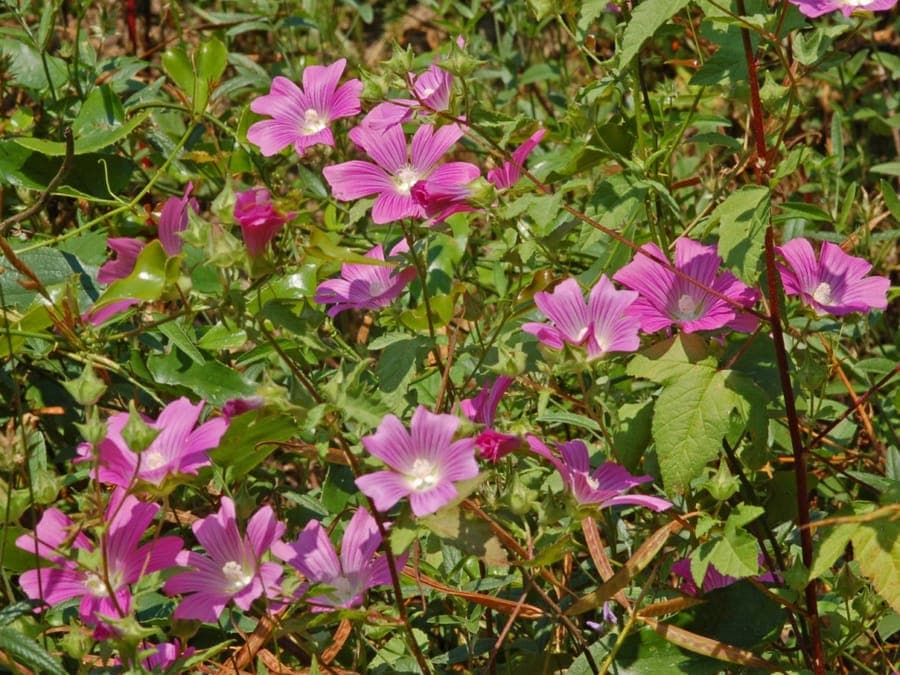
Hectonichus / CC BY-SA 3.0, via Wikimedia Commons
Spotted tree-mallow: complete guide
Malva punctata
Want to see Spotted tree-mallow: complete guide in your garden?
1 minute, no credit card
Overview
Malva punctata (synonym Lavatera punctata), known in English as spotted-stalked tree-mallow or spotted tree-mallow, is a striking Mediterranean species within the mallow family Malvaceae. The specific name 'punctata' means 'dotted' or 'spotted', referring to the characteristic dark markings on the stems and petioles that immediately distinguish this species from its relatives.
Belonging to the same family as hollyhocks, common mallow, hibiscus, cotton and lime trees, Malva punctata occupies the southeastern corner of the genus's European range: it is native to Italy, Greece, Albania, Turkey, Turkmenistan, Syria, Lebanon, the Balearic Islands, Corsica, Sardinia, Sicily, Cyprus, Tunisia and Algeria. It grows naturally on dry, calcareous hillsides, rocky coastal ground and open garrigue scrubland.
For the gardener, this Mediterranean provenance means: full sun, well-drained alkaline soil, excellent drought tolerance, and a showy summer display of purple to lilac flowers in June and July. The plant fits perfectly in a gravel garden, a dry border or a courtyard with warm south-facing walls. Visit gardenworld.app to explore planting designs that incorporate this and other drought-tolerant Mediterranean plants.
Appearance and bloom cycle
Malva punctata is an annual or biennial herb that can reach 40-100 cm in height, occasionally taller in very favourable conditions. The plant has an erect, branching growth form. The stems are robust, slightly woody at the base in older plants, and prominently marked with dark spots or blotches - the most immediately recognisable feature of the species.
The leaves are large, five- to seven-lobed with a heart-shaped base and toothed margins, similar to common mallow (Malva sylvestris). They are green and slightly rough-textured on the upper surface. Lower stem leaves are the largest; upper leaves become smaller and less deeply lobed.
The flowers are typical of the mallow family: five petals, each 2-3 cm across, pale purple to lilac with darker veining. They appear in the leaf axils, several flowers per node. Each individual flower lasts only one day, but the plant produces successive flowers over several weeks.
The main flowering period is June and July. After pollination, the distinctive cheese-wheel-shaped fruits develop that give mallows their name in many European languages. Each flat, disc-like fruit breaks apart into individual segments, each containing a seed.
Ideal location
Malva punctata is a strongly heat- and sun-loving plant. It performs best in a fully sunny position receiving at least seven hours of direct sunlight daily. In partial shade the plant grows more slowly and flowers less freely.
In its natural range it occupies dry, calcareous slopes, rocky coastal margins and open scrubland - habitats characterised by high summer temperatures, low rainfall and poor soils. The plant is exceptionally tolerant of heat and drought.
In the garden, ideal positions include:
- A Mediterranean-style gravel garden
- A dry, chalky or rocky border
- A south-facing wall planting
- A warm courtyard or terrace
- A rock garden or stony slope
The upright growth habit and considerable height make Malva punctata suitable as a background or mid-border specimen, or as an eye-catching focal plant in a smaller Mediterranean-themed planting.
Soil
Malva punctata has specific soil requirements: it needs a free-draining, poor to moderately fertile soil. Calcareous, stony or gravelly substrates are exactly what it naturally colonises. Heavy, wet clay is entirely unsuitable.
The optimal pH range is 7.5-8.0 - alkaline to slightly alkaline. This is one of the highest pH preferences in the mallow genus and reflects the species' affinity for lime-rich ground. On neutral or slightly acid garden soils, add ground limestone or crushed shells to raise the pH. On very acid soils, substantial liming will be needed.
Poor soil is acceptable and even preferable; exceptionally rich, heavily fertilised soil produces rank leafy growth at the expense of flowering. In a gravel garden or Mediterranean border, avoid enriching the soil and use a gravel mulch rather than bark.
Good drainage is absolutely essential. Waterlogging after rain or in winter causes rapid root rot. On poorly drained ground, improve the soil structure with 30-40% coarse grit or horticultural sand before planting.
Watering
Once established, Malva punctata is among the most drought-tolerant of the mallows. In its Mediterranean homeland it survives hot, dry summers on minimal rainfall.
In a northern European garden, natural rainfall is generally sufficient for an established plant. Only in prolonged dry spells should you water, and then only every ten to fourteen days, moderately. The plant is far more likely to suffer from too much water than too little.
Freshly transplanted seedlings need more consistent moisture for the first four to six weeks to establish a root system. Water twice weekly during this period, moderately. Once the plant is well-rooted, reduce frequency progressively.
Overwatering is the most common cause of failure with this species: waterlogged roots rot quickly, leaves yellow, and flower buds drop. Always water at the base of the plant and avoid wetting the foliage.
Free design
Want to see Spotted tree-mallow: complete guide in your garden? Make a free design now.
Pruning
As an annual or biennial plant, Malva punctata does not require formal pruning. However, a few simple interventions improve the display and maintain plant health.
Deadheading: Removing spent flowers as they fade encourages the plant to produce more buds and can extend the flowering period through to early autumn.
Seed control: If you wish to prevent self-seeding, remove the distinctive mallow fruits before they ripen and break apart. If you allow seed to ripen, you can expect self-sown seedlings the following spring in open, sunny spots nearby.
Autumn clearance: After the plant dies back, cut the stems down to 10-15 cm above ground. Compost the removed material.
Biennial management: In mild winters the plant may survive as a biennial. In early spring cut back all dead or damaged shoots to living wood.
Tall plants may need staking. Use a bamboo cane tied loosely to the main stem to prevent wind damage.
Maintenance calendar
January - February: Rest. Store saved seed dry in a cool, dark place. Order plants or seed from a specialist Mediterranean plant nursery or garden centre.
March: Sow indoors at 18-22 degrees Celsius. Soaking seed in lukewarm water for 24 hours before sowing aids germination. Expect germination in two to four weeks.
April: Acclimatise seedlings outdoors in a sheltered spot during the day, bringing them in at night if frost is still possible.
May: Plant out after last frost risk. Choose the sunniest, driest position. Set into well-drained soil, firm in well and water once.
June: First flowers appear. Deadhead regularly. Very little watering needed.
July: Peak flowering. Enjoy the lavender-purple blooms. Stake tall plants if needed.
August: Flowering tapers. Seed fruits ripening. Decide whether to collect seed or allow self-seeding.
September: Collect seed for next year. Plant dies at first severe frost.
October - November: Cut back dead stems. Compost or use as mulch.
December: Rest. Plan any adjustments for the next growing season.
Winter hardiness
Malva punctata is a Mediterranean plant and is not reliably hardy in cold continental climates. As an annual or biennial it does not form the thick perennial rootstock that some other mallows develop for winter survival.
In USDA zone 8-10 (mild Atlantic coastal climates, Mediterranean climates), the plant may survive as a biennial or short-lived perennial and flower in its second season. In zones 6-7 (most of inland northern Europe, including the Netherlands, Belgium and northern Germany), the plant behaves as a strict annual and is killed by the first hard frost below about -5 degrees Celsius.
The seeds are frost-hardy and very persistent in the soil, remaining viable for three to five years if stored dry at 5-10 degrees Celsius. In a sheltered, south-facing urban garden with warm wall reflectance, Malva punctata may occasionally self-seed successfully across winters, creating an effectively self-maintaining colony - though this is not guaranteed north of latitude 52 degrees.
Specialist Mediterranean plant nurseries and many garden centres in the UK stock Malva punctata or can source it. Look for it alongside other heat-loving summer-flowering perennials and annuals.
Companion plants
Malva punctata combines beautifully with other sun-loving, drought-tolerant Mediterranean plants that share its preference for alkaline, well-drained soil.
Lavender (Lavandula angustifolia): The blue-purple flower spikes harmonise perfectly with the mallow's lilac blooms, and both thrive on chalky, dry soil.
Sage (Salvia officinalis and related species): Grey-green aromatic foliage and blue flowers that contrast elegantly with the larger mallow flowers.
Hollyhock (Alcea rosea): A tall relative that adds dramatic vertical interest in the same planting style.
Fennel (Foeniculum vulgare): Feathery, airy foliage that provides a soft textural contrast beside the robust mallow leaves.
Rock rose (Cistus spp.): Low, spreading plants with papery flowers that complement the taller mallow perfectly.
Helianthemum (Helianthemum spp.): Low-growing ground cover with abundant small flowers for the base of the planting.
In a Mediterranean-style gravel border with a chalky substrate and minimal irrigation, Malva punctata stands as a centrepiece among lavender, sage, thyme and other herbs. On gardenworld.app you can design a bespoke planting plan that brings Mediterranean style to your own front garden or courtyard.
Closing
Malva punctata is a remarkable plant for lovers of Mediterranean garden styles and drought-tolerant planting. Its spotted stems, imposing stature and prolific lilac flowering make it a genuine focal point in the summer garden.
It is also botanically fascinating: a representative of the rich Mediterranean flora that has adapted over millennia to hot, dry summers and poor, lime-rich soils. In an era when summer drought and heat become more common even in northern European gardens, Malva punctata is a plant that belongs in the gardens of the future.
Whether you are creating a rock garden, a Mediterranean corner or simply adding height and bold colour to a sunny border: Malva punctata deserves a place in the most sun-drenched spot your garden can offer. Find your inspiration at gardenworld.app.
Want to see Spotted tree-mallow: complete guide in your garden? Make a free design now.
Upload a photo, pick a style, and get a photorealistic design with plant list in under a minute.
10,000+ gardens designed already
No credit card required


Similar plants
Malva sylvestris: complete guide
Malva sylvestris
Malva sylvestris: Common mallow with magenta blooms and dark purple veins. Versatile, hardy, easy-growing. European classic.
Hollyhock: complete guide
Alcea rosea
Everything you need to grow Alcea rosea: planting tips, care, bloom season, and ideal garden placement. Perfect for cottage gardens and vertical accents.