
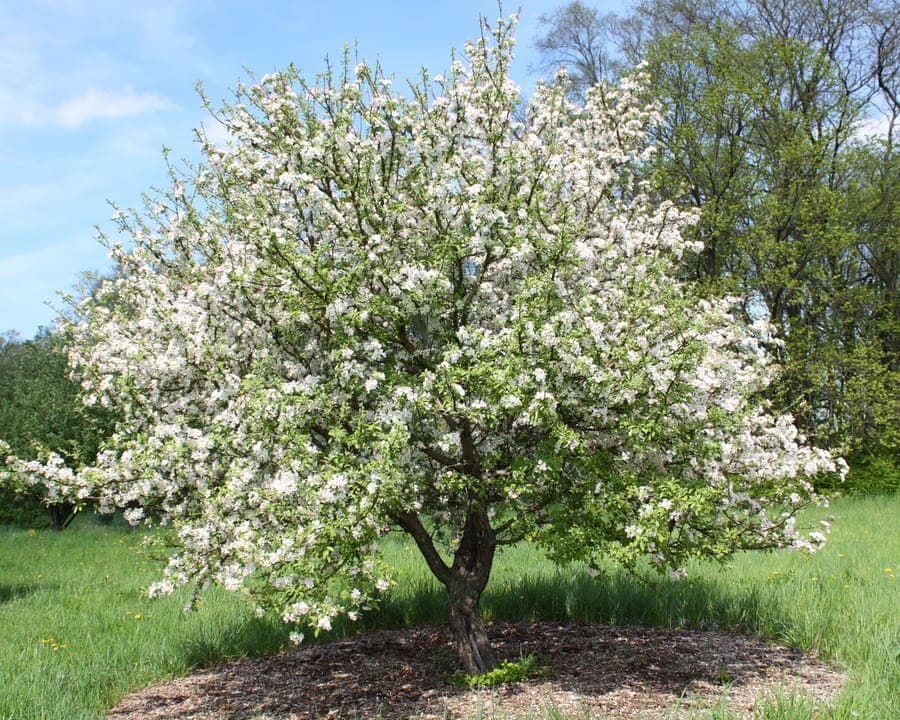
Bruce Marlin / CC BY 3.0, via Wikimedia Commons
Malus prunifolia: complete guide
Malus prunifolia
Want to see Malus prunifolia: complete guide in your garden?
1 minute, no credit card
Overview
Malus prunifolia, also known as Chinese Crabapple or Plumleaf Crabapple, is a decorative tree from central and south-central China. This tree is popular for its profuse white spring blossoms and long-lasting red fruit hanging from August through winter. The tree reaches 6 to 8 meters in height and spread, making it suitable for medium-sized gardens and landscape plantings. Many birds and animals are attracted to the fruit.
Appearance and bloom
Malus prunifolia is an upright tree with spreading branches and narrow lanceolate leaves with finely serrate margins. In April-May, dense clusters of small white flowers tinged pink appear. The blooms measure about 2 cm across. After flowering, numerous small apple-like fruits develop (approximately 2-3 cm), initially green, later bright red to deep cherry-red. These fruits persist on the tree long into winter, often through January.
Ideal location
Malus prunifolia grows best in full-sun locations (at least 6 hours direct sunlight). The tree also thrives in partial shade, but flowers less abundantly. Place the tree as a specimen on open sites or as part of mixed tree groupings. Windy sites are no problem. Avoid deeply shaded forest areas.
Soil
This tree prefers normal, well-draining soils. It accepts loam, sand, and clay soils, provided no waterlogging occurs. Slightly acidic to neutral soils are preferred (pH 6-7). Add humus at planting. Excellent drainage is important; improve drainage on heavy soils with sand or gravel. Moderately nutrient-rich is ideal, though the tree grows also on poor soils.
Free design
Want to see Malus prunifolia: complete guide in your garden? Make a free design now.
Watering
Once established, Malus prunifolia tolerates drought well. Young trees should receive regular water during the first two growing seasons (1-2 times weekly). Mature trees need less water; water only during severe drought. Heavy rainfall can cause damage, so good drainage is essential.
Pruning
Malus prunifolia requires little pruning if you want an open crown. Prune after flowering (May-June) to maintain form. Remove crossing, damaged, or weak branches. Heavy pruning is not needed and disrupts flower production. Lighter annual pruning is better.
Maintenance calendar
April-May: flowering period, enjoy the display. May-June: prune after bloom. June-July: growth period, water young trees. August-October: fruit development and ripening. November-January: red fruit is peak of beauty. February-March: winter rest, water only during drought.
Winter hardiness
Malus prunifolia is hardy to zone 4 (-20 to -25C). The tree tolerates harsh winters well, though terminal buds may freeze in very cold springs. In colder mountain regions it grows well. Snow and ice buildup can damage branches, but the tree recovers quickly.
Companion plants
Plants nicely with other ornamental crabapples (Malus): M. hupehensis, M. sylvestris, M. x sargentii. Also good with other bird-attracting trees: Sorbus, Ilex, Crataegus. For underplanting: Taxus, Buxus, low-growing perennials.
Closing
Malus prunifolia is a beautiful, undemanding ornamental crabapple with abundant white spring blossoms and long-lasting red fruit. It is hardy, attractive to birds, and requires little maintenance. Ideal as a specimen in gardens or landscape plantings. At gardenworld.app, we help you place this tree perfectly. At gardenworld.app, we create your dream garden together with beauty and sustainable ecosystems.
Want to see Malus prunifolia: complete guide in your garden? Make a free design now.
Upload a photo, pick a style, and get a photorealistic design with plant list in under a minute.
No credit card required


Similar plants
Siberian crab apple: complete guide
Malus x robusta
Complete guide to the Siberian crab apple (Malus x robusta): location, soil, pruning, winter hardiness and the best companion plants for your garden.
Chinese flowering crabapple (Malus x spectabilis): complete guide
Malus x spectabilis
Meet the Chinese flowering crabapple (Malus x spectabilis): a classic spring bloomer with carmine buds and pink blossom.
Potentilla crassinervia: complete guide
Potentilla crassinervia
Potentilla crassinervia, the Corsican cinquefoil, grows wild on Corsica and Sardinia's peaks. Discover how to grow this hardy alpine rock garden gem.