
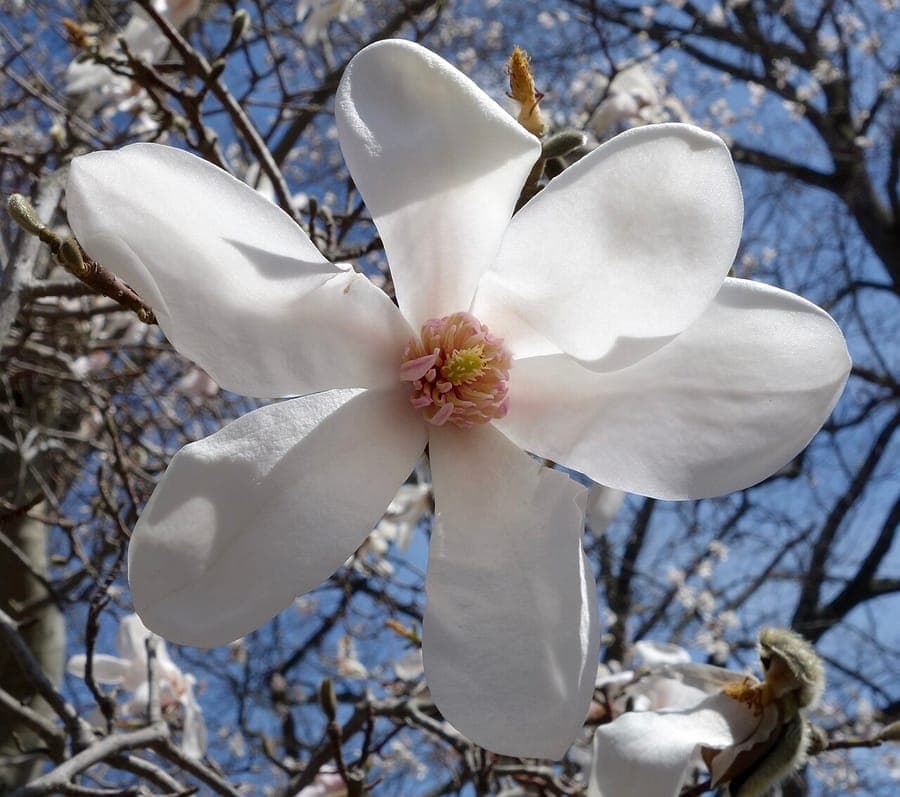
William (Ned) Friedman / CC BY-SA 4.0, via Wikimedia Commons
Magnolia salicifolia: complete guide
Magnolia salicifolia
Want to see Magnolia salicifolia: complete guide in your garden?
1 minute, no credit card
Overview
Magnolia salicifolia, commonly called anise magnolia or willow-leaved magnolia, is a graceful Japanese tree from central and southern Japan. This magnolia is special for its slender, elegant growth habit, delicate willow-like leaves, and especially its wonderfully fragrant white flowers blooming in March-April.
The plant ranks among smaller magnolia species, typically reaching 8-10 meters, making it perfect for standard front yard proportions. With its upright, columnar form and autumn golden-yellow foliage, it offers year-round interest.
Appearance and bloom
Magnolia salicifolia grows as a slender, upright tree with naturally columnar form. Leaves are distinctly narrow and elongated-hence the name salicifolia (willow-like). They're glossy green and lighter beneath.
The flowers are the jewels: pure white, fragrant chalices far more perfumed than many magnolia species. They smell of anise or licorice-hence the English name "anise magnolia". Blooms appear in March-April before leaves fully emerge.
Following bloom, characteristic magnolia fruits develop. In autumn, leaves turn golden-yellow before dropping.
Ideal location
Give anise magnolia full sun to dappled shade. Aim for at least four hours direct sunlight daily, but six to eight is better. Full sun produces fuller, more abundant bloom.
This tree is vulnerable to late frost on growth tips. Avoid planting in frost pockets or low depressions. An elevated, open location is ideal.
Flower fragrance is most perceptible on warm days and sheltered spots. Plant where you can pause and enjoy the scent.
Soil
Anise magnolia grows best in well-draining, neutral to slightly acidic soil (pH 6-7). Heavy clay can be amended with compost, leaf mold, and sand.
The tree prefers moderately fertile soil-not excessive nitrogen. Ensure good surface drainage; no waterlogged roots.
Adding composted material at planting aids establishment.
Free design
Want to see Magnolia salicifolia: complete guide in your garden? Make a free design now.
Watering
Once established (after 2-3 years), anise magnolia is fairly drought-tolerant. During the growing period (March-October), water regularly, especially during dry springs at bloom time and dry summers.
After October, water much less. In winter, minimal watering-the tree rests in drier conditions. However, ensure young trees never completely dry out.
During exceptional drought (July-August), occasional deep watering helps.
Pruning
Anise magnolia requires minimal pruning-its natural form is already attractive. Remove only dead, damaged, or form-disrupting branches.
If you want denser growth, gently pinch some growth tips after flowering. This encourages side branching.
Large wounds heal slowly on magnolias, so be cautious and minimal.
Maintenance calendar
March-April: Bloom period, ample water during dry springs. May-June: Careful post-bloom form adjustments, light feeding. July-September: Regular watering during dry periods. October-November: Winter prep, reduced water. December-February: Winter dormancy, minimal moisture.
Winter hardiness
Anise magnolia is hardy to about -15 degrees Celsius (USDA zones 6-7). Throughout most of the Benelux it grows well. During severe winters, some tip damage may occur, but the tree recovers.
Late spring frost can damage flowers, but this cannot be prevented.
Companion plants
Anise magnolia pairs beautifully with:
- Helleborus niger (Christmas rose)
- Eranthis hyemalis (winter aconite)
- Crocus sativus (saffron crocus)
- Acer palmatum (Japanese maple)
- Fatsia japonica (Japanese aralia)
- Ilex crenata (Japanese holly)
These combinations create a Japanese, early-spring atmosphere.
Closing
Magnolia salicifolia appeals to those who love fragrance and elegance. This tree offers years of early, scented blooms with minimal maintenance. With patience and good drainage, it thrives in nearly every garden.
Source young anise magnolia trees from specialized nurseries or larger plant centers. Plant in autumn or early spring.
Discover more magnolia inspiration on gardenworld.app.
Want to see Magnolia salicifolia: complete guide in your garden? Make a free design now.
Upload a photo, pick a style, and get a photorealistic design with plant list in under a minute.
No credit card required


Similar plants
Saucer magnolia: complete growing guide
Magnolia × soulangeana Soul.-Bod.
Saucer magnolia is a hybrid featuring spectacular pink-white flowers appearing before leaf emergence. Ideal as specimen plant. Winter-resistant to -15°C.
Magnolia delavayi: complete guide
Magnolia delavayi
Delavay magnolia is an imposing shrub from southern China with large glossy leaves and fragrant creamy-white flowers. Learn about cultivation, hardiness, and care for this rare species.
Sweet michelia: complete guide
Magnolia doltsopa
Discover the sweet michelia, a majestic tree from the Himalayas. Learn everything about this impressive specimen, blooming, and perfect growing conditions.