
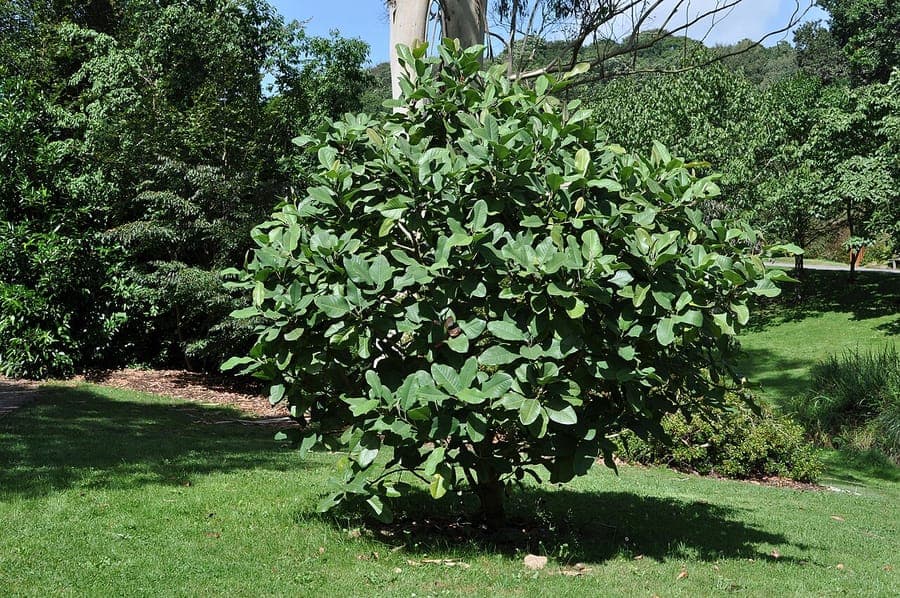
This illustration was made by Citron You must credit this : Citron / CC-BY-SA-3.0 / CC BY-SA 3.0, via Wikimedia Commons
Magnolia delavayi: complete guide
Magnolia delavayi
Want to see Magnolia delavayi: complete guide in your garden?
1 minute, no credit card
Overview
Magnolia delavayi is a remarkable shrub from the mountainous regions of southern China, specifically Yunnan and Sichuan provinces. This relatively little-known magnolia belongs to the family Magnoliaceae and is prized for its enormous glossy leaves and fragrant cream-white flowers. In its Chinese homeland it reaches 8 to 10 meters, but in European gardens typically 4 to 6 meters tall.
For many Dutch gardeners, this plant represents an exciting discovery. It requires winter protection and careful site selection, but rewards patient gardeners with exotic beauty and architectural presence.
Appearance and blooming
The leaves are Magnolia delavayi's most distinctive feature. They are exceptionally large, 20 to 35 centimeters long, lance-shaped, glossy green, and highly ornamental. The foliage is largely retained in mild winters, giving the shrub a tropical aspect.
Flowers appear in late summer and early autumn (August to October), an unusual flowering period for magnolias. The blooms are creamy-white to soft pink, approximately 15 to 20 centimeters across, intensely fragrant, and utterly captivating.
The flowers emerge from large silvery buds visible throughout summer. This progression from bud to bloom is a spectacle in itself.
Ideal location
Magnolia delavayi thrives in a sunny to partially shaded location, protected from strong winds. Wind accelerates moisture loss from the large leaves and can damage flowers. A southeast-facing wall offers ideal protection and warmth.
The plant is frost hardy to approximately -10 to -12 degrees Celsius. In the Netherlands, it is recommended for milder western and southern coastal regions. In harsher areas, it grows best against a sunny south-facing wall.
Soil
Magnolia delavayi prefers loose, well-draining soil with neutral to slightly acidic pH. Heavy clay is less suitable without substantial amendment. Add generous peat moss or composted bark for better structure and moisture availability.
The plant values good soil structure. Ensure excellent drainage to prevent root rot in wet winters.
Free design
Want to see Magnolia delavayi: complete guide in your garden? Make a free design now.
Watering
During the growing season (April through October), water regularly, especially during dry spells. The large leaves transpire considerable moisture. In very dry summers, daily watering may be needed.
In winter, reduce watering but do not let soil completely dry. Overwatering in winter causes root rot.
Mulch at the base helps retain moisture and protects shallow roots against frost.
Pruning
Pruning is not essential as the plant naturally develops a handsome form. Remove only damaged or dead branches in spring. Light pruning of growing shoots after flowering can encourage bushier growth, but minimize this as the plant prefers vigorous growth.
Maintenance calendar
March: Check for winter damage, light feeding. April to May: Begin regular feeding every 3 weeks, water in dry spells. June to September: Feed and water as needed, monitor for drought stress. October: Reduce feeding, prepare for winter. November to February: Minimal feeding, limit watering, frost protection.
Winter hardiness
Magnolia delavayi is frost hardy to approximately -10 to -12 degrees Celsius, requiring protection in harder winters. In Dutch gardens, we recommend wrapping with burlap or frost cloth in January-February. Young plants are more tender and should be planted against a wall.
Container plants in cold regions are better kept indoors during winter.
Companion plants
Magnolia delavayi pairs beautifully with:
- Camellias for similar warmth requirements
- Fatsia japonica for tropical texture
- Fatshedera for green backdrop
- Evergreen climbers for vertical interest
- Hellebores beneath for layering
Final thoughts
Magnolia delavayi is a spectacular choice for gardens in mild climates or against protected south-facing walls. With its immense glossy foliage and fragrant creamy flowers, it is a true showstopper. While rare in cultivation, it is absolutely worth seeking for patient gardeners.
This Asian beauty requires extra attention and protection but rewards with years of exotic elegance. For those seeking an architectural shrub with drama and fragrance, this is worth serious consideration.
Want to see Magnolia delavayi: complete guide in your garden? Make a free design now.
Upload a photo, pick a style, and get a photorealistic design with plant list in under a minute.
No credit card required


Similar plants
Saucer magnolia: complete growing guide
Magnolia × soulangeana Soul.-Bod.
Saucer magnolia is a hybrid featuring spectacular pink-white flowers appearing before leaf emergence. Ideal as specimen plant. Winter-resistant to -15°C.
Sweet michelia: complete guide
Magnolia doltsopa
Discover the sweet michelia, a majestic tree from the Himalayas. Learn everything about this impressive specimen, blooming, and perfect growing conditions.
Sprenger's magnolia: complete guide
Magnolia sprengeri
Discover Sprenger's magnolia, a very rare tree from Central China with spectacular spring blooming. Learn everything about this unique specimen.